
The UAE describes the IRGC attacks on ADNOC ships as piracy after a third assault in 48 hours and calls for the opening of Hormuz.
 Ahmed Al-Rashid
The UAE Describes IRGC Attacks on ADNOC Ships as Piracy After Third Assault in 48 Hours and Demands Opening of Hormuz
On the evening of Friday, August 14, a third vessel belonging to the Abu Dhabi National Oil Company (ADNOC) was attacked while transiting the Strait of Hormuz, marking the third assault on the company's fleet in less than a week and the second in 48 hours. ADNOC announced through the Emirates News Agency (WAM) on Saturday that the attack did not result in any injuries and that the situation is "under control," but what stood out was not the details of the strike as much as what was stated in the UAE Ministry of Foreign Affairs' statement: the targeting of commercial navigation and the use of the strait as a tool for economic coercion was described as "acts of piracy" by the Iranian Revolutionary Guard Corps (IRGC).
The Third Assault in 48 Hours
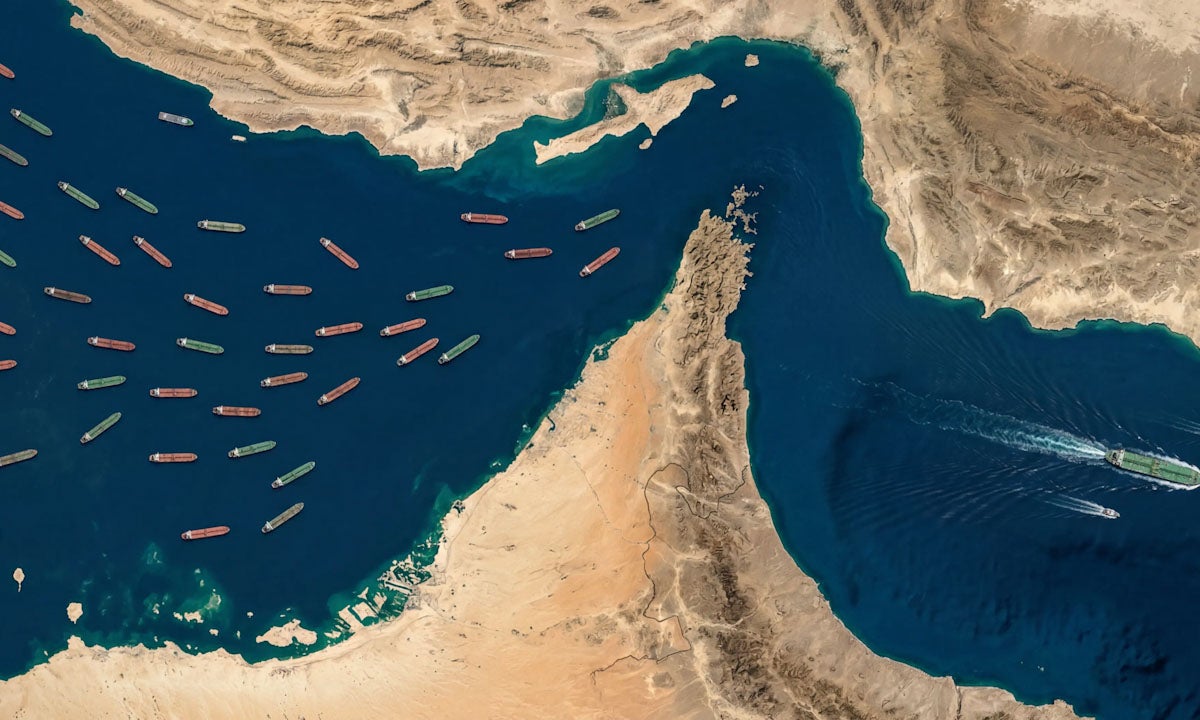
The new attack occurred at a time when the ADNOC vessel was crossing the strait at night, and WAM reported that there were no reports of injuries. The UK Maritime Trade Operations (UKMTO) reported that an unknown projectile struck the hull of a bulk carrier in the strait on Friday, though it was unclear if this incident was the same. This attack is the third in less than a week following a missile strike on an ADNOC tanker on August 8 and two drone attacks on departing tankers on August 13 and 14, marking the longest continuous targeting of UAE navigation since the war began on February 28.
The numbers put the picture in context: the average number of vessels transiting the strait has dropped to about 13 ships per day compared to 130 to 140 before the war, a decline of about 90 percent. War risk insurance premiums have jumped from 1-3 percent of the vessel's value to 7.5-10 percent, and UKMTO has recorded 56 reports of damage to vessels in the strait and its adjacent waters since February 28. Brent closed at $88.52 per barrel on Friday, up 1.7 percent.
Describing "Piracy" — An Escalation in Language Before Action
What deserves analysis here is not the strike itself but the vocabulary. The UAE Foreign Ministry stated that the attack constitutes a "flagrant violation" of Security Council Resolution 2817, which affirmed the importance of freedom of navigation, and that targeting commercial vessels and using the strait as "a tool for economic coercion or extortion constitutes acts of piracy by the Iranian Revolutionary Guard Corps." In my view, this is not a fleeting diplomatic deterioration but a shift in the legal framework with which Abu Dhabi is dealing with Tehran: "piracy" in international law is a crime of universal jurisdiction that allows any state to intercept and prosecute its perpetrators, and it is a term that moves the incident from the realm of "armed conflict" to that of "organized crime."
Any military officer who has served in the region knows the practical difference: describing the IRGC as pirates strips their actions of any cover of "resistance" or "deterrence," and builds a narrative that later allows — if Abu Dhabi wishes — for participation in collective maritime enforcement without declaring war. But practically speaking, classification alone does not move a warship. The question that the language leaves hanging is: Is there a Gulf will to enforce this classification, or is it merely venting anger in statements of condemnation?
Why ADNOC Specifically?
The targeting of ADNOC's fleet three times in a week cannot be read as coincidence. ADNOC is not just any company: it is the backbone of the UAE economy and its energy gateway to the world, and the UAE is the Gulf state most engaged in the issue of freedom of navigation and the most insistent on reopening the strait. Tehran knows this well, which is why it chose to pressure the most sensitive link: sending a message that those who publicly adopt the line of "keeping Hormuz open" will pay the commercial and financial price first. This is a different reading from the Western narrative that sees the attacks as "random escalations" — what we see is a directed and calculated campaign of economic coercion aimed at raising the cost of confrontation for the Gulf state most determined to break the blockade.
Here lies the UAE's dilemma: Fujairah offers a partial alternative to Hormuz via the Gulf of Oman, but it does not compensate for a strait through which about one-fifth of global oil and gas supplies pass. The UAE needs the strait open more than any other Gulf neighbor, and this relative weakness is precisely what Tehran exploits.
The 15-Nation Coalition That Has Not Fired a Shot
The timing is sharp: the third attack occurred days after the announcement of the activation of a 15-nation naval coalition led by Saudi Arabia, which I previously analyzed after the August 13 attack. A coalition that announced "activation phase" did not prevent a new assault within 48 hours, nor has it issued any unified public response as of this writing. This confirms what I stated in my previous analysis: the coalition is stronger in its statements than in its deterrent capability, as the signing countries have ships but lack a unified command structure and clear rules of engagement against a force that uses drone boats and anti-ship missiles from its territorial waters. Practically, the U.S. fleet — with the aircraft carrier Abraham Lincoln having spent over 260 days at sea and conducted more than 10,000 air sorties — remains the only effective guarantor of navigation, and its role is what prevents the alleged "piracy" from turning into a full-scale war.
End of the Memorandum of Understanding and Oman's Maneuver
The diplomatic context adds another dimension: the memorandum of understanding signed between Washington and Tehran on June 17 expires today, Sunday, and Tehran has linked the reopening of the strait to the fulfillment of U.S. commitments to lift the blockade and sanctions. Meanwhile, it seems that Tehran is trying to build a parallel track with Muscat: Foreign Minister Abbas Araghchi announced that negotiations on "managing navigation" in the strait between Tehran and Oman — the other only coastal state — "may reach a result soon." If this maneuver succeeds, the outcome will be a covert Gulf division: Abu Dhabi describes the IRGC as pirates and demands the complete opening of the strait, while Muscat negotiates on "managing" its transit with Tehran. In Washington, President Trump threatens to declare the strait "an American region," while Iranian Deputy Foreign Minister Qasem Gharib Abadi responds that the strait "was Iranian and will remain Iranian."
Conclusion
Three strikes on ADNOC's fleet in a week, an official Emirati classification of the IRGC's actions as "piracy," a coalition of 15 nations that does not prevent a new assault, and a memorandum of understanding ending without an alternative. The UAE raises the rhetoric because it is the most affected, but at the same time, it clings to "diplomatic options" through Anwar Gargash. This is the structural contradiction that Abu Dhabi does not want to confront: one cannot describe the IRGC as pirates and demand the unconditional opening of the strait, then leave enforcement in the hands of an untested coalition and an American fleet preoccupied with a long war. When the word "piracy" is spoken in the Gulf, it has closed the door to diplomatic interpretation — but it does not open a strait, nor does it return the ADNOC vessel to its course until the IRGC knows that the cost of a fourth attack will be higher than the cost of refraining from it.
Iran's Revolutionary Guard conducted a third attack on ADNOC vessels in the Strait of Hormuz on August 14, 2023, prompting the UAE to label the actions as piracy. This incident follows two previous attacks within 48 hours, raising concerns over maritime security and freedom of navigation in the region. The UAE's response indicates a shift in its legal framing of the situation, potentially allowing for broader international intervention.
- Three attacks on ADNOC vessels in one week
- UAE describes attacks as piracy
- Insurance premiums for shipping have increased significantly
- Average ship crossings in the Strait of Hormuz have decreased by 90%
- The UAE is seeking to keep the Strait of Hormuz open.