
The U.S. Aims to Build Momentum for Elections, Ukrainian President Reveals "Deadline," U.S. Requests Russia and Ukraine to Cease Fire in June?
[Global Times Special Correspondent in Russia, Xiao Xinxin, Global Times Special Correspondent, Yu Wen] The conflict between Russia and Ukraine has lasted nearly four years. According to a report by the Ukrainian National News Agency on February 7, Ukrainian President Zelensky told the media that the U.S. hopes the Russia-Ukraine conflict will end before June this year and has proposed for the first time that teams from both countries hold negotiations in the U.S. soon, with the Ukrainian side agreeing to attend. Why June? Zelensky stated that the U.S. chose this summer as a "deadline" because the midterm election campaign in the U.S. Congress will begin then, "elections are absolutely more important to them, and we should not be naive." These reports have not been confirmed by the U.S. or Russia. On the 8th, the Russian "Ukrainian Network" stated that Zelensky's latest comments on the negotiation process are "hypocritical statements that seem real," essentially still looking for excuses to obstruct the peace talks. However, both sides believe that as the U.S. midterm elections approach, the window for ceasefire negotiations is narrowing.
"The Americans are anxious"
According to reports, Zelensky held a briefing with reporters on the 6th, and the relevant content was published on the 7th. Zelensky said at the meeting: "The Americans proposed to end the war between Russia and Ukraine before this summer, and they may pressure both sides according to this timeline." "If the Russians are really ready to end the war, then setting a deadline is very important." He also revealed, "For the first time, the U.S. proposed that the negotiation teams of Ukraine and Russia meet in the U.S., possibly in Miami a week later. We have confirmed our participation." The BBC reported that neither Washington nor Moscow immediately commented on this, but since President Trump resumed office more than a year ago, he has been committed to pushing for an end to this conflict.
On the same day, Zelensky stated that the U.S. proposed to sign all agreements related to the ceasefire at the same time, but he believes this is not the correct approach. The Ukrainian side had previously proposed to the U.S. a "phased ceasefire," clarifying what each party needs to do "at what time and in what phase." The Washington Post reported that Zelensky also said that his intelligence sources indicate that Russia and the U.S. are discussing a bilateral economic agreement worth about $12 trillion, which outlines the framework for U.S.-Russia economic cooperation, which he referred to as the "Dmitriev Plan"—Kirill Dmitriev is the head of the Russian Sovereign Wealth Fund, the presidential special representative for foreign investment and economic cooperation, and a key figure in the ceasefire negotiations.
Zelensky stated that Ukraine is not aware of all the bilateral economic or commercial agreements being discussed between the U.S. and Russia, but some of these agreements may involve Ukraine's sovereignty and security, "Ukraine will not support any such agreements reached without our consent that involve us."
In addition to the "June ceasefire" narrative, there is also a "March ceasefire" narrative. Reuters reported on the 6th, citing informed sources, that U.S. and Ukrainian negotiators discussed the ambitious goal of reaching a peace agreement between Russia and Ukraine in March and planned to hold national elections in Ukraine in May and conduct a nationwide referendum on the proposed peace agreement. One source said, "The Americans are anxious." U.S. negotiators warned Ukraine that as the U.S. November midterm elections approach, Trump may focus more on domestic affairs, which means that senior U.S. officials will not have enough time and political capital to pay attention to the Russia-Ukraine talks.
"Wishful thinking"
Reuters stated that given the lack of consensus between Russia and Ukraine on the key issue of territory, the timeline for a "March ceasefire" may be delayed. Some sources also said that the timeline proposed by the U.S. is wishful thinking. According to estimates from Ukrainian election authorities, organizing a national election under the current circumstances would take about six months and would require legislative amendments, as elections are prohibited during the state of emergency in Ukraine. A Ukrainian official stated that Zelensky is open to the idea of holding elections soon. Although his approval rating has declined since the conflict erupted in 2022, it remains well above 50%, and he is confident in his ability to win.
Recently, Russia, Ukraine, and the U.S. have held multiple talks, but no breakthrough progress has been made. The Russian "Ukrainian Network" stated that as the U.S. midterm elections approach, the window for the U.S. to facilitate an agreement between Russia and Ukraine is narrowing, and Zelensky is extremely anxious about the possibility of the U.S. pressuring Ukraine on issues such as territory. He secretly accused the U.S. of applying pressure and indicated that Ukraine would not withdraw troops from the east, in an attempt to push the U.S. to turn its guns on Russia.
The Russian "Military Observation Network" quoted analysts on the 8th, stating that the unresolved core issues will lead to a stalemate in the Russia-Ukraine negotiations that is unlikely to be broken in the short term. Against the backdrop of the approaching U.S. midterm elections, the U.S. may increase pressure on Russia and Ukraine to reach an agreement as soon as possible to demonstrate mediation results. Both Russia and Ukraine are also trying to tilt the U.S. position in their favor as much as possible. Under the current circumstances, the struggle on the battlefield between Russia and Ukraine will not weaken, and both sides are trying to gain more favorable conditions for negotiations.
On the 8th, Zhang Hong, a researcher at the Institute of Russian, Eastern European and Central Asian Studies of the Chinese Academy of Social Sciences, told a Global Times reporter that Ukraine is currently in a difficult situation, struggling to choose between territorial concessions and national survival, while the U.S. is expected to continue to pressure Ukraine in hopes of reaching a hasty agreement to provide a political boost for the midterm elections.
Ukraine requests Poland to "borrow electricity"
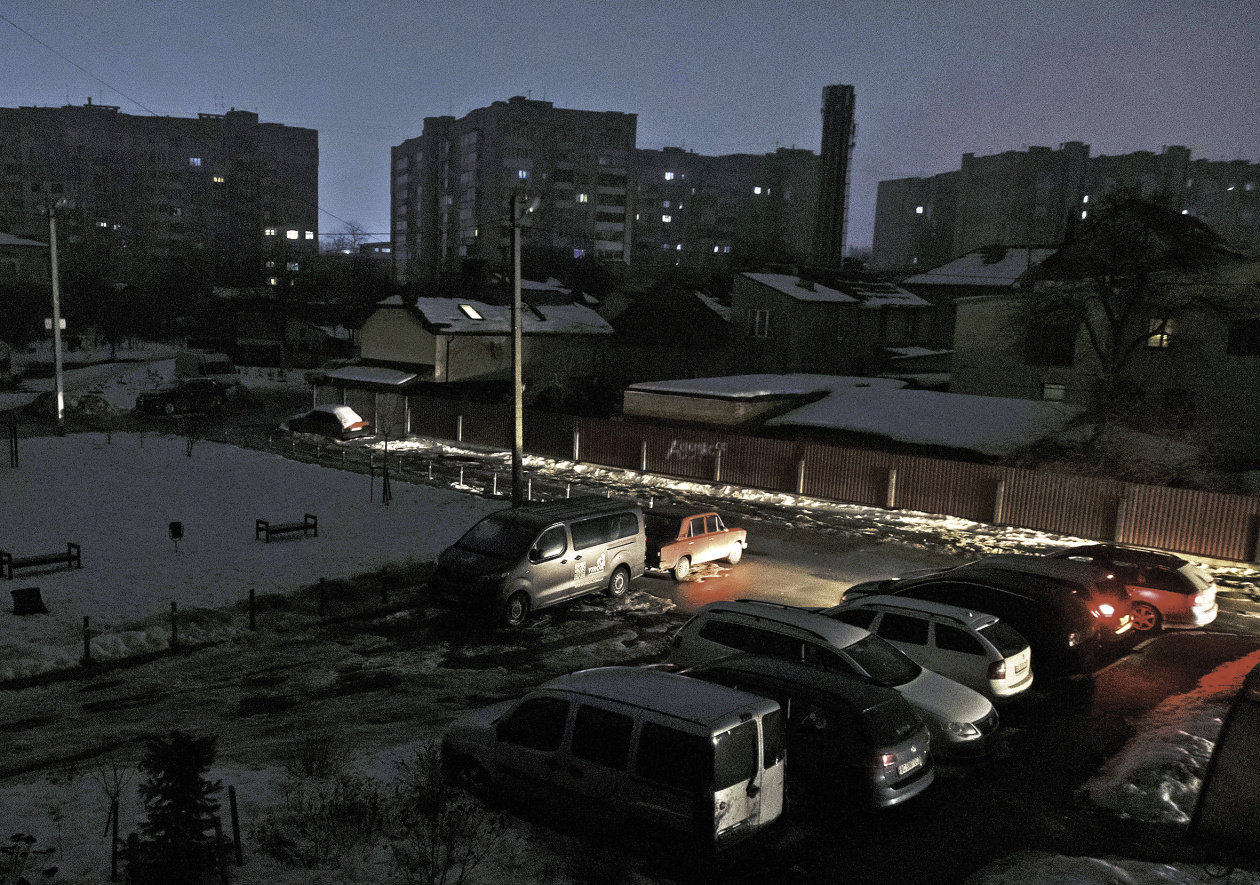
"As diplomatic mediation continues, Russia's attacks on Ukraine's energy facilities are also ongoing." The BBC reported that the Ukrainian national grid operator stated on the 7th that the Russian military recently launched large-scale attacks on Ukraine's energy infrastructure, causing nationwide power outages. Ukrainian Energy Minister Shmyhal stated that emergency rolling blackouts are being implemented nationwide, and an urgent request for electricity supply has been made to neighboring Poland.
Zelensky posted on social media on the 8th, stating that in the past week, Russian troops launched over 2,000 drones, 1,200 precision-guided bombs, and 116 various missiles into Ukraine. The Russian military has been attacking Ukraine's energy, logistics infrastructure, and residential areas almost every day. On the 7th, the Russian military launched a new round of airstrikes against Ukraine using over 400 drones and nearly 40 missiles, with the main targets being Ukraine's power grid, power generation facilities, and substations.
On the 8th, the Russian side announced that it had captured the assailant who attempted to assassinate Russian Defense Ministry Major General Alekseev, and the Federal Security Service and the Ministry of Internal Affairs have identified his accomplices. According to RIA Novosti, the direct perpetrator of the shooting was Russian citizen L. Kolba (who fled to the UAE after the attack and has been arrested), and his accomplices are Russian citizens V. Vasin (who has been arrested in Moscow) and Z. Shereblitskaya (who has fled to Ukraine). The Russian side accuses Ukraine of being the mastermind behind this shooting incident, aiming to sabotage peace negotiations. The Ukrainian side has denied this.
Ukrainian President Zelensky announced that the U.S. has proposed negotiations for a ceasefire between Ukraine and Russia before June 2023, coinciding with the U.S. midterm elections. Zelensky confirmed Ukraine's willingness to participate in talks in the U.S. amid concerns about potential U.S. pressure on Ukraine regarding territorial issues. The situation remains complex as both sides continue to negotiate amidst ongoing military actions.
- U.S. proposes ceasefire negotiations before June 2023 due to upcoming midterm elections.
- Zelensky confirms Ukraine's participation in proposed talks in the U.S.
- Concerns raised about U.S. pressure on Ukraine regarding territorial concessions.