
The U.S. and Israel's Week-Long Offensive Aims to Drag Allies into the Conflict as Iran Strikes the USS Lincoln Again
Since the U.S. and Israel launched military strikes against Iran on February 28, it has been about a week. As of the 5th, data statistics show that the U.S. and Israeli attacks have resulted in 1,230 deaths within Iran. In addition to targeting locations within Iran, the U.S. and Israel have also expanded the conflict to the Indian Ocean and areas such as Lebanon.
Meanwhile, Iran's "Real Commitment 4" counteroffensive operation also entered its 21st round in the early hours of the 6th. The Iranian military has once again announced that it attacked the U.S. aircraft carrier "Lincoln."
So far, there are no signs of the U.S. and Israel backing down, and the U.S. has shown signs of wanting to drag more allies into the conflict against Iran, but has faced cold responses from many allies.
U.S. and Israel have been attacking Iran for about a week; 1,230 people have died due to the attacks
According to information obtained by reporters from the Iran Martyrs and Veterans Affairs Foundation, as of the afternoon of the 5th local time, 1,230 people have died in the large-scale airstrikes by the U.S. and Israel within Iran.
Additionally, various statistics from within Iran show that as of the afternoon of the 5th local time, the Iranian side has reported the following attack situations:
A total of 105 civilian locations and facilities in Iran have been attacked by the U.S. and Israel;
636 locations across Iran have recorded 1,332 attacks;
Furthermore, 14 medical and pharmaceutical institutions have been damaged in the attacks.
The Israeli military completes 13 rounds of airstrikes on Tehran
According to observations by reporters in Iran, Tehran remains the city most frequently attacked. The northern, western, and northeastern areas of Tehran have experienced multiple explosions since the early hours of the 5th. In the early hours of the 6th local time, explosions were heard again in Tehran.
According to information released by the Israeli military on the afternoon of the 5th, they have completed the 13th round of airstrikes on Iran's capital, Tehran. The targets announced by Israel include: the headquarters of Iran's special forces, bases of the Basij militia, and other targets. The Israeli military also stated that they have destroyed 300 Iranian ballistic missile launchers in this conflict.
The Israeli military claims the strikes against Iran are entering the next phase
Later on the 5th, Israeli Defense Forces Chief of Staff Herzi Halevi stated that after completing the surprise phase of the strikes against Iran, achieving air superiority, and suppressing Iranian ballistic missile positions, the Israeli military is entering the next phase of operations, and will intensify efforts to undermine the foundations and military capabilities of the Iranian regime.
Explosions were also reported in the southern Iranian port city of Abadan in the early hours of the 5th, with smoke from the explosions lingering for several hours. Reporters observed in Abadan that in the past two days, the frequency of daytime attacks by the U.S. and Israel on Abadan has decreased, but there is a trend of increased frequency at night.
Additionally, regarding earlier reports of "thousands of Kurdish armed members conducting ground activities into Iran from the Iraqi border," reporters confirmed with several residents of border cities in Iran's western Kurdistan province that the related information is not true, and the local social order is basically normal.
The Israeli military continues to attack Lebanon, shelling the southern suburbs of Beirut
In addition to targeting Iran, Israel has recently increased its strikes against Lebanon.
According to a statement released by Israeli military spokesperson Efi Defrin on the 5th, the Israeli military has attacked over 320 targets within Lebanon during the week (from March 2 to March 5), of which 80 were attacked in the past day.
Furthermore, on the afternoon of the 5th, the Israeli military issued evacuation warnings for the southern suburbs of the Lebanese capital Beirut and subsequently began shelling the area. In the evening of the 5th, the Israeli military launched a new round of airstrikes on the southern suburbs of Beirut.
According to the latest statistics released by the Lebanese Ministry of Public Health's emergency action center late on the night of the 5th, the Israeli attacks on Lebanon in recent days have resulted in 123 deaths and 638 injuries on the Lebanese side.
U.S. military sinks Iranian warship in the Indian Ocean
Iran's Foreign Minister: The U.S. will regret
Regarding the U.S. military, the sinking of an Iranian warship by the U.S. military in the Indian Ocean on the 4th continued to escalate on the 5th. Iran's permanent mission to the United Nations stated on the 5th that more than 100 crew members died as a result of this attack.
Iran's Foreign Minister Amir-Abdollahian confirmed on his social media account on the 5th that the attacked vessel was the Iranian Navy frigate "Dina," which was heading to India to participate in related naval activities, carrying about 130 crew members. Amir-Abdollahian emphasized that the ship was attacked without warning in international waters.
Amir-Abdollahian accused the U.S. of "committing atrocities" in waters 2,000 miles from the Iranian coast, stating: "The U.S. will ultimately feel deep regret for this precedent it has set."
Iran launches the 21st round of counterattacks, using super-heavy missiles to break through Israeli air defenses
In response to the ongoing attacks by the U.S. and Israel, Iran's counteroffensive actions have not ceased. So far, Iran's "Real Commitment-4" counteroffensive operation has reached its 21st round. Just about four hours ago, the Iranian Islamic Revolutionary Guard Corps announced the launch of the 20th round of the "Real Commitment-4" counteroffensive operation in memory of the martyrs of the Iranian military who died on the "Dina" vessel.
Additionally, according to reporters on the 5th from an informed source in Iran, since the U.S. and Israeli airstrikes began on February 28, Iran has launched over 500 ballistic and cruise missiles and more than 2,000 various types of drones in its counterattacks. Among these, about 40% of the targets are located in Israel, while 60% are aimed at U.S. targets.
Iran launches heavy missiles with one-ton warheads
Breaking through the Israeli military's seven-layer defense system
According to a statement released by the Iranian Islamic Revolutionary Guard Corps on the afternoon of the 5th, they used weapons including the "Khoramshahr-4" super-heavy missile, which carries a one-ton warhead, to successfully break through Israel's seven-layer defense system and hit targets within Israel.
The Revolutionary Guard also stated in the announcement that the main targets of this round of attacks were the city center of Tel Aviv, Ben Gurion Airport, and the Israeli Air Force stationed at that airport. In the previous 18th round of strikes, 20 U.S. military targets located in Bahrain, the UAE, and Kuwait were also effectively struck by Iran.
The announcement also stated that various branches of the Iranian armed forces are engaged in multi-front comprehensive operations, "far exceeding U.S. and Israeli military assessments, and the war pattern has changed."
Iran claims to be prepared for a U.S. ground invasion
Although on the 4th, the U.S. White House stated that the U.S. is not currently considering sending ground troops to Iran, both the Secretary of Iran's Supreme National Security Council, Larijani, and Foreign Minister Amir-Abdollahian stated in the latest statements released on the 5th that Iran is prepared to respond to U.S. ground actions.
Additionally, Amir-Abdollahian refused to negotiate with the U.S. and stated that Iran has not requested a ceasefire. When discussing the selection of the new Supreme Leader of Iran, Amir-Abdollahian emphasized: "This is entirely a matter for the Iranian people, and no one has the right to interfere."
Iran attacks the "Lincoln" aircraft carrier and claims to have shot down a U.S. F-15 fighter jet
Furthermore, on the 5th, the Iranian Islamic Revolutionary Guard Corps issued a statement claiming to have successfully hit a U.S. F-15E fighter jet using its air defense system, causing the aircraft to crash near Iran's southwestern border.
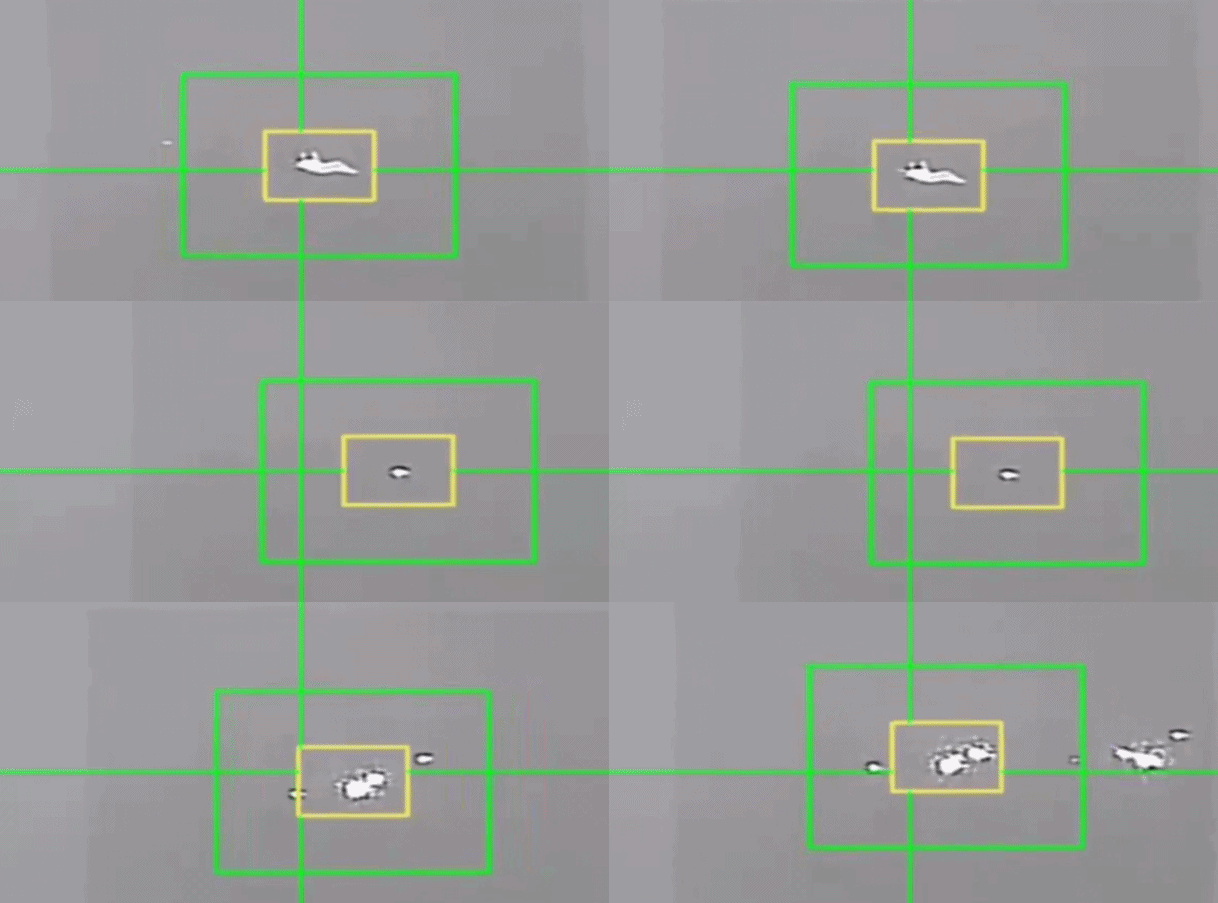
△ The Iranian Islamic Revolutionary Guard Corps released a video clip of its new space defense system intercepting hostile fighter jets on the night of the 5th
The Revolutionary Guard also released a video on the night of the 5th showing its new space defense system intercepting hostile fighter jets. The silhouette of the fighter jet in the footage closely resembles that of the U.S. F-15.
The U.S. Central Command responded by stating that the claim circulating on social media that a U.S. F-15E was shot down in Iran on the 4th is baseless.
Later on the 5th, a spokesperson for the Iranian Armed Forces' Khatam al-Anbiya Central Command stated that the U.S. aircraft carrier "Abraham Lincoln" was hit by an Iranian Islamic Revolutionary Guard Corps naval drone 340 kilometers from the Iranian maritime border in the Oman Sea, and that the "Abraham Lincoln" and its destroyer quickly retreated, now over a thousand kilometers away from the area. The U.S. has not yet responded to the attack on the "Lincoln."
Previously, on March 2, the Iranian Khatam al-Anbiya Central Command had announced the downing of a U.S. F-15 fighter jet. However, the U.S. later explained that three U.S. F-15E fighter jets crashed in Kuwaiti airspace due to a clear "friendly fire" incident while conducting operations. On the 1st, Iran had stated that it used four missiles to attack the "Lincoln," but the U.S. subsequently denied that the "Lincoln" was attacked.
Iran bans U.S., Israeli, and European vessels from passing through the Strait of Hormuz
Regarding the important waterway for international energy transport security—the Strait of Hormuz, both the Iranian Islamic Revolutionary Guard Corps and Iran's permanent mission to the United Nations provided further clarification on the passage of vessels through the strait on the 5th.
According to the Revolutionary Guard, military and commercial vessels belonging to the U.S., Israel, European countries, and their supporters are prohibited from passing through the Strait of Hormuz, and "if discovered by the Iranian Islamic Revolutionary Guard Corps, they will be attacked."
Iran's permanent mission to the United Nations stated that the claim of Iran blocking the Strait of Hormuz is baseless and absurd, and that Iran has always adhered to international law and maintained freedom of navigation.
The Iranian Islamic Revolutionary Guard Corps also stated that its naval aircraft hit a U.S. oil tanker in the northern Persian Gulf that morning, and "the tanker is currently on fire."
Iran has not yet selected a new Supreme Leader
In terms of domestic politics, the selection of Iran's new Supreme Leader remains a focal point of attention.
Iran's Deputy Foreign Minister Lavanchy stated in a statement released on the 5th that Iran has not yet selected a new Supreme Leader. Lavanchy indicated that after the assassination of Iran's Supreme Leader Khamenei, Iran has established a new three-member institution (the temporary leadership committee) that will be responsible for national affairs until a new Supreme Leader is elected. The election will follow Iran's constitutional procedures and be conducted by officials elected by the people.
To prepare for the election of the new Supreme Leader, the Iranian temporary leadership committee also held its fourth meeting on the 5th. The Secretary of Iran's National Security Council reported the latest situation of the conflict at the meeting, and the committee members, while firmly supporting the armed forces' participation in this battle, made the decision to strengthen the armed forces. The meeting also made necessary preparations for establishing a leadership expert meeting and electing the future leaders of the country.
The U.S. is reported to be forced to extend its military operations against Iran; many U.S. allies refuse to be "dragged down"
As of now, the new round of conflict that has erupted in the Middle East has lasted about a week, spreading from Iran to several countries in the Gulf region. The timeline set by the U.S. for its military actions against Iran has also been continuously extended over this week.
4 weeks → 8 weeks → at least 100 days
U.S. military operations against Iran expected to last longer than anticipated
At the beginning of the conflict, U.S. President Trump announced on the 1st that the timeline for military actions against Iran would be "around 4 weeks or shorter", which has gradually extended to what U.S. Secretary of Defense Peter Hegseth said on the 4th, "8 weeks or even longer." On the 5th, a report indicated that the estimated duration of this conflict by the U.S. has now been extended to "at least 100 days or even until September."
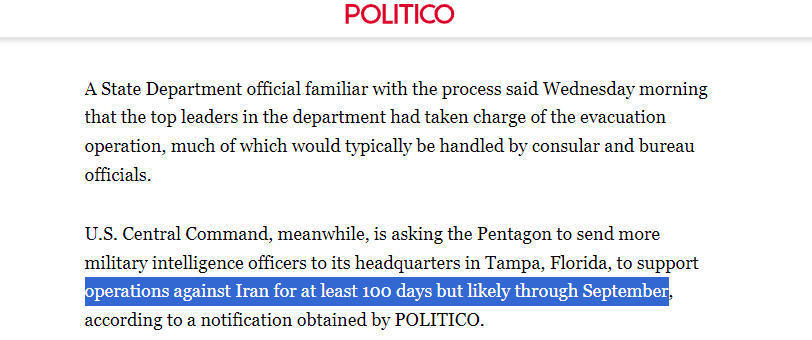
△ U.S. Politico reports: The U.S. Central Command is requesting the Pentagon to support military operations against Iran for at least 100 days
A notification document shows: "The U.S. Central Command is urging the Pentagon to send more military intelligence personnel to its headquarters in Tampa, Florida, to support U.S. military operations against Iran for at least 100 days or even until September."
Analysts believe this is the first request for additional intelligence personnel from the Central Command since the U.S. and Israel launched large-scale military operations against Iran on February 28, indicating that the duration of the conflict may far exceed President Trump's initial expectations, highlighting the Trump administration's failure to adequately anticipate the chain reactions of the conflict.
The U.S. attempts to drag allies into the conflict but faces cold responses
Additionally, to further advance military actions against Iran, the U.S. has recently made requests to several of its allies, asking them to allow U.S. forces to use their military bases to strike Iran. However, several European countries, led by Spain, have explicitly rejected the U.S. request.
As a result, U.S. President Trump issued a threat to Spain of "cutting off trade relations", which has also sparked support for Spain from the EU and many European leaders.
European leaders, including French President Macron and others, as well as the EU, have expressed support for Spain, with several senior EU officials emphasizing that they will ensure the interests of member states are fully protected. EU High Representative for Foreign Affairs and Security Policy Borrell criticized the U.S. in a statement on the 5th, stating that the current chaos in the Middle East is a direct consequence of the trampling of international law, and the shift in U.S. foreign policy has shaken the foundations of transatlantic relations.
President Trump continued to criticize Spain on the 5th for refusing to cooperate with U.S. military requests, labeling the European country as a "loser" and "very hostile to NATO." Additionally, Trump expressed disappointment to British Prime Minister Starmer for the UK's non-participation in the U.S. and Israeli military strikes against Iran.
As of now, European countries including Spain, Portugal, France, the UK, and Germany still refuse the U.S. military's request to use their domestic bases for offensive strikes against Iran. However, most countries have expressed support for providing defensive military assistance to Gulf countries.
U.S. and Israeli forces conducted extensive airstrikes against Iranian targets, resulting in 1230 deaths in Iran. Iran retaliated with over 500 missile and drone strikes, targeting both U.S. and Israeli interests. Concurrently, Israel increased military operations in Lebanon, attacking over 320 targets and causing significant casualties. The U.S. Navy sank an Iranian warship in the Indian Ocean, leading to further tensions.
- U.S. and Israeli airstrikes have resulted in 1230 deaths in Iran.
- Iran has launched over 500 missiles and drones in retaliation.
- Israel has attacked over 320 targets in Lebanon, resulting in 123 deaths.
- The U.S. Navy sank an Iranian warship in the Indian Ocean, killing over 100 crew members.
- Iran has threatened to retaliate against U.S. and Israeli forces in the region.