
The US Marine Corps is looking for a few good robots to build airfields
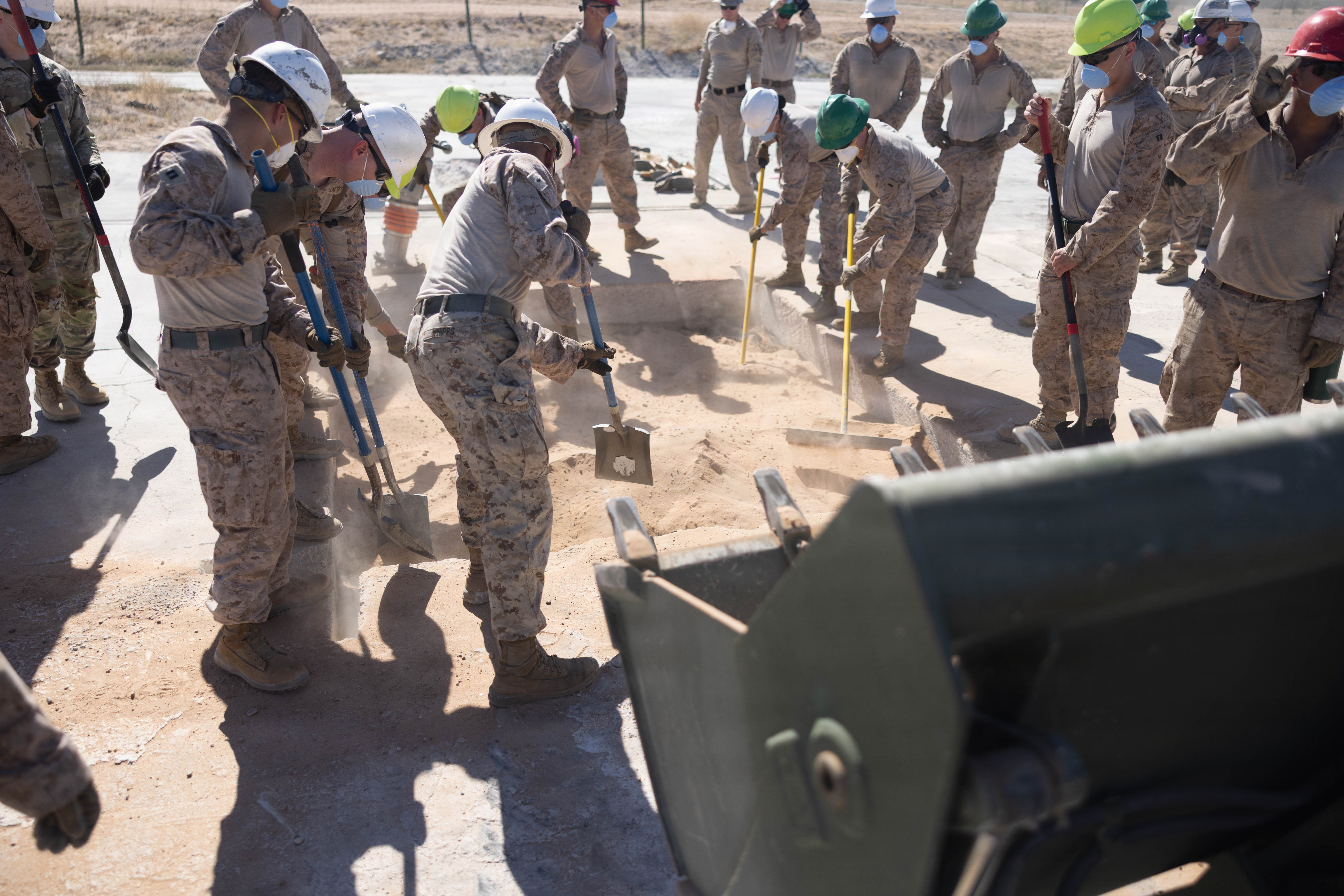
For Marines who have toiled over assembling airfields in austere environments, relief may be on the way.
The Marine Corps wants to develop robots that can do the grunt work of laying down the matting used to quickly construct Expeditionary Airfields, or EAF, in amphibious beachheads and other remote locations.
“Currently, assembling EAF matting is a manual process carried out by Marines — a task that is physically demanding, labor-intensive and exposes personnel to potential hazards,” explained the Small Business Innovation Research proposal, which has a deadline of June 3.
The project, titled “Automated Expeditionary Airfield Assembly,” calls for robots capable of operating on “uneven or unstable surfaces.” They must also “manipulate and position heavy EAF mat sections with precision” while enduring “harsh environmental and operational conditions,” according to the proposal.
The Marine Corps envisions robots with sufficient autonomy to “navigate and control without human assistance, which includes obstacle avoidance, path planning and grasping,” according to the SBIR.
Contractor solutions will be expected to explore “various robotic configurations — such as mobile manipulators and assistive technologies — for their effectiveness in EAF mat handling, alignment and interconnection across diverse and austere terrains,” the proposal states.
Phase I of the project involves demonstrating “the technical feasibility of a robotic system capable of automating or augmenting the assembly of EAF prefabricated surfaced aluminum (PSA) Flat Top-Nested (Top-N) Trackway mats.”
Robots will be evaluated on metrics such as “payload capacity, reach, manipulation precision, power consumption and operational endurance,” according to the proposal.
Phase II calls for a functional prototype capable of automated or semi-automated operations.
“The robot shall be able to handle the PSA mats in some manner to aid in the assemble of the airfield, be a closed system and able be able to operate in a realistic environment,” the SBIR specified. “The system will be judged on feasibility, time to assemble, ease of use and overall size and mass.”
Phase III requires a deployable system for field testing. The SBIR emphasizes that the robot “will undergo hardening against electrical, environmental and cyber threats.”
“The resulting system must demonstrate sustained operation in deployed environments, achieving significant reductions in manning requirements, operational costs and/or deployment time,” the proposal states.
The Marine Corps has been working to ease the difficulty of expeditionary airfield construction, including adopting commercial lightweight matting.
Meanwhile, robotics companies are developing robots optimized for construction work, including four-legged and even two-legged humanoid robots.
For airport operations, Japan Airlines is testing humanoid robots for baggage handling.
The U.S. Marine Corps is developing robots to automate the assembly of Expeditionary Airfields (EAF) to reduce the physical demands on personnel. The project includes creating robots capable of operating on uneven surfaces and manipulating heavy mat sections. The proposal outlines a phased approach, with Phase I focusing on technical feasibility and subsequent phases leading to functional prototypes and field testing. The initiative aims to enhance operational efficiency and reduce manning requirements in austere environments.
- The U.S. Marine Corps is developing robots to automate airfield assembly.
- The project aims to reduce the physical demands on Marines and improve efficiency.
- Robots must operate on uneven surfaces and handle heavy mat sections.
- Phase I involves demonstrating technical feasibility of robotic systems.
- The final system must withstand environmental and operational challenges.