
The US Navy's 2026 Type 31 Frigate Plan Will Not Fix the Pacific Fleet
 Marcus Chen
The US Navy's 2026 Type 31 Frigate Plan Will Not Fix the Pacific Fleet
The U.S. Navy is looking at six foreign frigate designs because its own shipbuilding system cannot deliver a small surface combatant on time. That is the important fact behind the latest competition. The Type 31 Arrowhead is one of the leading candidates, but importing a hull design will not import the trained welders, dry docks, engines, combat-system engineers, or maintenance capacity that a Pacific fleet actually needs.
Six Designs, One Industrial Problem
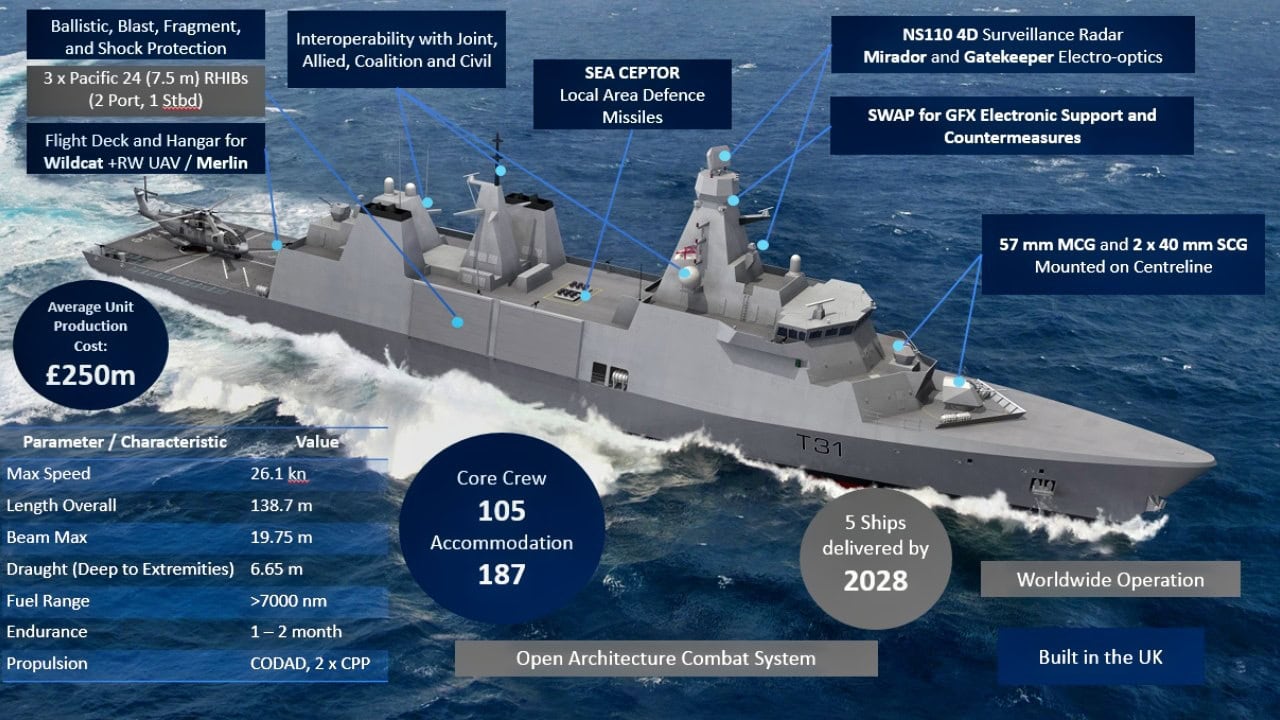
USNI News reported after Euronaval 2026 that six designs have emerged for a potential U.S. Navy international frigate competition. The list includes Britain's Type 31, Spain's F-110, and other European and Asian candidates. The concept follows the White House's proposed “Finland model”: build as many as the first two ships overseas, then move production and investment into American yards.
On paper, the Type 31 is a sensible escort. Babcock describes a roughly 6,000-ton ship about 140 meters long, with a crew of around 100, a 32-cell Mark 41 vertical-launching system, and an open architecture that can accept different sensors and weapons. The design is intended to conduct surface warfare, convoy escort, maritime security, and potentially anti-submarine warfare. Its lower crewing requirement matters when the Navy is already short of sailors.
But a frigate is not a spreadsheet entry. The first two hulls can be built overseas; the next ten cannot magically appear in an American yard. The Navy has spent years discovering that changing a design, a builder, or a contract structure does not eliminate the production queue. UPI's recent reporting on the shipbuilding crisis makes the same point from another direction: the Navy's expansion goals are outrunning the industrial base that must build and repair the fleet.
What the Type 31 Would Actually Add
A 32-cell launcher gives a frigate useful magazine depth, but it does not make the ship a destroyer. Depending on the loadout, those cells could carry surface-to-air missiles, anti-submarine weapons, or a mix of both. A ship assigned to the western Pacific would also need a reliable air-defense network, electronic warfare, long-range anti-ship weapons, unmanned-system integration, and the communications architecture to operate under jamming.
The Type 31's real value would be persistence. A cheaper ship with a crew near 100 could escort logistics vessels, protect maritime traffic, and contribute to sea denial without consuming a destroyer's manpower and missile inventory. In a Taiwan contingency, that matters. A force built only around Arleigh Burke-class destroyers and aircraft carriers will run out of hulls before it runs out of missions.
Yet persistence depends on maintenance. A ship that spends 30 days transiting from San Diego to the Philippine Sea and then requires a long repair period has not created much additional presence. The Pacific is a distance problem before it is a platform problem. Guam, Japan, the Philippines, and Australia need repair capacity, spare parts, fuel, and trained maintainers as much as they need another radar and launcher.
The Pacific Math Is Still Unforgiving
Assume the Navy eventually buys 12 frigates after the initial six-ship requirement is defined. With one-third unavailable for maintenance, training, or transit, only eight would be broadly deployable at any time. Divide that force among the first island chain, the Philippine Sea, the western Pacific logistics routes, and home-water commitments, and the number available for any single crisis becomes very small.
That is not an argument against frigates. It is an argument against treating procurement as presence. Twelve hulls can provide useful distributed capacity; they cannot substitute for a repair network or solve the missile inventory problem. A frigate escorting a replenishment ship is valuable only if it has the sensors, weapons, and communications to survive the same kill chain that threatens the ship it protects.
The Navy's proposed requirements also reportedly emphasize sea control and maritime security rather than making every frigate a premium anti-submarine platform. That is a reasonable choice for a fleet facing many missions. But it creates a blunt question for Congress: is the service buying a Pacific combatant, or a cheaper global patrol ship? Those are different designs with different survivability standards and different operating costs.
Allied Shipyards Are a Bridge, Not a Strategy
Foreign construction could shorten the first delivery date and expose U.S. yards to proven production methods. Britain's Type 31 partnership with HII and Spain's work with Lockheed Martin show that industrial cooperation is possible. South Korean and Japanese shipbuilders also bring scale that American yards currently lack. The recent U.S. debate over foreign-built warships is therefore more than a procurement dispute; it is a test of whether Washington values speed enough to accept a temporary loss of domestic control.
But allied yards cannot be used as a permanent escape hatch. If the American follow-on line depends on imported modules, foreign suppliers, and a tiny number of qualified subcontractors, the program will reproduce the same fragility under a different flag. The goal should be two things at once: get the first ships moving quickly and build a durable U.S.-allied production network that can replace combat losses and sustain deployments.
The Decision That Matters
The Type 31 may be a good frigate. The question is whether the Navy can turn a good frigate into a reliable fleet unit before the western Pacific demands it. The answer depends less on the brochure than on annual production, magazine replenishment, forward repair, and crew generation.
Any American frigate program that delivers six ships but cannot sustain them in the Philippine Sea will be a procurement success and an operational failure. The first hull is a demonstration. The tenth hull, the spare engine, the loaded missile magazine, and the repair berth are the real test. Until those pieces are funded together, the 2026 Type 31 competition is a bridge to a fleet the United States still has not built.
Sources
- USNI News, “The New Six Frigates,” November 13, 2026.
- UPI, “U.S. shipbuilding crisis deepens as Navy expansion outpaces capacity,” November 5, 2026.
- U.S. Navy Fiscal Year 2027 shipbuilding and surface-combatant planning discussed in reporting on the international frigate competition.
The U.S. Navy is considering six foreign frigate designs, including the Type 31, due to delays in domestic shipbuilding. The Navy's expansion goals are outpacing its industrial capacity, necessitating a focus on maintenance and repair capabilities in the Pacific. The Type 31 frigate is intended to enhance maritime security and escort logistics vessels, but its effectiveness depends on support infrastructure.
- The U.S. Navy is exploring six foreign frigate designs due to domestic shipbuilding issues.
- The Type 31 frigate is one of the leading candidates for the U.S. Navy.
- The Navy's expansion goals are outpacing its industrial base capacity.
- The report highlights the importance of maintenance and repair capabilities in the Pacific.
- The Navy's proposed requirements emphasize sea control and maritime security.