
The U.S. Plans to Establish a Four-Star Autonomous Warfare Command as the PLA's Unmanned Operations Enter a System Competition
 Li Minghui
The U.S. Plans to Establish a Four-Star Autonomous Warfare Command, Accelerating the PLA's Unmanned Combat System
On September 30, U.S. Secretary of Defense Lloyd Austin announced in Quantico that the Pentagon is preparing to establish an Autonomous Warfare Command (AUTOWARCOM) with "four-star" authority, aiming to complete legal and organizational preparations by October 2027. The focus of this announcement is not merely the addition of another drone program, but rather the U.S. attempt to integrate procurement, testing, training, and operational command into a single rapid iteration chain.
Shifting from Drone Procurement to Combat Systems
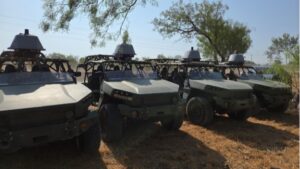
According to Breaking Defense, AUTOWARCOM will have service-level authority and be responsible for expanding autonomous and robotic capabilities; concurrently, the Agincourt program is preparing to bring operators, engineers, and enterprises directly alongside frontline needs. The U.S. Army has recently selected five companies—Anduril, Castellion, Lockheed Martin, RTX, and Mach Industries—to compete for the Increment 4 prototype of precision strike missiles with a range of at least 1,000 kilometers. When viewed together, these two developments point to the same logic: platforms can vary widely, but interfaces, data, and rapid upgrades must be unified.
What This Means for the PLA
The PLA is not lacking in drone models; the Wing Loong, Attack-11, and numerous small unmanned systems have already covered reconnaissance, strike integration, and swarm testing. However, what truly determines battlefield efficiency is whether drones can connect to the BeiDou navigation system, satellite communications, early warning aircraft, and ground command networks, and continue to execute missions under communication pressure. By elevating unmanned systems to the potential level of combat command, the U.S. has shifted the question from "Do we have advanced drones?" to "Can we sustain production, rapidly upgrade, and deploy them at scale?"
This also reveals both the strengths and weaknesses of China's military industry. China has a complete electronic manufacturing and civilian drone supply chain, theoretically making it easier to lower unit costs; however, the data permissions, software interfaces, and combat evaluation mechanisms between military and civilian systems may not be as swiftly integrated as in manufacturing. In simple terms, producing ten thousand drones does not equate to having ten thousand drones capable of coordinated combat.
Practical Implications for the Indo-Pacific
The U.S. does not intend to deploy drones solely on its home turf. Pentagon documents and Army tenders have included Indo-Pacific scenarios in their capability requirements, with long-range missiles, counter-drone systems, and autonomous platforms collectively serving dispersed deployment, rapid reconnaissance, and denial operations. For the Taiwan Strait, this will increase the persistent surveillance pressure faced by the PLA's forward nodes, airports, and vessels, and will also compel the PLA to incorporate electronic warfare, decoys, low-cost interceptors, and logistics into a unified unmanned combat design.
The author believes that AUTOWARCOM is more of an organizational reform in the short term, rather than an immediate "super weapon" that changes the balance of power on the battlefield. Whether the U.S. can obtain congressional authorization, stabilize its budget, and resolve data barriers between different military branches remains to be seen.
What is truly worth questioning is whether the PLA will continue to emphasize the performance of a few high-end unmanned platforms, or whether it will prioritize mass production, software iteration, and anti-jamming coordination equally. In future conflicts in the Western Pacific, what may determine the value of unmanned systems is not how far the first aircraft can fly, but who can ensure that the last thousand aircraft still understand the same set of commands in a disconnected and heavily jammed environment.
Source: Breaking Defense, September 30, 2026; U.S. Department of Defense "Project Agincourt" memorandum, September 30, 2026; Breaking Defense report on the U.S. Army's PrSM Increment 4 prototype tender, September 2026.
The U.S. Department of Defense announced plans to establish a four-star autonomous warfare command (AUTOWARCOM) by October 2027 to integrate unmanned systems into military operations. This initiative aims to streamline procurement, testing, and training processes for drones and precision strike missiles. The establishment of AUTOWARCOM is expected to enhance U.S. operational capabilities, particularly in the Indo-Pacific region, and poses challenges for the Chinese military's unmanned systems integration.
- The U.S. plans to create AUTOWARCOM by October 2027.
- AUTOWARCOM will integrate procurement, testing, training, and operational command for unmanned systems.
- The U.S. Army has selected five companies for precision strike missile prototypes.
- The report highlights the implications for the Chinese military's unmanned systems capabilities.
- The U.S. aims to enhance its operational capabilities in the Indo-Pacific region.