
The U.S. Says "There Is No Timeline for Ceasefire," Tehran Responds by Detaining in Retaliation, U.S.-Iran Relations Fall into a Mutual Lockdown Stalemate
【Global Times Special Correspondent in the U.S. Xiao Da and Wang Yi】Following the announcement of an extension of the ceasefire with Iran the day before, U.S. President Trump stated on the 22nd that there is “no timetable” for ending the conflict with Iran. However, the White House emphasized that while waiting for a response from Iran, the U.S. would continue to apply strategic pressure on Iran, including the ongoing implementation of the “economic fury” campaign and the maritime blockade. Meanwhile, Iranian Islamic Parliament Speaker Ghalibaf stated on the 22nd that a comprehensive ceasefire would only be meaningful if it did not rely on maritime blockades and the “hijacking” of the world economy, and if Israel ceased hostilities on all fronts. At the same time, The New York Times reported that under the 1973 War Powers Act, the president has a 60-day time limit to engage in military action without congressional authorization, which will expire on May 1. If Trump does not obtain authorization by then, he would theoretically have to withdraw U.S. troops. However, on the 22nd, the U.S. Senate again rejected a proposal to limit the president's war powers. Senate Minority Leader Schumer stated that the longer Trump delays in extricating the U.S. from this war, the deeper the country becomes mired in it.
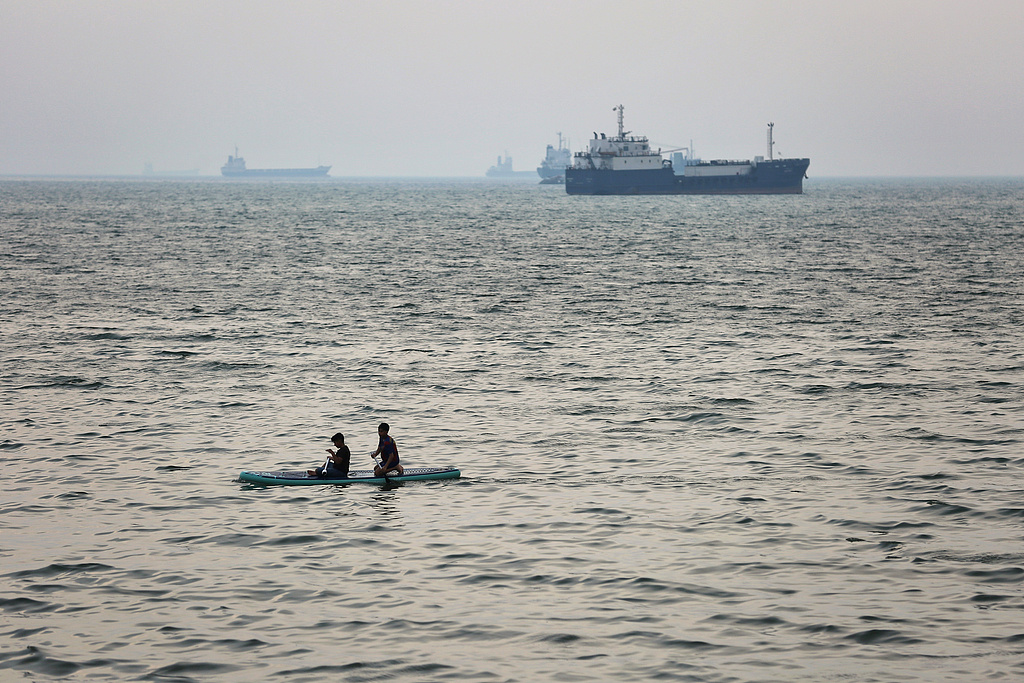
The U.S. maritime blockade against Iran continues
According to a report from Fox News on the 22nd, Trump stated during an interview with the network that, “Some say I am eager to end this conflict to save the midterm elections, but that is not true. This administration wants to secure a good deal for the American people.” He also said that previous reports about a “3 to 5-day window” for extending the ceasefire were “not true.” Trump further stated that he “has no time pressure,” and that the newly extended ceasefire agreement and U.S.-Iran negotiations also “have no time (constraints).”
On the same day, White House Press Secretary Levitt stated at a press conference that the White House and U.S. intelligence agencies are clear about who calls the shots regarding Iran's agreement with the U.S., but there is an “ongoing struggle between pragmatists and hardliners” within Iran, and thus Trump is giving Iran some time to provide a “consistent response.” However, Levitt emphasized that while waiting for a response from Iran, the U.S. would continue to apply strategic pressure on Iran, including the ongoing implementation of the “economic fury” campaign, and the maritime blockade has not stopped. She said, “The president is satisfied with the maritime blockade. He understands that Iran's situation is very unfavorable. Now, the initiative is in the president's hands.”
On the 23rd, Trump posted on social media that he had ordered the U.S. Navy to “fire upon and sink any vessels laying mines in the waters of the Strait of Hormuz.” He later added that “the U.S. has complete control of the Strait of Hormuz.” He stated that no vessels can enter or exit the strait without U.S. military approval, “until Iran is willing to reach an agreement.”
CNN reported on the 22nd that the U.S. continues to enforce a blockade against Iran, but it is unclear when the second round of U.S.-Iran negotiations will take place. The U.S. public relations rhetoric cannot hide an important fact: the strategy of using overwhelming military threats as leverage to force Iran to make concessions at the negotiating table has repeatedly failed. From Iran's perspective, any military escalation threats issued by the U.S. likely lack credibility.
“Trump's recent threats against Iran have backfired, exacerbating the crisis within the U.S.” Spain's El País reported on the 23rd, stating that Trump has been frequently giving interviews and posting on social media in an attempt to cover up an obvious fact: the U.S. has made concessions without receiving any returns. Recently, the U.S. has been immersed in a narrative that can be defined as “Schrödinger's cat”: according to this logic, although the U.S. claims to have “won,” it cannot find a way to end the war.
Meanwhile, the conflict that Trump has initiated against Iran is exacerbating his domestic support crisis. According to the latest polls from multiple organizations, Trump's approval ratings have hit new lows. A poll released by NBC on the 22nd showed that 63% of American respondents are dissatisfied with Trump's performance, primarily focusing on two points: the economic situation and the war with Iran. On the same day, the latest poll results from the Associated Press-NORC Public Affairs Research Center, Reuters, and Ipsos all indicated that Trump's approval rating has fallen to its lowest point since he returned to the White House.
U.S. media: Tehran still controls the Strait of Hormuz
Regarding whether Iran will extend the ceasefire and participate in the second round of negotiations, Iranian Islamic Parliament Speaker Ghalibaf stated on social media on the 22nd that a comprehensive ceasefire would only be meaningful if it did not rely on maritime blockades and the “hijacking” of the world economy, and if Israel ceased hostilities on all fronts. He emphasized that applying pressure on Iran would not bring any benefits to Washington, stating, “They have not achieved their goals through military aggression, nor will they achieve them through bullying.” Regarding the reopening of the Strait of Hormuz, Ghalibaf emphasized that as long as the ceasefire agreement is openly violated, the Strait of Hormuz cannot be reopened.
According to Iran's Mehr News Agency on the 22nd, Iranian President Raisi stated on social media that (the U.S.) violating promises, implementing blockades, and making threats are the main obstacles to real negotiations. He stated, “The world has seen your (the U.S.) endless hypocritical rhetoric and inconsistency in words and actions.”
In response to the U.S. continuing its maritime blockade against Iran, Iranian state television released a video on the 23rd showing the Iranian Navy approaching a large commercial vessel in the Strait of Hormuz and boarding it for seizure. Reports indicate that the Iranian Islamic Revolutionary Guard Corps announced on the 22nd that it had seized several vessels attempting to pass through the Strait of Hormuz without authorization, one of which was linked to Israel, and another lacked the necessary permits and “repeatedly violated regulations, endangering maritime safety,” ultimately being seized by the Iranian Revolutionary Guard and directed to the Iranian coast. The Iranian Islamic Revolutionary Guard Corps Navy reiterated that the order and security of the Strait of Hormuz is “our red line.”
The New York Times reported on the 22nd that although both sides have effectively extended the ceasefire, Iran and the U.S. remain in a standoff. “An eye for an eye, a seizure for a seizure.” After Iran seized multiple vessels, the spokesperson for the Iranian Parliament's National Security and Foreign Policy Committee, Rezaei, wrote on social media on the 22nd. The head of the U.S. think tank “Defense Priorities,” Kalanick, stated that Iran's seizure of multiple vessels indicates that despite the U.S. military having attacked approximately 13,000 targets within Iran and implemented a maritime blockade, Tehran still firmly controls the Strait of Hormuz.
The U.S. government faces legal pressure to end the war
Reuters reported on the 23rd that the U.S. and Iran are locked in a mutual blockade stalemate, and the crucial Strait of Hormuz is effectively still under blockade, putting immense pressure on the economies of countries around the world. On the 22nd, Brent crude oil prices once again surpassed $100 per barrel, which will raise energy and food costs in many countries globally.
Spain's El Mundo reported on the 23rd that every morning, the lines outside gas stations in Dhaka, the capital of Bangladesh, are getting longer. In countries like Bangladesh, the Philippines, Pakistan, and Sri Lanka, fuel rationing has shifted from a temporary measure to the norm. The blockade of the Strait of Hormuz has not only driven up energy prices but has also undermined the foundation of global food security. According to the latest predictions from the World Food Program, if the conflict in the Middle East continues, an additional 45 million people will face famine this year, bringing the total number of people facing hunger globally to 363 million, potentially becoming the worst hunger crisis in history.
Germany's Frankfurter Allgemeine Zeitung reported on the 23rd that the current U.S.-Israel-Iran situation is an “economic war of blockades against blockades.” The U.S. continues to enforce a maritime blockade against Iran, systematically cutting off Iran's oil revenue, which is part of the U.S. “maximum pressure” campaign. Tehran is betting that it can endure the long-term consequences of the blockade better than its opponents and other relevant parties.
CNN stated that Iran may never agree to give up its strategic leverage in the Strait of Hormuz. While U.S. airstrikes against Iran may have “achieved tactical victories,” the cumulative effect of the U.S.'s chaotic strategic thinking and erratic rhetoric is putting the country at risk of “strategic failure.”
Meanwhile, according to reports from The New York Times, The Washington Post, and other U.S. media, under the War Powers Act, the president has a 60-day time limit to engage in military action without congressional authorization, which will expire on May 1. If Trump does not obtain authorization by then, he would theoretically have to withdraw U.S. troops. According to the law, if the 60-day time limit expires, Trump has only three options: seek congressional authorization, begin troop withdrawal, or exercise a one-time 30-day extension. However, the extension is limited to situations necessary for “ensuring the safe withdrawal of troops” and does not grant the president the power to continue offensive actions.
On the 22nd local time, the U.S. Senate again rejected a proposal from the Democrats to limit Trump's war powers. This is the fifth time the Senate has rejected a proposal aimed at limiting Trump's military powers regarding Iran since the U.S. initiated military actions against Iran at the end of February. Senate Minority Leader and Democrat Chuck Schumer stated that the longer Trump delays in extricating the U.S. from this war, the deeper the country becomes mired in it, “and he will find it increasingly difficult to extricate himself.” Schumer also stated that the Democrats will continue to push for weekly votes on proposals to limit the president's war powers until the Republicans “wake up and help us end this war.”
The U.S. continues to exert strategic pressure on Iran, maintaining a naval blockade in the Hormuz Strait while Iran responds by seizing vessels. President Trump has indicated there is no set timetable for military actions, and tensions remain high as both nations engage in a standoff. The situation is exacerbated by rising oil prices and the potential for further escalation as the May 1 deadline approaches for military action without congressional approval.
- U.S. President Trump stated there is no timetable for ending military actions against Iran.
- Iran's parliamentary speaker emphasized conditions for a meaningful ceasefire.
- U.S. Navy has been ordered to fire on vessels laying mines in the Strait of Hormuz.
- Iran has seized multiple vessels in response to U.S. actions.
- Oil prices have surged due to the ongoing conflict and blockade.