
The withdrawal of 12 B-1 bombers from Britain reveals the limits of American deterrence towards Iran in 2026.
 Ahmed Al-Rashid
Withdrawal of 12 B-1 Bombers from Britain Reveals Limits of American Deterrence Toward Iran in 2026
[Amman] American and British reports announced on October 4 and 5, 2026, that the U.S. Air Force is withdrawing 12 B-1 bombers stationed at the British RAF Fairford base, according to circulating reports, following arrests and a security threat related to a plot suspected to be linked to Iran. While the decision may seem like a local security measure, it carries a broader military message to both the Gulf and Iran: Washington is prepared to reduce its exposed presence when it sees that a forward base has become a vulnerability, even if the bombers themselves are an important pressure tool.
What Happened at Fairford
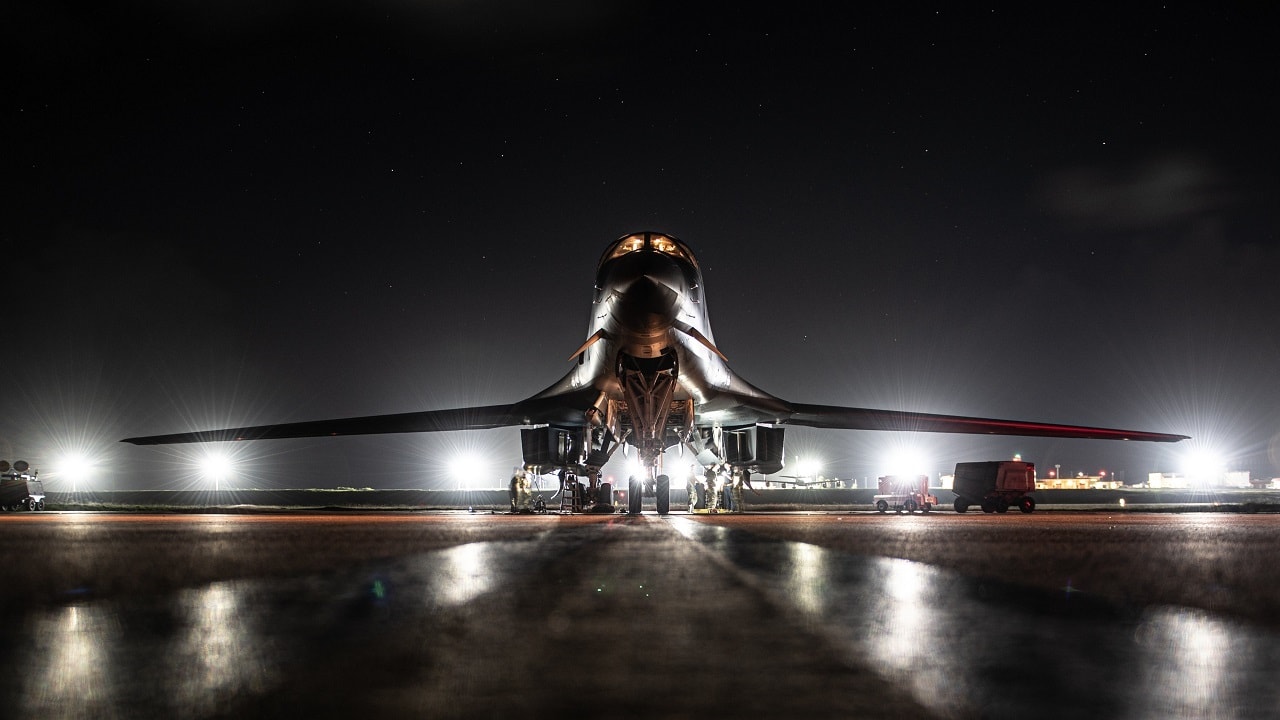
Reuters reported that the United States removed the bombers from the base, which had been at the center of security concerns after a plot targeting it was thwarted, while other reports indicated that the bombers would return to the United States. There is no public information proving that the aircraft were taken out of service or that Washington has ended its ability to use them against Iran. The distinction is important: we are witnessing a relocation of deployment, not a abandonment of long-range strike capability.
The B-1B bomber is designed to carry conventional weapons and conduct long-range sorties, providing U.S. leadership with the option of sending fighter aircraft from nearby bases or using a platform capable of carrying a large payload and reaching distant theaters. However, the value of this option is not measured solely by the number of aircraft. Flight time, aerial refueling, base protection, communications, and rearmament determine whether the bomber is a true deterrent or merely a strong image in news broadcasts.
The Message to the Gulf and Iran
Practically, the withdrawal of the B-1 from Britain increases the distance between one of the U.S. strike tools and the Middle East. This does not mean that Saudi Arabia or the UAE are without an American umbrella, but it reminds Gulf capitals that the umbrella is managed according to Washington's priorities, not the rhythm of Gulf concerns. If the United States needs to redeploy the bombers to the Gulf, it will require arrangements for transit, hosting, and protection, and possibly more time than politicians envision when discussing rapid response.
Tehran will interpret the decision in two contradictory ways. The first is that indirect threats, including targeting infrastructure or exploiting security gaps, can raise the cost of U.S. deployment without confronting the bombers in the air. The second is that Washington has not withdrawn the capability itself, but has changed its location, and therefore the withdrawal from Fairford should not be interpreted as a retreat from deterrence. In deterrence doctrine, ambiguity about the location of power can be beneficial, but it becomes dangerous if the adversary believes that security protection is more important than mission execution.
Testing the Triangle of Capability
Here, the triangle of capability emerges, which is often absent from discussions about arms purchases in the region: equipment, training, and institutions. The equipment is present; the United States possesses B-1s and other bombers, as well as a network of airlifters and reconnaissance. Training is also available, and its crews can conduct long-range operations. However, the third element is the most sensitive, namely the institution capable of protecting bases, sharing information, managing internal threats, and maintaining political freedom of movement.
Gulf countries have spent billions of dollars on air defense and fighter aircraft, but the incident at a distant base in Britain reminds us that defending power does not always begin with an interceptor missile. Sometimes it starts with internal checks, base security, and the ally's ability to keep aircraft in place when pressure escalates. The Patriot or THAAD systems do not solve the problem of a base that forces cannot use safely, and purchasing modern fighters does not automatically create the capability to manage a multi-theater crisis.
Why This Matters to Saudi Arabia
Riyadh is monitoring this development while simultaneously conducting a large military operation in Yemen near Bab al-Mandab, at a time when reports indicate that Washington is refraining from direct participation in the operation. The two events should not be hastily combined into a single conclusion, but the general trend is clear: Saudi Arabia wants greater capability to protect shipping lanes and vital facilities, while the United States continues to redefine the level of risk its forces and bases are willing to accept.
This explains the Gulf states' rush to diversify partnerships with Turkey and Pakistan, expand local manufacturing, and purchase multiple layers of air defense. However, diversification does not equal independence. Riyadh can buy radars, missiles, and command systems from several countries, but it will still need an early warning network, satellites, precision munitions, and operational coordination that remains largely tied to the United States. The problem is not that Washington is an unreliable ally, but that the Gulf wants an ally that does not have the right to reassess its calculations, and this contradiction cannot be resolved by an arms deal.
Conclusion
The withdrawal of B-1 bombers from RAF Fairford is neither an American defeat nor an Iranian victory. It is a limited security decision that reveals a broader truth: American deterrence in the Middle East is strong when secure bases, logistics, and political decision-making are available, and weak when the image of the weapon is separated from the conditions of its operation. Those who have served in the region know that the aircraft does not deter on its own; what deters is the institution that can keep it in the air, protect it on the ground, and bear the cost of its use. Here, the tension remains between the Gulf's reliance on American power and its desire for security that does not change with Washington's recalibrations.
Sources
The U.S. Air Force withdrew 12 B-1 bombers from RAF Fairford in the UK on October 4-5, 2026, due to security threats linked to Iran. This move indicates a strategic shift in U.S. military presence, emphasizing that while the bombers are relocated, the capability to respond to threats remains intact. The decision raises concerns in Saudi Arabia regarding U.S. military priorities and regional security dynamics.
- 12 B-1 bombers were withdrawn from RAF Fairford in the UK.
- The withdrawal is linked to security threats related to Iran.
- The U.S. is not abandoning its capability to strike Iran, just relocating its assets.
- The decision reflects U.S. military strategy and priorities in the region.
- Saudi Arabia is concerned about U.S. military presence and its implications for regional security.