
‘They got very lucky,’ Trump says of downed Apache helicopter’s crew
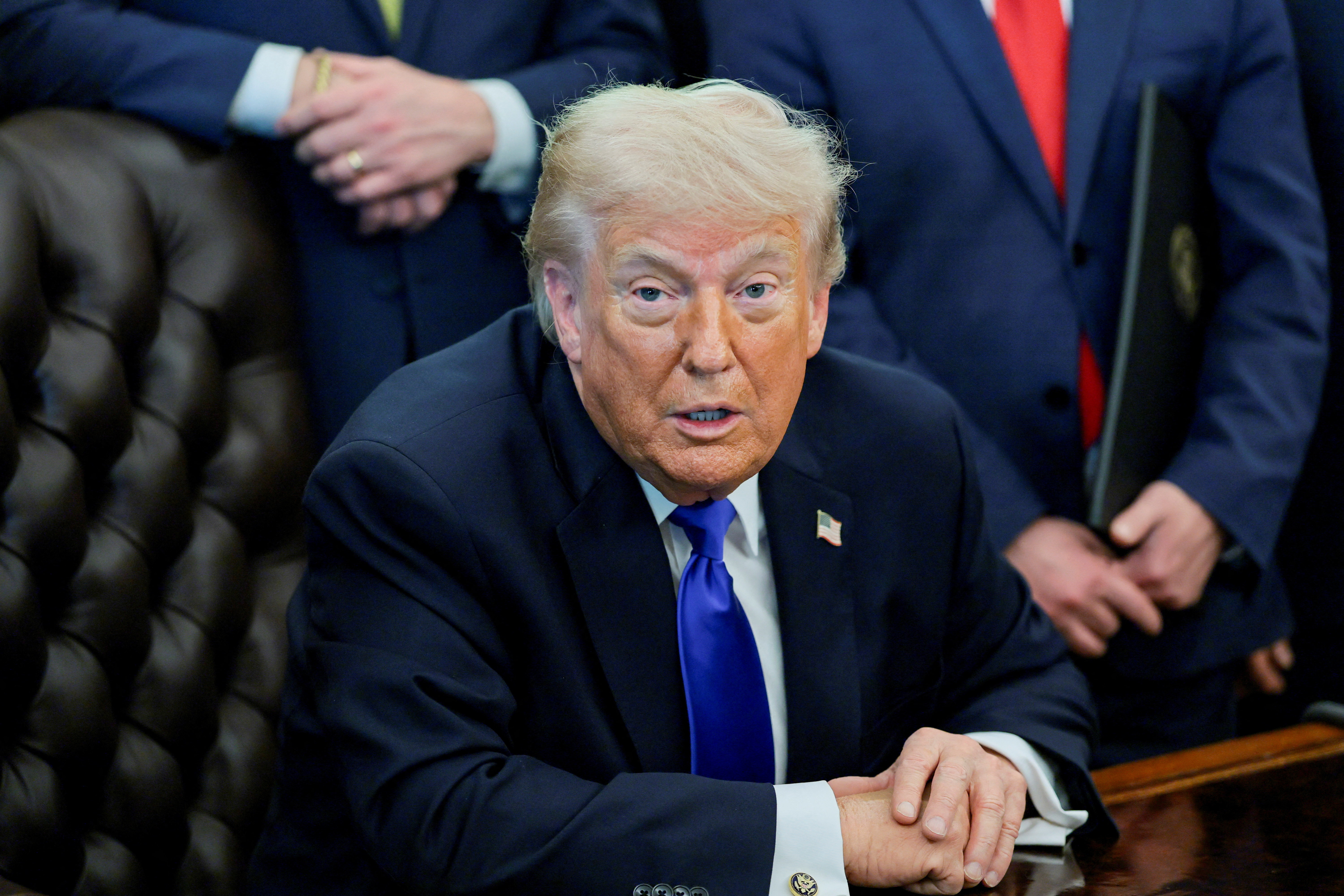
President Donald Trump on Wednesday said two U.S. Army aviators “got very lucky” after an AH-64 Apache attack helicopter was downed by Iran over the Strait of Hormuz, emphasizing that American retaliation for the incident is not over.
Speaking to reporters in the Oval Office, the president declared, “We hit them hard yesterday and we’re going to hit them hard again today.”
Trump initially claimed in a Truth Social post on Tuesday that Iran had shot down the aircraft, before revising his account a day later to say it was struck by an Iranian ordnance that failed to detonate on impact.
“That bomb was lodged in the helicopter, it didn’t explode. It was on fire but it didn’t explode,” Trump explained. “Those two guys, they knew how to fly, but they got very lucky.”
He then quipped: “You won’t believe the rescue, how cool it was.”
The crew members were retrieved by a remotely piloted Navy surface drone, in what Trump and military officials described as the first U.S. operation of its kind.
Still, the episode demonstrated one asymmetrical element of the conflict. U.S. officials said a low-cost Iranian Shahed-136 drone — estimated to cost roughly $20,000 — engaged the American attack helicopter valued at between $35 million and $40 million.
Describing the subsequent rescue, Capt. Tim Hawkins, a spokesman for Central Command, told Military Times that the unmanned surface vessel retrieved the downed aviators and ferried them to a rendezvous point at sea, where they were then hoisted aboard a helicopter for extraction.
“The surface drone that assisted in [Monday’s] rescue of the Apache crew off the coast of Oman was a U.S. Navy Corsair unmanned surface vessel operated by U.S. 5th Fleet’s Task Force 59,” he said. “The task force began fielding these drones in theater in late March.”
The 24-foot Corsair — built by Texas-based Saronic Technologies — can carry payloads of up to 1,000 pounds over a 1,000-nautical-mile range and reach speeds of up to 35 knots, according to the company’s website.
Soon after the U.S. began carrying out retaliatory strikes on Tuesday night, Iranian Foreign Minister Abbas Araghchi, in a social media post, wrote that “our powerful armed forces will leave no attack or threat unanswered.” The Islamic Revolutionary Guard Corps later announced, through a statement carried by Iranian state TV, that it had conducted 21 attacks on U.S. bases across the region, including in Bahrain, Kuwait and Jordan.
But despite the fresh wave of attacks, Trump on Wednesday insisted that a peace agreement can be reached.
“We’ll see what happens with the deal. We were really close to a deal but they keep tapping us along, they keep playing us for suckers,” Trump said. “All they have to do is they have to start signing a paper, it’s fully negotiated.”
Given that negotiations are highly sensitive and secret, it’s unclear how close — or distant — the sides are from an agreement.
An AH-64 Apache helicopter was downed by Iranian ordnance over the Strait of Hormuz, and its two aviators were rescued by a U.S. Navy surface drone off the coast of Oman. President Trump stated that U.S. retaliation for the incident is not over, and Iranian officials announced multiple attacks on U.S. bases in response. The operation involved the U.S. Navy 5th Fleet’s Task Force 59 and marked a significant military engagement in the region.
- An AH-64 Apache helicopter was downed by Iranian ordnance over the Strait of Hormuz.
- The crew was rescued by a U.S. Navy surface drone, marking a first for such operations.
- Iranian Foreign Minister stated that their armed forces will respond to attacks.
- The Islamic Revolutionary Guard Corps conducted 21 attacks on U.S. bases in the region.
- President Trump indicated that U.S. retaliation is ongoing.