
Thirty MUSVs Won't Fix the U.S. Navy's 2026 Pacific Sensor Gap
 Marcus Chen
Thirty MUSVs Won't Fix the U.S. Navy's 2026 Pacific Sensor Gap
Thirty Medium Unmanned Surface Vessels (MUSVs) at $40 million each is a $1.2 billion bet that the U.S. Navy can buy distributed maritime presence faster than China can build targeting networks. The bet is worth making. It is not, by itself, a solution.
On September 29, the Navy announced production Other Transaction Authority agreements with Galliano Marine Services, HII, and Saronic Technologies for 10 vessels each. The first boats are scheduled to arrive before the end of Fiscal Year 2027. The announcement followed Phase I at-sea testing and marks a move beyond prototype demonstrations. It also exposes the hard part of the program: the Navy is buying a number, but it has not yet published the operational details needed to judge what that number can actually do.
The Navy Has Passed the Prototype Test
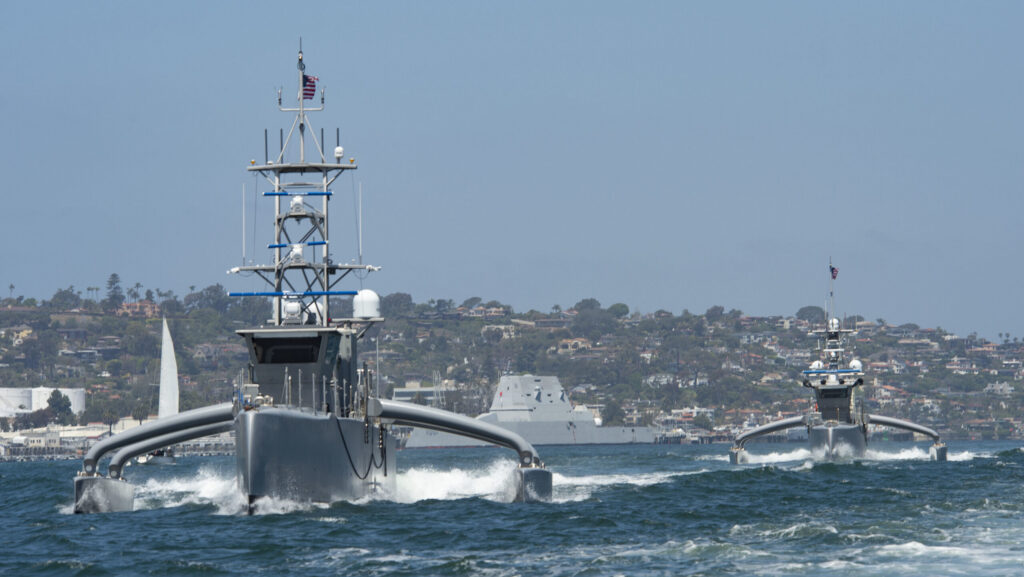
The Navy says Phase I evaluated three basic functions: whether the vessel could understand its maritime environment, navigate autonomously under the International Regulations for Preventing Collisions at Sea, and sustain a long-duration mission. Those are not trivial requirements. An autonomous boat that cannot reliably classify contacts, obey collision rules, or remain at sea is a liability, not a fleet asset.
But these are entry requirements for a useful unmanned ship, not proof of combat value. The public announcement does not provide a common MUSV displacement, speed, endurance figure, communications architecture, or payload standard. That omission matters. The Navy describes the vessels as adaptable platforms for sensors, weapons, and other mission packages, yet a platform is only operationally relevant when commanders know what it can carry, how far it can go, and how it behaves when the network is jammed.
The three-vendor structure is sensible. Ten boats per agreement creates competition and gives the Navy a way to compare designs before committing to a single industrial architecture. It also gives the fleet a chance to discover whether autonomy software, control stations, and payload interfaces work across different hulls. The danger is that competition becomes permanent experimentation. The Navy has spent years proving that unmanned vessels can operate. The next test is whether sailors can employ them in a contested fleet formation.
Thirty Hulls Are Not Thirty Combat Systems
In a Taiwan contingency, MUSVs would be valuable because they can distribute sensors and complicate Chinese surveillance. They could extend passive sensing, support communications relays, scout approaches to a chokepoint, or carry a limited mission payload into a dangerous area. Losing an unmanned vessel is politically and operationally cheaper than losing a destroyer with a crew aboard.
That is the advantage. The arithmetic is less impressive once the support bill appears.
Thirty vessels require shore control teams, spares, satellite or line-of-sight communications, cyber protection, launch and recovery procedures, maintenance crews, and a doctrine for handing control between operators. If every boat needs even a small dedicated crew ashore, the Navy has not removed manpower; it has moved manpower from the deck to the network. If the boats are expected to operate in the Western Pacific, they also need forward access and sustainment. A MUSV that must return to Guam or Hawaii for routine maintenance is not a persistent sensor in the first island chain.
The Navy's own language points to this problem. It calls MUSVs a “tailored offset” that can be rapidly adapted and placed at risk without putting sailors in unnecessary danger. That is a useful concept, but an offset only works when it changes the opponent's calculations. A small group of unmanned boats with predictable communications, weak electronic protection, or short endurance may simply become another set of tracks for the People's Liberation Army to find and suppress.
China Will Attack the Network Before the Hull
Beijing does not need to sink all 30 vessels to defeat the program. It needs to disrupt the kill chain linking each vessel to a U.S. commander, a targeting source, and a weapon. The People's Liberation Army has invested heavily in maritime surveillance, long-range missiles, electronic warfare, and layered sensors. In that environment, the decisive MUSV specification may not be top speed or payload weight. It may be the ability to continue producing useful data after the satellite link is degraded and the fleet network is under attack.
This is where the current announcement is thin. The Navy reports successful autonomous navigation and long-duration testing, but it does not say whether Phase I included realistic GPS denial, intermittent communications, spoofed contacts, or adversarial cyber conditions. Testing a boat in open water is not the same as testing it while a Chinese force is trying to blind it.
The Congressional Research Service has repeatedly identified autonomy, command-and-control, payload integration, and operational concepts as central issues for Navy unmanned systems. The Congressional Budget Office has likewise treated unmanned vessels as part of a broader force-design trade rather than a simple replacement for crewed combatants. Those warnings should shape the next phase. The Navy should publish measurable thresholds for endurance, autonomous recovery, lost-link behavior, cyber resilience, and payload interchangeability before declaring the program a fleet success.
The Real Deadline Is Before 2027
Delivering the first MUSVs before the end of FY2027 is a useful industrial milestone. It is not a warfighting deadline. The Navy needs operating units, not just delivered hulls. That means assigning commanders, training sailors, exercising the boats with destroyers and aircraft, and learning how to repair them at dispersed sites.
The $40 million average price also needs scrutiny. Procurement cost is not total ownership cost. A cheap vessel that consumes scarce operators, specialized support equipment, and high-bandwidth communications can become expensive at scale. Conversely, a common payload and open software architecture could make 30 boats more valuable than their hull count suggests.
My judgment is straightforward: the MUSV buy is a necessary hedge against China's mass and missile advantage, but it is not yet a Pacific combat capability. The Navy has demonstrated that these vessels can navigate. It now has to demonstrate that they can sense, communicate, recover, and remain useful after the first American network is attacked. Until then, 30 MUSVs are 30 promising hulls—not 30 answers to the U.S. Navy's sensor gap.
Sources
- EDR Magazine, “Navy to procure 30 medium unmanned surface vessels following completion of Phase I at-sea testing,” 30 September 2026.
- Congressional Research Service, “Navy Large Unmanned Surface and Undersea Vehicles: Background and Issues for Congress.”
- Congressional Budget Office, analysis of the Navy's future fleet and unmanned vessel force design.
The U.S. Navy announced the procurement of 30 Medium Unmanned Surface Vessels (MUSVs) on September 29, 2026, as part of a $1.2 billion investment to enhance maritime presence in the Western Pacific. The vessels are scheduled for delivery before the end of FY2027 following successful Phase I at-sea testing. However, operational details regarding their capabilities and integration into naval operations remain unspecified, raising concerns about their effectiveness in contested environments.
- U.S. Navy plans to procure 30 MUSVs at $40 million each, totaling $1.2 billion.
- Production agreements were announced with Galliano Marine Services, HII, and Saronic Technologies.
- The first vessels are expected to arrive before the end of Fiscal Year 2027.
- Phase I testing evaluated the vessels' navigation, environmental understanding, and mission endurance.
- The Navy has not yet published operational details for the MUSVs.