
Threat to Destroy All Bridges in Iran, Ground Troops Not Ruled Out, US Media: White House Discusses Large-Scale Attack on Iran
[Global Times reporter Xian Yifan, Global Times special correspondent He Tinglan] The United States has once again threatened Iran with attacks on civilian infrastructure. On the 14th, U.S. President Trump stated in an exclusive interview with Fox News that unless Iran returns to the negotiating table, U.S. forces will strike its bridges and power plants next week. He also indicated that he does not rule out the possibility of sending ground troops to Iran. U.S. media reported that on the same day, Trump held a meeting in the White House Situation Room to discuss plans for a large-scale offensive against Iran, stating that "the scale will be broader than the current operations around the Strait of Hormuz." On the morning of the 15th local time, the Islamic Revolutionary Guard Corps of Iran issued multiple statements claiming that Iran had struck U.S. military facilities in Bahrain, Jordan, Kuwait, and other locations. Analysts quoted by CNBC stated that the conflict between the U.S. and Iran could evolve into a protracted war, and the "only way" to resolve the conflict is through diplomacy, but this approach has become "more difficult" now.
The U.S. resumes maritime blockade of Iranian ports
The New York Times reported that Washington has resumed its hostile posture towards Tehran. "We will strike them hard tomorrow night," Trump said on the 14th, "and by next week, the situation will become very bad for them... unless they sit down to negotiate, we will destroy all their bridges and power plants." The BBC reported that the U.S. had threatened to bomb Iran's civilian infrastructure back in April, and the UN High Commissioner for Human Rights, Turk, stated at that time that "under international law, deliberate attacks on civilians and civilian infrastructure are war crimes."
On the 14th, Trump stated that U.S. military strikes against Iran would continue "until I say 'enough'." He also claimed that Iran's strength has been severely weakened, but it still has the capacity to resist, likening Iran to a "great boxer," saying, "You think you have defeated him, but then he suddenly counterattacks and delivers a heavy blow."
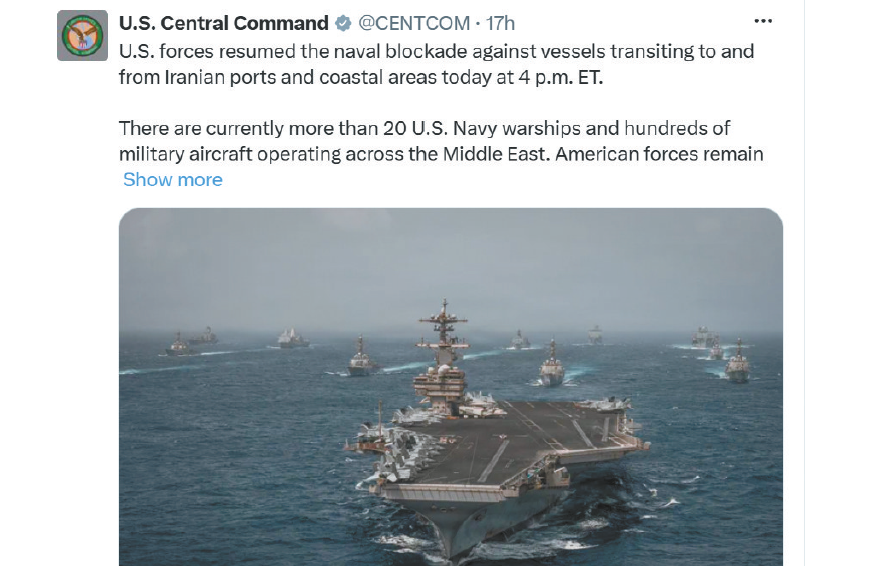
Just hours before Trump's remarks, he withdrew a plan announced on the 13th to impose a 20% fee on all goods transported through the Strait, stating that he decided to replace this fee with trade and investment agreements reached between Gulf countries and the U.S. The New York Times reported that the U.S. would continue to implement a maritime blockade of Iranian ports, which resumed at 4 PM Eastern Time on the 14th. CNN reported that the U.S. had previously imposed a maritime blockade on Iran for about two months from April to June.
Axios reported on the 14th, citing informed sources, that Trump held a meeting in the White House Situation Room that day, with the core topic being "a new plan for delivering a devastating blow to Iran's strategic targets." The report stated, "Trump seems willing to escalate the war to cause enough destruction to force Iran to open the Strait of Hormuz and accept Trump's demands regarding nuclear issues." Attendees included Vice President Pence, Secretary of State Rubio, Secretary of Defense Hegseth, and Chairman of the Joint Chiefs of Staff Milley.
Iran: Destruction of multiple U.S. military facilities
The BBC reported that on the 14th, the U.S. had been striking Iran for four consecutive days. The New York Times stated that the U.S. Central Command announced that during a seven-hour airstrike, "dozens of military targets" were hit. This indicates that the U.S. has resumed the intensive bombing campaign that began over four months ago. At 6 AM Eastern Time on the 15th, U.S. forces began a new round of airstrikes against Iran, lasting about 90 minutes. According to the Associated Press on the 15th, at least 19 U.S. warships are currently in the Arabian Sea, including two aircraft carriers and an amphibious assault ship, along with hundreds of military aircraft operating in the Middle East.
On the morning of the 15th local time, the Islamic Revolutionary Guard Corps of Iran issued multiple statements claiming that Iran had struck U.S. military facilities in Bahrain, Jordan, Kuwait, and other locations. According to these statements, Iran targeted and destroyed facilities including the command and control center, fuel storage, and arms depots of the U.S. Fifth Fleet in Bahrain; destroyed hangars housing F-15, F-16, and F-35 fighter jets at a U.S. airbase in Jordan, as well as several U.S. MQ-9 drones; and destroyed U.S. military facilities in Kuwait, including satellite communication centers, air defense radar systems, Patriot air defense systems, and HIMARS rocket launcher platforms.
According to a report by the Islamic Republic News Agency on the 14th, Iran's permanent representative to the United Nations, Iravani, sent a letter to UN Secretary-General Guterres, stating that "since the signing of the memorandum, until today, the U.S. has not only failed to fulfill its commitments but has actively and systematically undermined the foundation of the memorandum," adding that "these deliberate, well-planned, and ongoing actions pose a serious threat to international peace and security, further indicating that the U.S. completely disregards its international legal obligations."
Conflict enters a "dangerous new phase"?
The Wall Street Journal reported on the 14th that the war launched by the U.S. against Iran has entered a "dangerous new phase." Analysts believe that "stable peace" seems out of reach, as both sides hope to gain the upper hand in this "test of wills." "We are now caught in a forced war of attrition, with both sides trying to push the other to an unknown breaking point," said Pollack, a former CIA analyst.
Professor Nasr of Johns Hopkins University stated, "This is essentially a struggle over leverage." He believes that as long as Iran controls the Strait of Hormuz, the U.S. cannot force it to abandon its nuclear program or accept the conditions for ending the war proposed by the U.S. CNBC quoted analysts as saying that the U.S. is trapped in a predicament of its own making, unable to find a dignified way out.
According to a report by the Iranian news agency on the 14th, data released by the Iranian Strait Management Authority indicated that over 200 non-Iranian vessels coordinated to pass through the Strait of Hormuz during the three weeks from the signing of the memorandum to the U.S. deliberately creating tensions in the Strait.
The Iranian news agency analyzed on the 15th that the trajectory of U.S.-Iran relations depends on various factors, including the political decisions of both countries, regional situations, and economic environments. The article stated that the U.S. "can continue to use various threatening rhetoric," but history has shown that international relations are the result of changes in regional power, political interests, and the international environment. Currently, Iran's most important issue is to maintain social trust, unity, and national identity during difficult times, in order to respond to the impacts of the crisis with greater resilience.
U.S. military forces conducted airstrikes against Iranian military facilities, while Iran retaliated by attacking U.S. installations in Bahrain, Jordan, and Kuwait. President Trump threatened further military action unless Iran returns to negotiations. The situation has escalated with significant U.S. naval and air deployments in the region.
- U.S. President Trump threatened to destroy all Iranian bridges and power plants unless negotiations resume.
- Iranian forces attacked U.S. military facilities in Bahrain, Jordan, and Kuwait.
- The U.S. military has resumed airstrikes against Iranian targets after a period of relative calm.
- At least 19 U.S. Navy ships and hundreds of aircraft are currently deployed in the region.