
Three 8-Wheeled Vehicles Assemble Electromagnetic Catapult, New Variable Emerges in PLA Drone Launch Method
 Li Minghui
Three 8-Wheeled Vehicles Assemble an Electromagnetic Catapult: A New Variable in PLA Drone Launch Methods
A detail disclosed by the South China Morning Post on July 3 is more interesting than the headline itself: In a video from the School of Mechanical Engineering at Beijing Institute of Technology, three eight-wheeled flatbed vehicles drive into an area resembling an airport runway. After being connected by mechanical structures at both ends, they form a continuous catapult track, allowing a fixed-wing propeller drone to accelerate and take off along the track. Related posts seem to have been deleted later, but The War Zone noted the same footage on June 30 and confirmed that this system belongs to a containerized weapon family exposed on the "Zhongda 79" cargo ship at a Shanghai shipyard last year.
This is not simply a smaller version of the large carrier-based electromagnetic catapult found on the Fujian ship. Its true innovation lies in breaking down the "launch facility" into transportable, modular, and camouflaged components. In simple terms, while drones previously relied on airport runways, rocket boosters, sliding tracks, or ship decks, the Chinese engineering team is attempting to fit a small segment of an airport into a fleet of vehicles and containers.
Issues Observed from the Three Vehicles
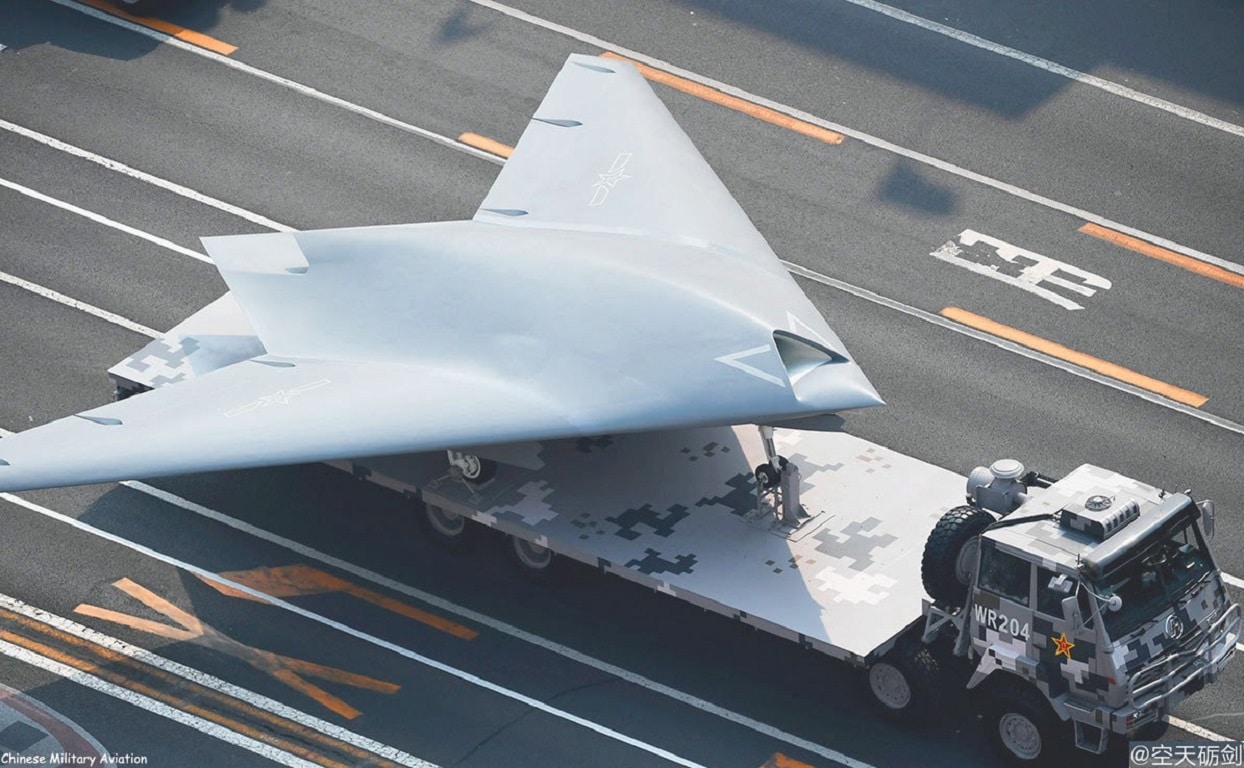
What stands out in the footage is not the drone itself, but the vehicles. TWZ observed that the three catapult vehicles operate separately, connect upon arrival, and possess a large-angle all-wheel steering capability. This design is not just for show; when launching fixed-wing aircraft with electromagnetic catapults, the wind direction is crucial. If the entire track cannot quickly pivot in a confined space, the so-called mobile deployment will be compromised.
Public information also mentions that the related containerized system includes cruise missile launch boxes, air defense missile modules, radar, electronic warfare, command and control, close-in weapons, and electromagnetic catapult vehicles. The original post circulating online claimed an annual production target of 2,000 sets, with over 70 units involved, including China Shipbuilding, the Ordnance Industry, Aerospace Science and Industry, Aerospace Technology, China Electronics Technology, and Aviation Industry. This figure should be viewed cautiously; the author does not recommend interpreting it directly as established combat readiness capacity, but it at least indicates that the project is not a laboratory toy, but rather a system product aimed at mass engineering.
It Addresses the Shortcomings of Drones
The awkwardness of fixed-wing drones lies in the fact that the farther they fly and the larger their payload, the more they typically rely on runways; those capable of vertical takeoff and landing must compromise on range and payload. The value of electromagnetic catapults is that they allow some medium-sized drones to take off over shorter distances while avoiding the heat signals, maintenance, and single-use consumable issues associated with rocket boosters.
The previously mentioned modular catapult concept can stretch between approximately 20 to 60 meters in length, potentially supporting drones around the 2-ton level. This level is still far from the J-15T, let alone a traditional carrier-based aircraft fleet; however, it is sufficient to change deployment methods for reconnaissance-strike integrated drones, communication relay aircraft, decoy drones, or low-cost collaborative combat aircraft. If the PLA places such a system on islands, road airports, roll-on/roll-off ships, or civilian cargo ship decks, what they gain is not a cheap aircraft carrier, but a series of temporary drone launch points.
Don't Rush to Call Cargo Ships Aircraft Carriers
It is necessary to temper expectations here. The most challenging aspects of electromagnetic catapults are not just launching the aircraft but also power supply, energy storage, heat dissipation, track calibration, drone loading cycles, and fault recovery. If installed on the deck of cargo ships like the "Zhongda 79," issues related to rolling, pitching, and deck reinforcement caused by sea conditions have not been publicly addressed. A more realistic usage scenario may involve ports, islands, and temporary shore-based positions maturing first before discussing maritime mobile launch.
- Advantages: Modular transport, strong concealment, and suitable for dispersed deployment in the Western Pacific island chain environment.
- Shortcomings: Power supply and maintenance vehicles are unavoidable, and continuous operational efficiency still needs verification.
- Risks: If deployed extensively on civilian ships or port facilities, the rules for identification and strikes during wartime will become more complex.
The author believes that what truly deserves attention about this system is not a single video demonstration, but whether there will be heavier drones on the track, whether there will be night or complex weather launches, and whether there will be a publicly available recovery system. Takeoff is just the first link in the chain; if rapid recovery, recharging, and redeployment cannot be achieved, it remains merely a beautiful engineering prototype. The real unanswered question is whether the PLA will treat it as a patch for drone airports or develop it into a modular aerial firepower node applicable to both land and sea.
The PLA demonstrated a modular electromagnetic catapult system for launching drones using three connected 8-wheeled vehicles in Beijing on July 3. This system allows for transportable and camouflaged drone launch facilities, aiming to produce 2000 units annually. It enhances the operational capabilities of fixed-wing drones, reducing reliance on traditional runways, though challenges in power supply and maintenance remain.
- Three 8-wheeled vehicles were connected to form a continuous launch track for drones.
- The system allows for modular, transportable, and camouflaged drone launch facilities.
- The PLA aims to produce 2000 units of this system annually, involving over 70 organizations.
- The system is designed to enhance the operational capabilities of fixed-wing drones without traditional runway requirements.
- Challenges remain regarding power supply, maintenance, and deployment in maritime conditions.