
Three exercises that pushed counter–UAS from prototype to proven
Modern uncrewed aerial systems (UAS) have turned airspace defense into a fast-moving, asymmetric contest. Low-cost, high-impact options for attacking critical infrastructure and high-value assets have shown that traditional, radar-centric point defenses struggle to keep pace. Protecting our defense infrastructure and assets has evolved into an asymmetric warfare exercise, where sub-$1,000 systems collapse traditional air superiority and create vulnerabilities to our sensor networks, bases, and personnel.
AV’s Halo_Shield is designed for this environment: a modular, distributed counter-UAS (C-UAS) architecture that fuses passive and active sensor data, and distills them into a coherent command-and-control (C2) picture in AV_Halo software. Halo_Shield is installed as Tiles – integrated, resilient kill chains across domains, incorporating tactical effectors and sensors. The architecture offers earlier detection and reduces risk versus point defenses reliant on single modes. LOCUST High Energy Laser System.
Over three major Defense Department exercises: T-REX 25-2, TWIX 2026, and T-REX 2026, Halo_Shield has moved from promising prototype to proven warfighting system, demonstrating complete kill-chain performance in demanding, operationally realistic environments.
T-REX 25-2: Proving Halo_Shield in the field
The T‑REX 25‑2 Technology Readiness Experimentation event at Camp Atterbury, Indiana, evaluated how ready the Halo_Shield architecture was for real‑world base defense against UAS threats. T‑REX is a DoW and National Guard campaign run with Task Force RAPTR to rapidly assess emerging systems in realistic conditions.
It focused on four questions: whether Halo_Shield could fuse multiple, passive sensors into a single common operating picture (COP), operate in contested environments, contribute to multilayer base defense, and be produced and sustained realistically.
Halo_Shield served as a software‑driven, multi‑sensor tracking and fusion platform that combined Walaris AirScout (acoustic, optical), Squarehead Discovair (acoustic), AV Titan SV (passive RF), and cooperative feeds, fusing them into tracks displayed in the COP. For T‑REX 25‑2 it was deployed as a vehicle‑mounted, multi‑server Terrestrial Tile. The event challenged Halo_Shield using exercises from simple “red air” – simulated enemies – flights, to more complex maneuvers and limited swarm activities. This combined live Group 1–3 UAS flights with suitability measurements and operator feedback mapped to detailed objectives.
Halo_Shield successfully fused multiple inputs, enabling passive detection of small drones and fast visual confirmation without heavy manual effort. It could be powered on and operational in about 15 minutes, with more complex configurations adding only 15–20 minutes including software setup. The system ran with near‑100 percent uptime, with no software crashes or hardware failures.
We demonstrated interoperability via rapid integration of the exercise’s OMNI messaging format, enabling participation in the Passive Multi‑Spectral Air Surveillance Kill Chains (PMASKC) architecture and Ninja Fusion/TRAX environment. Overall, T‑REX 25‑2 showed Halo_Shield to be a technically solid, highly interoperable fusion and C2 platform with a strong early concept for distributed base defense.
TWIX 2026: Interoperability and agility
TWIX 2026 at Sumter, SC, was an event uniting the U.S. Air Force, MITRE, DHS, the National Guard, and industry including AV. We undertook TWIX as an interoperability trial: pre‑deploying Halo_Shield, defining deployment requirements, collecting real‑world sensor data, demonstrating layered multi‑sensor/multi‑effector defense, and validating interoperability.
At TWIX, Halo_Shield delivered layered defense through overlapping sensors, central control of offensive and defensive tools with clear status and threat views (using AV’s PUMA LE ISR), robust communications, integrated acoustic, radar and RF sensors with built‑in health checks, and secure, standards‑aligned data sharing via UDL and partner specifications. It did not operate in isolation; it contributed to a broader C2 picture and showed it can be dropped into complex environments and “speak the same language” as other systems.
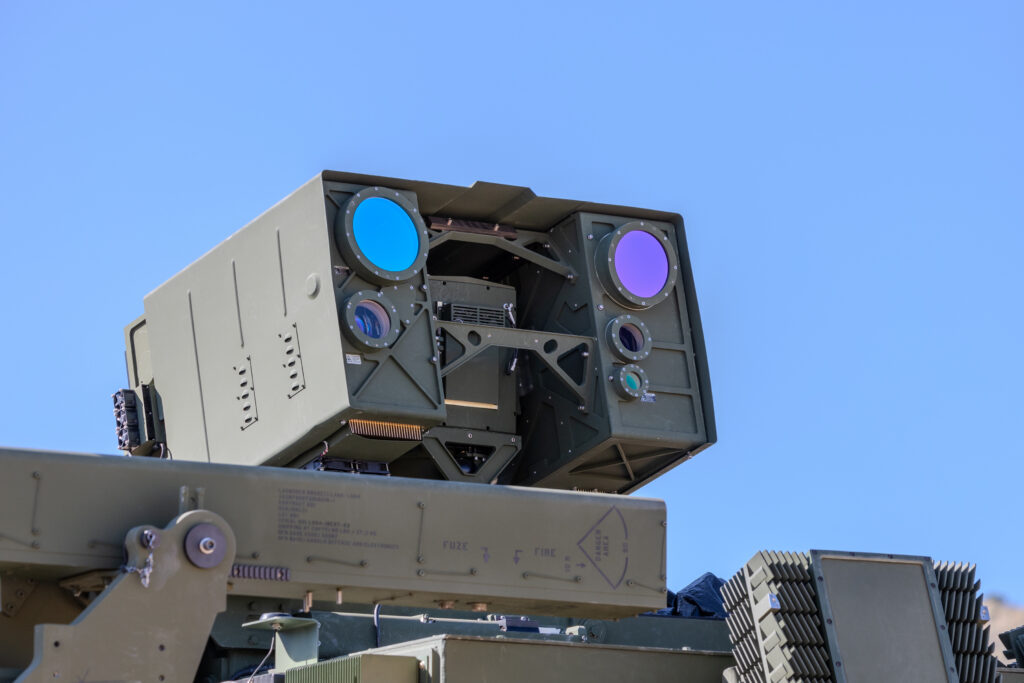 LOCUST High Energy Laser System. (Photo provided by AV.)
Pre‑integration allowed full deployment, networking, configuration, and operation by day one. Remote nodes were repositioned and reconfigured with minimal downtime, demonstrating agility essential for expeditionary operations and rapid base defense. TWIX also tested human and system resilience: range outages, weather and changing coordination demands forced rapid adaptation.
TWIX also surfaced actionable improvements: making Halo_Shield more plug‑and‑play, reducing setup variability, improving tuning and fusion, and refining displays and user flows so new operators can understand and act quickly under pressure. These lessons directly inform how AV now designs, deploys, and operates Halo_Shield.
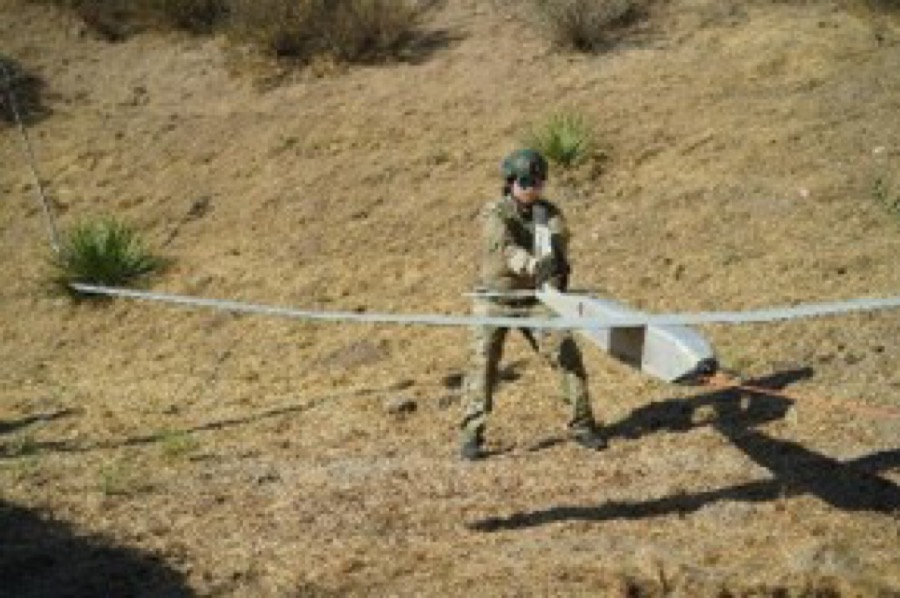 AV’s Puma LE with Intelligence, Surveillance and Reconnaissance (ISR) capabilities. (Photo provided by AV.)
T-REX 2026: Full kill-chain performance at Grand Forks
T-REX 2026 at Grand Forks AFB was the most demanding Halo_Shield test to date. In addition to AV’s own AV_Halo, Argus Perimeter Security, Titan RF C-UAS and Locust high-energy laser (HEL) platforms, we integrated Squarehead Acoustic Sensors, Axis EO/IR cameras, Walaris AirScout, and SRC Gryphon active radars into an operational C-UAS defense architecture.
Across multiple days of vignettes, the AV team combined RF effects and HEL engagements against Group 1 and Group 2 UAS, measuring full kill-chain performance under real-world network, safety, and operational constraints.
Launch-to-detection time in trials was less than a minute, detection-to-ID and cue to kill a few seconds each. Halo_Shield defeated “easy” UAS quickly, achieved repeated kills against Group 2 platforms, neutralized a five-ship swarm in short order, and even defeated a hovering UAS before its formal release. These proved Halo_Shield’s Terrestrial and Sentinel tile operations.
Celestial and Aerial Tiles were tested live. AV_Halo CORTEX and Puma ISR supported left-of-launch detection by identifying potential launch sites and pilot teams, and monitoring runway sectors for pre-launch activity.
A major highlight was the first ever high-energy laser firing at Grand Forks AFB. Halo_Shield served as the C2 for LOCUST laser engagements, performing cue from fused track, weapons pairing and scheduling assignment, and commander confirmation under strict safety oversight. Historically, laser firings had required external support. At T-REX 2026, AV_Halo COMMAND successfully took that role.
Qualitative feedback matched the technical results: evaluators concluded Halo_Shield did well and delivered on its promise. This sets up the opportunity to continue to develop scenarios and strengthen future installs and exercises.
See Halo_Shield in action
Across T-REX 25-2, TWIX 2026, and T-REX 2026, Halo_Shield proved itself as a robust, interoperable, multi-sensor fusion and C2 platform for modern airspace defense. It delivered rapid deployment, near-continuous uptime, scalable architecture, deep interoperability, and a modular tile-based concept that supports distributed, resilient kill chains across domains.
For acquisition leaders and operators seeking a field-proven, near-term solution for integrated C-UAS and airspace defense, we invite you to see Halo_Shield operate live at Grand Forks on our website. You can sit in front of the multi-screen COP, watch detections stream in, tracks fuse, and decisions accelerate, and see how modular tiles, passive sensors, and advanced C2 can redefine airspace defense. Engage with the AV team, and help shape what comes next.
About the Author

Stephen Lloyd is a senior aerospace and defense leader with nearly four decades of federal service, including 33+ years with the Federal Aviation Administration supporting the National Airspace System and defense-adjacent missions. He served in critical roles such as Director for Safety within the FAA Air Traffic Organization, where he led enterprise Safety Management System initiatives spanning risk management, assurance, and operational response. Following federal service, Lloyd transitioned to industry, advising government and private-sector UAS and aviation programs before joining AV. As Senior Director, he leads advanced transportation and airspace solutions teams supporting defense and civilian applications, bringing deep expertise in air traffic systems, safety, and mission-critical operations to AV initiatives.
The Halo_Shield counter-UAS system was successfully demonstrated during the T-REX 25-2, TWIX 2026, and T-REX 2026 military exercises at Camp Atterbury, Sumter, and Grand Forks AFB. It showcased its capabilities in multi-sensor fusion and command-and-control operations, achieving rapid deployment and effective defense against UAS threats. The system integrated various sensors and platforms, proving its reliability and interoperability in real-world conditions.
- Halo_Shield demonstrated complete kill-chain performance in military exercises.
- The system achieved near-100 percent uptime with no software crashes or hardware failures.
- Halo_Shield successfully fused multiple sensor inputs for UAS detection and tracking.