
Top U.S. general says AI will change how America fights its wars
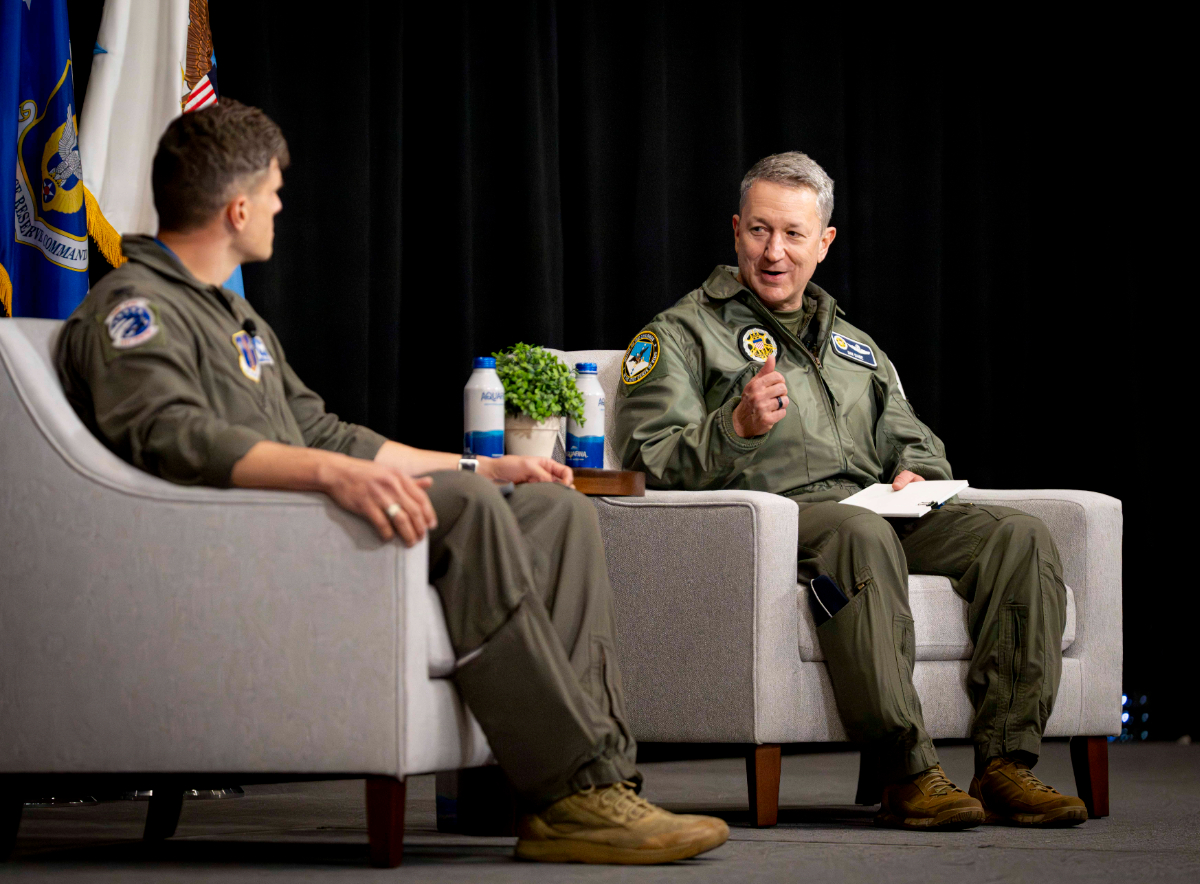
Gen. Dan Caine, chairman of the Joint Chiefs of Staff, has named artificial intelligence as one of his three strategic priorities, ranking it behind only securing a budget and ahead of ongoing military operations.
Caine made the remarks on Oct. 26 during a fireside chat at the National Defense Transportation Association and U.S. Transportation Command fall meeting in Grapevine, Texas, moderated by Transcom commander Gen. Randall Reed of the U.S. Air Force, according to a Pentagon News account of the session. Throughout the discussion, Caine referred to the technology as “super intelligence,” or SI, the term President Donald Trump is trying to substitute for “artificial intelligence” across the federal government.
“I have sort of three strategic priorities right now, separate from [others]. No. 1 is making sure that we have a budget. … No. 2 is [super intelligence], and No. 3 is ongoing operations,” said Caine.
The wording follows a Sept. 29 executive order that directs the executive branch, to the extent the law allows, to use “Super Intelligence” and “SI” in place of “Artificial Intelligence” and “AI.” The order does not create a new category of technology. It defines super intelligence as the same systems already covered by the statutory definition of artificial intelligence in federal law, so when Caine says SI, he is describing the AI tools the military uses and develops today.
Trump first announced the change in his Sept. 22 speech to the United Nations General Assembly, saying all U.S. government documents would switch to the “much more accurate term.” The State Department has since ordered its staff to rename AI-related programs and systems, and military offices have started adopting the language as well; the U.S. Marine Corps aviation acquisition office this month described new maintenance tools it is pursuing as predictive super intelligence technologies.
The term already carries a different meaning in the technology field. Researchers and AI companies have long used superintelligence to describe a hypothetical future system that surpasses human intelligence, and the industry more often uses “artificial general intelligence” for AI that would match or exceed people across tasks. Critics have argued that the government’s branding blurs that distinction, and Trump has responded by calling anyone who uses the term “Artificial Intelligence” an enemy of the White House.
Caine told the Transcom audience that the technology will be essential for the joint force to win tactical engagements, run logistics and sustainment, and carry out command and control, the functions that let commanders direct forces in combat. He described a future conflict in which the number of kinetic and non-kinetic actions moving between the United States and an adversary, from missiles, rockets and bombs to cyberattacks, would be significant enough to require machine help.
“When I think of SI, …it’s going to be a game changer as we move forward,” said Caine.
The chairman stressed that the work involves training leaders as well as systems and models, so that future commanders get decision support while humans stay appropriately involved and the military balances the opportunities against the risks. He said the Joint Staff is already working on that effort.
“It’s going to be an important part of our future, [and] we need to lean in,” said Caine.
The Pentagon’s use of the technology has grown quickly over the past year. In May, Under Secretary of War Emil Michael said the number of department personnel using AI tools rose from about 80,000 to 1.5 million in a single year, spanning enterprise productivity software through classified intelligence analysis. The department is also applying AI to missile defense data fusion and has launched a pilot program that uses AI-assisted tools to manage security classification.
Transcom offers an obvious test case for the logistics side of Caine’s argument. The command moves troops, equipment and supplies worldwide by air, sea and land, and the forecasting, routing and maintenance planning behind that work are the kind of data-heavy tasks where the Pentagon has been most willing to put AI tools into daily use. Caine did not describe specific Transcom programs during the session, according to the Pentagon account.
He closed the point by saying the commercial sector is likely to set the pace if past experience holds, and that the military needs to keep up.
“And we need to match them at the same speed and tempo,” Caine said.
Content preview only. Full article available at source. View Full Article
Gen. Dan Caine highlighted the strategic importance of artificial intelligence, termed 'super intelligence,' during a discussion in Grapevine, Texas, on October 26, 2023. He stated that AI will be crucial for military operations, logistics, and command and control. The U.S. military has seen a significant increase in personnel utilizing AI tools, rising from 80,000 to 1.5 million in one year.
- Gen. Dan Caine prioritizes AI as a strategic focus for military operations.
- The term 'super intelligence' is being adopted in place of 'artificial intelligence' by the U.S. government.
- The number of personnel using AI tools in the military increased from 80,000 to 1.5 million in one year.
- AI is being applied to logistics, command and control, and tactical engagements.
- The Pentagon is working on training leaders to effectively use AI technologies.