
U.S. Army pilots test MV-75 tiltrotor in simulators before its first flight
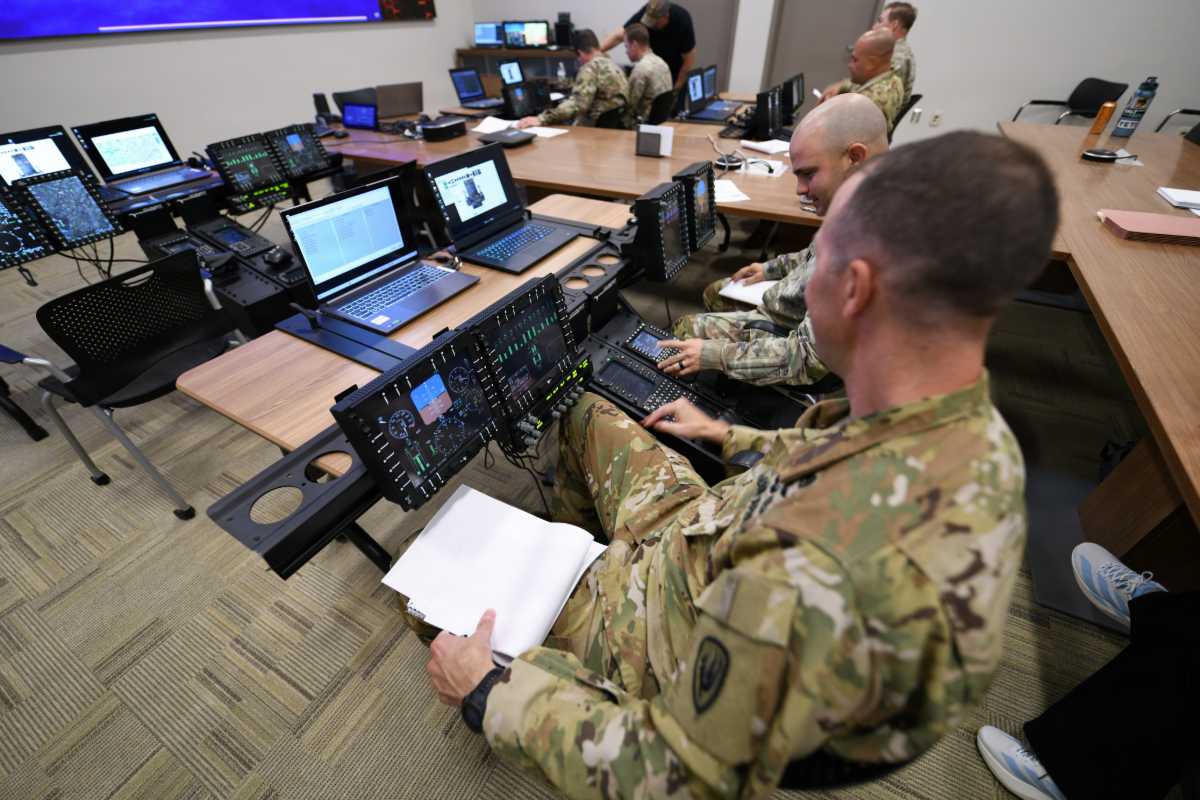
U.S. Army aviators and National Guard aviation officers spent a week this summer flying a virtual MV-75 Cheyenne II, critiquing cockpits and rehearsing maintenance in virtual reality, as the service brings soldiers into the tiltrotor’s design before the first test aircraft has flown.
The sixth MV-75 Special User Evaluation ran Aug. 24 to 28 at Redstone Arsenal, Alabama, according to an Army statement published Oct. 27 by the program’s acquisition office. Participants came from the MV-75 Operational Development Team, a group of aviators, crew chiefs and maintainers based at Fort Rucker, Alabama, and from a National Guard advisory working group with representatives from Colorado, Idaho, Kansas, Louisiana, Minnesota, New York and Pennsylvania. The Army has not released findings from the evaluation, and the account describes what participants did and how the program will use their feedback without saying whether any design changes resulted.
Special User Evaluations put the people who will fly and fix an aircraft into its development cycle early, so that problems with workload, human-systems integration and maintenance surface while they are still cheap to correct. For this session, crews worked through the MV-75 virtual prototype to learn the crew station and flew simulated missions over terrain to assess tiltrotor flight dynamics, vertical-lift controls and conversion from helicopter mode to high-speed airplane mode. At the Army’s Advanced Prototyping Engineering and Experimentation Laboratory, aviators compared the cockpit layouts of the CH-47 Chinook and UH-60 Black Hawk to identify features worth keeping and usability problems worth avoiding, and they flew familiarization sorties in an MD 530 helicopter with the Army Flight Test Directorate to assess its cockpit. The program office said it will consolidate that comparative feedback and use it in technical discussions with Bell, the aircraft’s builder.
Maintainers used virtual-reality interfaces to practice removing and replacing major components, and participants also reviewed cybersecurity, infrastructure and acquisition lifecycle requirements. Staff Sgt. Eric Lopez of the Operational Development Team said the aircraft’s upgraded electronics, maintenance packages and technical manuals would simplify sustainment for soldiers, an assessment that cannot yet be tested on real hardware.
The National Guard participants focused on how the aircraft would be used at home. CW4 Darren Frey of the Colorado National Guard and the High Altitude Army National Guard Aviation Training Site said the MV-75’s longer range and faster transit could let states centralize fleet maintenance at a single hub while still covering the whole state for rapid-response missions, potentially reducing infrastructure and maintenance requirements. Col. Jim Mandel of the Idaho National Guard said the officers in the working group advise their states’ adjutants general on positioning aviation assets for state and federal missions.
Maj. J.T. Hingey, deputy team chief of the Operational Development Team, said the evaluation was the team’s first in-person engagement with the project manager and the flight test directorate. He said flying the virtual prototype under the guidance of experimental test pilots with V-22 Osprey experience gave the Fort Rucker team insight it will use to improve its own simulator, refine tactics, techniques and procedures, and brief senior Army leaders. He also stressed the need for a shared understanding of the program baseline and the outside factors that affect it, so the aviation enterprise can stay aligned when funding, schedules or other variables change.
The MV-75 is the production version of Bell’s V-280 Valor demonstrator, which first flew on Dec. 18, 2017, and won the Future Long Range Assault Aircraft competition in December 2022. The program reached Milestone B, the formal start of engineering and manufacturing development, in August 2024, and in April 2026 the Army officially named the aircraft the Cheyenne II, the first all-new platform to enter its inventory since the 1980s. The 101st Airborne Division’s combat aviation brigade has been selected as the first unit to receive it.
The company completed the first MV-75 wing in February and said it took 90% fewer labor hours than the first V-22 wing, an efficiency it attributes to the aircraft’s digital design. By midsummer the first six test aircraft were in various stages of assembly, with final assembly at Amarillo, Texas, and fuselages built at a new center in Wichita, Kansas. The first gearbox has been completed, and testing on the first flight control computers has started in Bell’s weapon systems integration lab.
The schedule is less settled. The Army sharply accelerated the program in early 2026, pulling initial fielding forward to 2027 from a previous target of around 2031, but at the April naming ceremony officials declined to commit to first flight or production dates. Funding then interrupted the work: after fiscal 2026 money for the program ran out in July, the Army and Bell went through a three-month communications blackout under federal funding rules and only resumed program discussions in October. The Army’s fiscal 2027 request includes $2.1 billion in research and development funding for the MV-75, up from $350 million in fiscal 2026, and Bell said meetings with the government are planned to agree on a feasible baseline schedule.
The Operational Development Team’s work at Fort Rucker draws heavily on the V-22, the only tiltrotor in U.S. military service, which the U.S. Marine Corps and U.S. Air Force have operated since 2007. The MV-75 differs from the Osprey in a key respect: its engines stay fixed in the nacelles while only the rotors and driveshafts tilt, and a driveshaft through the wing lets one engine power both rotors. The Army has never flown a tiltrotor, so the team is using virtual prototypes and joint-service V-22 lessons to build tiltrotor expertise, streamline pilot training and prepare units before the first aircraft arrive.
The aircraft’s speed will also force changes around it. The Army has said the MV-75 is designed to fly roughly twice as far and twice as fast as its current helicopters, and Army officials have noted that the AH-64 Apache, which normally escorts assault helicopters, tops out at about 300 km/h (185 mph), well below the tiltrotor’s planned cruise of more than 480 km/h (300 mph). The Black Hawk, which the MV-75 is meant to partly replace, is expected to remain in service into the 2050s.
Content preview only. Full article available at source. View Full Article
U.S. Army aviators and National Guard officers tested the MV-75 Cheyenne II tiltrotor in simulators at Redstone Arsenal, Alabama, from August 24 to 28, 2023. They evaluated cockpit design, maintenance procedures, and flight dynamics using a virtual prototype. The exercise aimed to integrate user feedback into the aircraft's development process, enhancing its operational capabilities compared to existing helicopters.
- U.S. Army pilots tested the MV-75 Cheyenne II in simulators from August 24 to 28, 2023.
- The evaluation took place at Redstone Arsenal, Alabama.
- Participants included aviators and maintainers from various states and the National Guard.
- The MV-75 is designed to improve operational capabilities compared to existing helicopters.
- The program aims to incorporate user feedback into the aircraft's development.