
Transporting a Large Number of Marines: Is Ground Combat the Focus? Will the U.S. Deploy Amphibious Assault Ships to the Middle East to Seize Islands?
[Global Times Special Correspondent Chen Yang] The navigation issue in the Strait of Hormuz remains unresolved, and Iran continues to retaliate against Israel and U.S. forces stationed in the Middle East. This situation has led to an increasing possibility that U.S. President Trump may order a ground offensive against Iran. The U.S. Naval Institute website revealed that the Pentagon has dispatched a second amphibious readiness group to the Middle East. However, at the same time, more and more U.S. media and experts are warning that a ground offensive would escalate this military conflict further, leading to a more uncontrollable future.
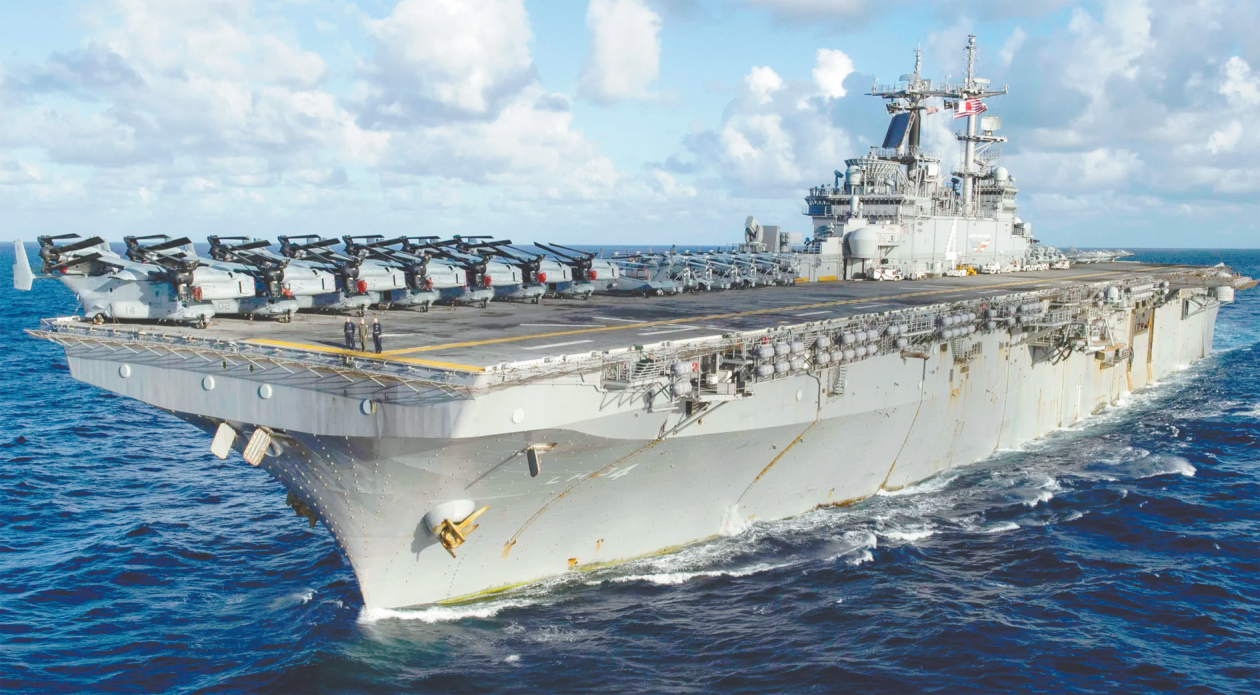
The second amphibious readiness group has set sail
The U.S. Naval Institute website reported on the 20th that the amphibious readiness group centered around the USS Boxer amphibious assault ship has departed from California, USA, heading to the Middle East, and is expected to take at least three weeks to arrive. This amphibious readiness group includes the USS Boxer amphibious assault ship, the USS Comstock dock landing ship, and the USS Portland amphibious transport dock, and is carrying the 11th Marine Expeditionary Unit of the U.S. Marine Corps.
It is reported that the amphibious readiness group is a rapid response force used by the U.S. Navy to intervene in global affairs, typically consisting of one amphibious assault ship and two large landing ships, which are permanently equipped with 2,000 sailors and about 2,200 Marines from the Marine Expeditionary Unit. Unlike U.S. Army units that require a longer time for equipment assembly, boarding, and preparation for oversea operations, the amphibious readiness group is preloaded with the necessary equipment and logistics for the Marine Expeditionary Unit, allowing for rapid deployment to execute various missions, from supporting F-35 fighter operations to non-combatant evacuations and disaster relief.
The report mentioned that prior to this, the U.S. Navy's USS Tripoli amphibious assault ship, USS New Orleans amphibious transport dock, and their embarked 31st Marine Expeditionary Unit had already approached the Middle East region via the Strait of Malacca. A spokesperson for the U.S. Pacific Fleet stated that the USS San Diego amphibious transport dock, which was originally thought to be part of the deployment, has now returned to port in Sasebo, Japan.
According to the U.S. Defense One website, the U.S. Navy theoretically has 10 amphibious assault ships and 21 amphibious landing ships, and under the requirement that 80% of the vessels are ready for deployment at any time, it can form up to 8 amphibious readiness groups. However, due to the poor condition of U.S. Navy vessels and delays in maintenance, the Pentagon has set a goal for the U.S. Navy to "simultaneously deploy 3 amphibious readiness groups in global waters" by 2025. Even so, it is difficult for the U.S. Navy to achieve this; for example, the current U.S. Navy can only deploy one amphibious readiness group from the West Coast to the Pacific each year, with a theoretical deployment time of 6 months, but it often extends to 9 months due to the inability of replacement forces to keep up.
The U.S. Naval Institute website stated that the U.S. Navy's USS Iwo Jima amphibious readiness group and the 22nd Marine Expeditionary Unit have been deployed near Venezuela since mid-August of last year. Therefore, after the USS Boxer amphibious readiness group departs, the U.S. Navy will not be able to send other organized amphibious combat forces to the Middle East in the short term.
Is an island seizure operation feasible?
U.S. Axios News cited anonymous officials stating that the Trump administration may lean towards blockading or occupying Iran's Khark Island, through which most of Iran's oil is exported. The main goal of this move is to increase pressure on Tehran to reopen the Strait of Hormuz. The official stated, "Trump wants to keep the Strait of Hormuz open, and if occupying Khark Island is necessary to achieve that goal, he will do it. If he decides to launch coastal operations, he will do that too. But no such decision has been made yet." U.S. CBS News also cited anonymous sources saying that Pentagon officials have made detailed preparations for deploying U.S. ground forces to Iran, but did not disclose specific operational plans.
However, the U.S. website "Power" reported on its "Battlefield" channel that capturing Khark Island would require a large-scale, sustained military operation, and the risks are extremely high. The U.S. military has three options for seizing the island: amphibious assault, helicopter insertion, and airborne drops, which may also be used in combination, but all methods carry significant risks. This is because the island is only about twenty kilometers from the Iranian mainland, meaning that U.S. forces involved in the mission would face various types of Iranian coastal fire threats. Additionally, Khark Island is located deep in the Persian Gulf, and if the U.S. amphibious fleet wants to conduct a traditional amphibious assault, it must first cross the Strait of Hormuz from the Arabian Sea to enter the Persian Gulf, but during this transit, especially while passing through the Strait of Hormuz, it would become a target for concentrated Iranian fire. Former U.S. Army officer Harrison Mann stated that the Iranian military could lay mines in the strait and the waters surrounding Khark Island, while also using coastal anti-ship missiles, drones, and unmanned boats to launch attacks, making any landing operation vulnerable to Iranian artillery and rocket fire.
The report noted that considering these factors, long-range air strikes may be the most likely option. Currently, among the two amphibious readiness groups sent to the Middle East, both the USS Boxer and USS Tripoli amphibious assault ships are equipped with F-35B stealth fighters, enhancing their air combat capabilities. Earlier reports indicated that the U.S. Army's 82nd Airborne Division canceled a large exercise originally scheduled for early March in Louisiana, with all personnel remaining on standby at Fort Bragg in North Carolina, leading to speculation that this airborne unit might be used in the direction of the Middle East.
However, even with helicopter vertical landings or airborne drops, there are other risks. For example, the heavy weapons available to airborne troops during drops are limited, and casualties can easily occur upon landing. The U.S. Marine Corps' V-22 Osprey tiltrotor aircraft and various helicopters would need to make multiple trips to deliver sufficient forces, giving Iran ample time to calibrate their strike parameters.
Even if U.S. forces capture Khark Island, it would be difficult to garrison it. Former U.S. Central Command Commander Joseph Votel analyzed that to hold Khark Island, U.S. forces would need to deploy a force of about 800-1,000 personnel. "This also means you have to take care of them, you have to supply them, and you have to provide medical evacuation. This requires logistical support for the garrisoned forces, and to some extent, this logistical line must also be protected. All of these are factors that cannot be ignored and often involve larger-scale military operations."
Seizing enriched uranium? Former Commander of U.S. Central Command: The risks are extremely high
Previous analyses by U.S. media suggested that U.S. forces might also deploy special operations forces to seize Iran's enriched uranium. CBS News reported that after the U.S. military launched Operation Midnight Hammer last summer, most of Iran's enriched uranium facilities were destroyed, but the nuclear material itself was not destroyed, with about 450 kilograms of 60% enriched uranium buried under the rubble. The U.S. goal is to completely eliminate Iran's nuclear weapon potential, not just destroy facilities, so the Pentagon has been considering whether to send special operations forces to either transport it away or dilute it on-site.
However, Votel believes that seizing Iran's enriched uranium would be a larger-scale military operation, rather than a short-term special operation like the one in the capital of Venezuela. He believes that Iran's enriched uranium is likely stored primarily at nuclear facilities related to Natanz or Isfahan, which are located hundreds of kilometers inland in Iran. Although U.S. special operations forces have been trained for "sensitive counter-proliferation missions," it is "unlikely that a few people could just go in and take the stuff away."
Votel stated that such a raid operation faces two major practical challenges: determining the specific location of the enriched uranium, with the worst-case scenario being that it is buried under rubble and requires deep excavation to find the target; and how the special operations forces can safely arrive and gain battlefield control during the excavation process.
Therefore, Votel estimates that in addition to the special operations forces executing the seizure of enriched uranium, a relatively large security force would also need to be deployed, possibly even a brigade-sized combat force of 3,000-4,000 personnel as support. At the same time, it is essential to ensure the deployment of dedicated air forces responsible for air cover and intelligence, surveillance, and reconnaissance (ISR) tasks. Such a large ground force would inevitably involve complex logistics and operational support. Additionally, special operations forces would have to deal with the challenges of handling nuclear materials. The entire process carries extremely high risks.
The U.S. Navy has deployed a second amphibious readiness group, led by the USS Boxer, to the Middle East, with an expected arrival in three weeks. This group includes approximately 4,200 personnel and is prepared for potential ground operations against Iran, including the strategic seizure of Khark Island. Discussions indicate a focus on maintaining open access to the Hormuz Strait amid rising tensions.
- The U.S. has deployed a second amphibious readiness group to the Middle East.
- The USS Boxer is the core of this group, expected to arrive in 3 weeks.
- There are discussions about potential ground operations against Iran, including seizing Khark Island.
- The U.S. Navy has limited amphibious capabilities due to maintenance issues with its fleet.