
Trump’s Russian diesel deal benefits Moscow more than US consumers, experts say

KYIV, Ukraine — American diesel prices rose for a second straight week as Russia’s seaborne crude exports reached their highest weekly value since the country launched its full-scale invasion of Ukraine. The price hike comes weeks after U.S. President Donald Trump moved to ease restrictions on Russian diesel and pressure Kyiv to spare Russian refineries ahead of the U.S. midterm elections.
Diesel averaged $6.35 a gallon on Monday, just below the record $6.53 set in September, according to data from the U.S. Energy Information Administration.
The economy is the top issue heading into the Nov. 3 midterms, with 84% of registered voters calling it “very important” to their vote and 54% saying the same of energy policy, according to a Pew Research Center survey conducted Sept. 28 to Oct. 4.
“The president decided to pin this problem not on Putin, but on me. Explaining to his people that because of this, diesel prices in America are going up. That is completely untrue,” Ukrainian President Volodymyr Zelenskyy said of Trump’s recent claims that Ukraine’s attacks on Russian refineries were to blame for the price increases.
Trends in federal data back up the Ukrainian president, showing that the steep initial rise in diesel prices followed the start of the Iran war — not Ukrainian strikes on Russian production infrastructure.
U.S. diesel stayed below $3.90 a gallon from August 2025 until the U.S. and Israeli strikes on Iran began Feb. 28, then jumped nearly 25% in a week to $4.86, according to the Energy Information Administration.
“This crisis has its roots in the Middle East. Everyone understands that perfectly well. Everyone knows how to do the math,” Zelenskyy said on Oct. 12, quoting his remarks to the Warsaw Security Forum. “If Russia accounts for 2.2% of global diesel supplies, what impact can it have on the price? That’s how negligible it is.”
Even Moscow’s senior officials agree.
“The key guarantee of full stabilization of this market is the speediest normalization of the situation around the Persian Gulf, overcoming the conflict around Iran,” Russian Deputy Foreign Minister Georgy Borisenko told reporters Oct. 12.
The International Energy Agency confirmed in an Oct. 14 report that easing Russia’s diesel export ban is unlikely to materially change global supplies because Russia lacks the working refinery capacity.
Critics of the deal
The diesel sales will barely move American prices before the vote, but the deal would benefit Russia disproportionately and cost Kyiv one of its few levers against the Kremlin, according to the Institute for the Study of War and the Carnegie Russia Eurasia Center.
The current situation gives Moscow deeper diplomatic ties with Washington — economic cooperation that continues despite Russia’s attacks on Ukraine’s more vulnerable energy grid — as well as more money for its war chest and the prospect that U.S. pressure will halt Ukraine’s strikes on its refineries that help fund the war, experts at both institutions said.
“The diesel agreement gives Putin an opportunity to advance economic cooperation with Washington before any settlement in Ukraine,” Carnegie senior fellow Tatiana Stanovaya wrote on Oct. 14. “Economic agreements can coexist with unchanged demands on Ukraine and continued military pressure.”
The Kremlin is also using the deal to win U.S. support for its negotiating position with Ukraine, part of a recurring effort to offer Washington economic incentives it claims are unrelated to the war “in order to extract concessions from the U.S. regarding the war,” ISW said.
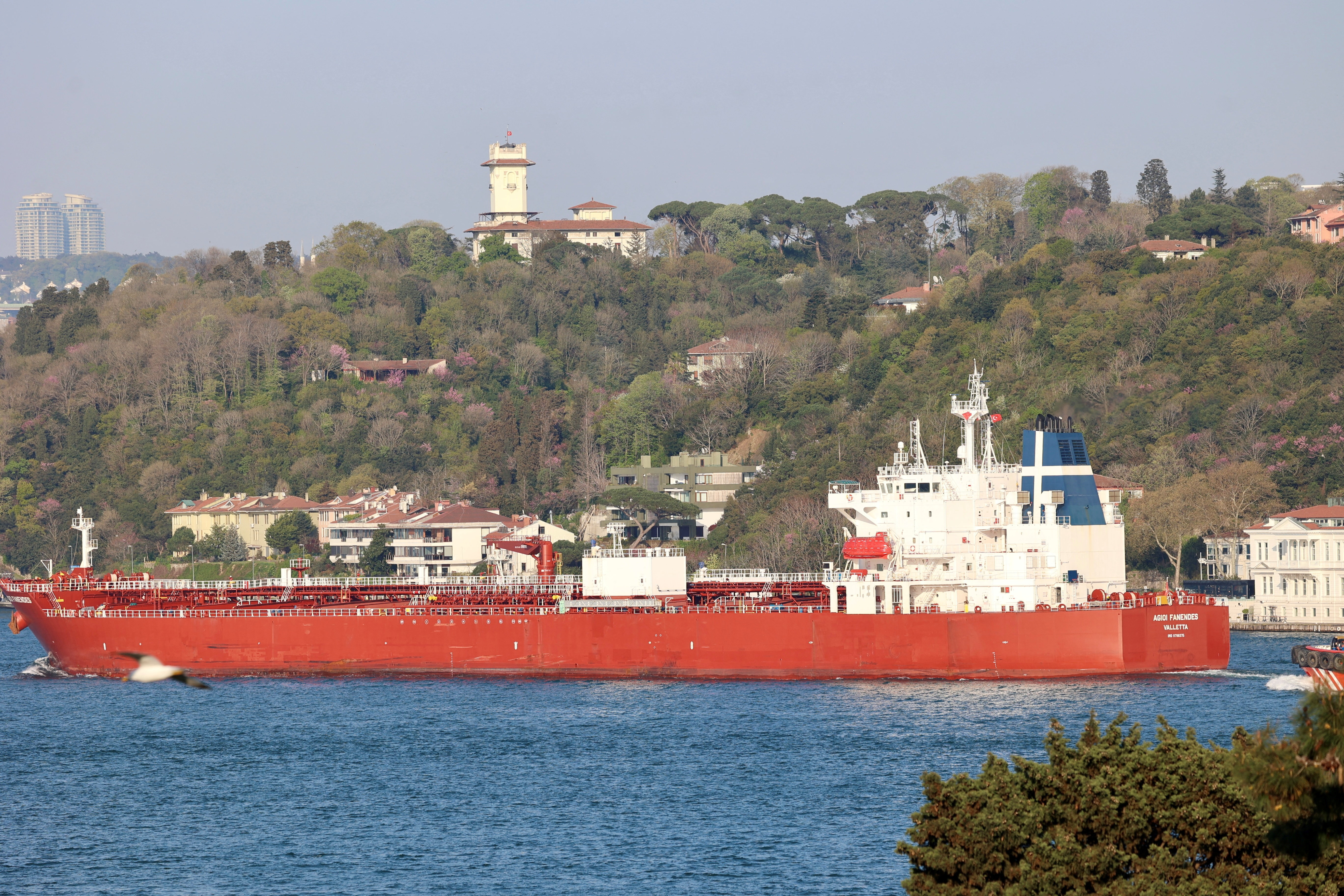 Agioi Fanendes, a Malta-flagged medium-sized tanker, transits the Bosphorus in Istanbul, Turkey, April 11, 2024. The tanker, loaded with diesel fuel, departed Russia on Friday, Oct. 23, 2026, headed for the United States. (Yoruk Isik/Reuters)
Critics in Kyiv and Washington, including members of Trump’s own party, warn the deal will put more oil money in Russian hands and disproportionately impact Ukraine. Zelenskyy told the Warsaw Security Forum that the country has “just one oil refinery,” while Russia has 32 major refineries, according to the International Energy Agency.
Four Republican and three Democratic senators urged the Trump administration Oct. 11 to “immediately reverse course,” saying in a joint statement that “the United States should not provide Putin with a financial lifeline while Russia continues to kill Ukrainian civilians.”
Two days later, 12 senators from both parties, including Republicans Mitch McConnell, R-Ky., and John Cornyn, R-Texas, wrote to Trump in a letter that the deal will have “a negligible impact on fuel prices” and “is a gift to our adversary and a betrayal of our Allies.”
“Putin is looking for a way to get the United States to pressure Ukraine to stop striking those refineries,” Rep. Don Bacon, R-Neb., wrote the day the deal was announced.
Not enough to offset losses
Ukraine’s strikes have taken some Russian diesel off the market.
Russian diesel production fell by nearly 30% as attacks on refineries intensified, the International Energy Agency said in a Sept. 17 analysis.
The estimated gross value of Russia’s seaborne crude shipments hit a wartime high of $2.76 billion this week, up roughly $430 million from the week before, Bloomberg reported.
No strikes on Russian refineries were reported last week, and the lull has allowed Moscow to boost processing rates, likely diverting crude that would otherwise have been exported, the outlet reported.
But the Gulf’s losses are far larger. Diesel exports from the region dropped to 390,000 barrels a day in August, just over a quarter of prewar levels, according to International Energy Agency figures.
Russia’s promised deliveries won’t close that gap.
The first shipment equals just about 2% of U.S. diesel demand over a month, CNBC reported. Goldman Sachs estimated the first two months of deliveries would cut wholesale prices on the U.S. Gulf Coast by just $1 to $2 a barrel, or roughly 2 to 5 cents a gallon.
“Now we can see how cash will start flowing back into Russia through the diesel deal,” Zelenskyy told reporters at a European Union summit in Brussels on Oct. 16, according to Reuters.
“This diesel deal will never be enough to offset the impact of the Strait of Hormuz on global markets. But it will put more money straight into Putin’s pocket to fund this war.”
Trump eased sanctions on Russian diesel after an Oct. 9 call with Russian President Vladimir Putin, saying in a Truth Social post that Russia would supply hundreds of thousands of tons of diesel fuel “immediately” and that diesel prices would come down “IN RECORD NUMBERS, AND FAST!”
The same day, U.S. envoys Steve Witkoff and Jared Kushner told Ukrainian negotiators in Miami that the White House hoped the diesel deal would soften Moscow’s stance on peace talks. Witkoff met Putin for in-person negotiations last week for the ninth time since February 2025.
Kyiv offered to refrain from striking Russian refineries if Moscow stopped hitting Ukraine’s energy infrastructure, Zelenskyy said Oct. 11.
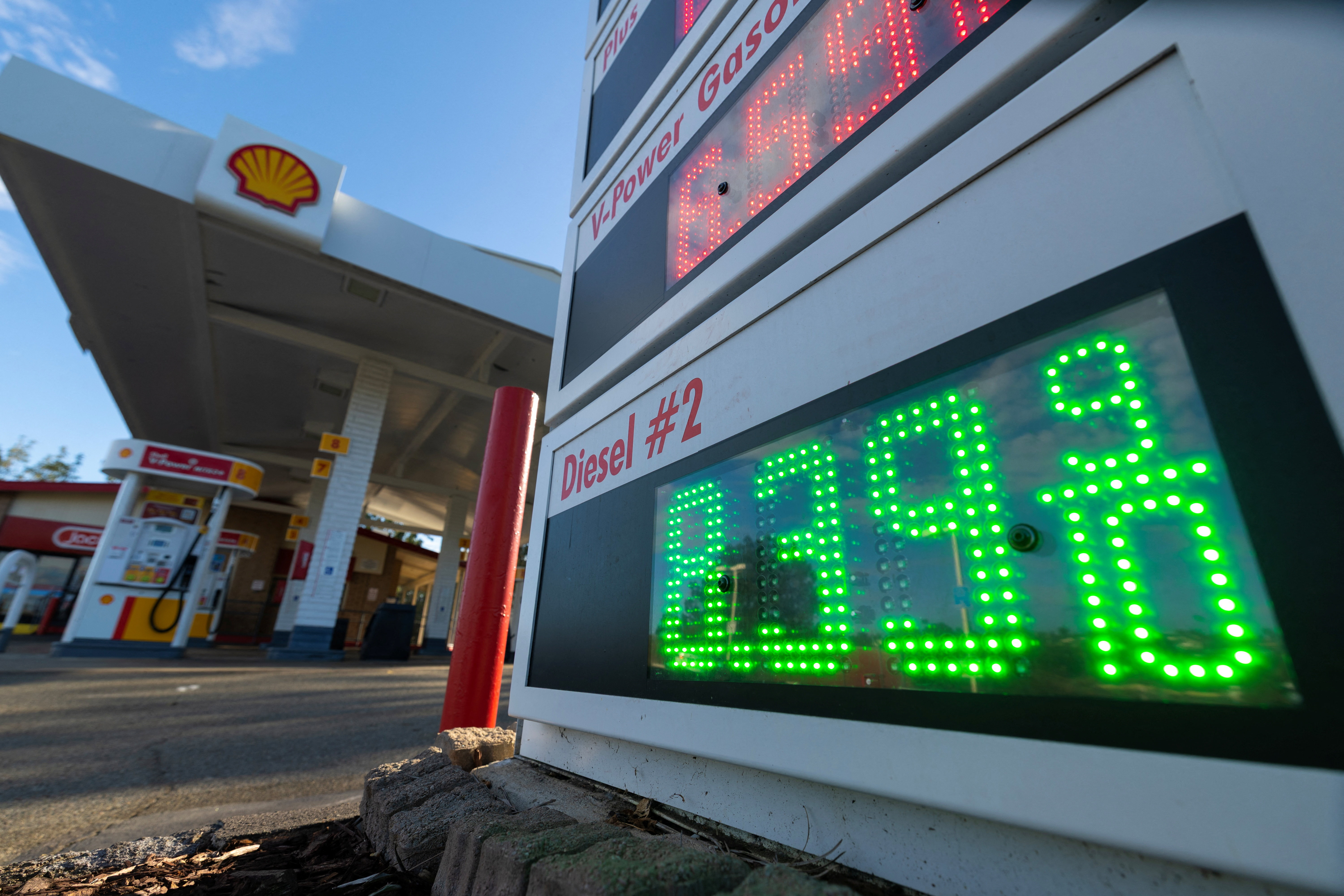 The current price of diesel fuel is displayed at a gas station in Encinitas, California, on Oct. 21, 2026. (Mike Blake/Reuters)
Ukraine paused refinery strikes at Trump’s request, but Russia kept hitting Ukraine’s energy infrastructure, prompting Kyiv to resume its own counterattacks, Zelenskyy told the Financial Times on Oct. 15.
“We’re done,” he said.
Within days of Trump’s sanction announcement, Ukrainian officials accused Washington of pressuring Kyiv to capitulate by withholding missile warnings and throttling the military’s essential Starlink connectivity, intelligence that Zelenskyy said “helps save people’s lives.”
Trump denied any interruption in missile warnings or Starlink service, but Ukrainian officials have stood by their account, prompting Zelenskyy to say he felt betrayed by the U.S.
Both have since been restored, Zelenskyy said Saturday, but Russia’s attacks have not let up.
Russia fired 16 ballistic missiles and more than 280 drones at Ukraine overnight Monday into Tuesday, targeting “energy, logistics and ordinary urban infrastructure” almost everywhere, Zelenskyy said.
The barrage came as the U.N. Independent International Commission of Inquiry on Ukraine concluded that Russian authorities had committed war crimes and crimes against humanity through attacks on Ukraine’s energy infrastructure.
U.S. President Donald Trump eased restrictions on Russian diesel exports, leading to rising diesel prices in the U.S. and benefiting Russia economically. Ukrainian President Zelenskyy criticized Trump's claims about the causes of price increases, asserting that the situation undermines Ukraine's leverage against Russia. Experts warn that the deal disproportionately benefits Moscow while providing minimal relief to U.S. consumers and could impact Ukraine's military efforts.
- U.S. diesel prices rose due to increased Russian crude exports.
- Trump's easing of restrictions on Russian diesel is seen as benefiting Moscow more than U.S. consumers.
- Ukraine's President Zelenskyy criticized Trump's claims regarding the cause of diesel price increases.
- The International Energy Agency stated that easing Russia's diesel export ban won't significantly change global supplies.
- Critics warn that the deal will provide Russia with financial resources to continue its military operations against Ukraine.