
Turkey Hosts 32 NATO Leaders and Demands Europe Listen
 Alexandra Reeves
Turkey Hosts 32 NATO Leaders and Demands Europe Listen
Turkey is trying to turn a NATO summit into something more useful than another family photograph.
That is the real point of Turkish Defence Minister Yasar Guler's interview with Reuters, published by SRN News on June 30. Ahead of the July 7-8 Ankara summit, Guler said the United States has "no intention of withdrawing" from NATO and that the alliance is not in crisis, but adjusting to a changed security environment. That is the polite version. The less polite version is that NATO is trying to work out how to keep American deterrence, make Europeans spend more, support Ukraine, manage the Gulf, and stop treating Turkey as a useful outsider.
Ankara will host 32 NATO leaders, plus officials from the Gulf and the Asia-Pacific. That guest list matters. This summit is not just about Russia on the eastern flank. It is about whether NATO can become a more global defence-industrial network without losing the basic military bargain that made it work in Europe.
Turkey Is Saying the Quiet Part Clearly
Guler framed Washington's pressure as burden shifting, not abandonment. According to Reuters, he said the United States wants European allies and Canada to assume more responsibility for European security, while preserving the transatlantic bond. That is a reasonable reading of the moment. It is also exactly the message Ankara wants NATO capitals to hear.
President Donald Trump has threatened to pull the United States out of the alliance. Washington has also moved to withdraw troops, aircraft, ships and weapons from Europe, with disputes over burden-sharing, defence spending and allied involvement around the Strait of Hormuz adding fuel. But the American position is not simply isolationism. It is conditionality. Europe can still have the American nuclear umbrella and high-end enablers, but it is expected to buy more of the house around them.
Turkey sees the opening. It has NATO's second-largest army, a growing drone and defence electronics sector, and a geography that touches the Black Sea, the Caucasus, Syria, Iraq and the eastern Mediterranean. Yet it remains excluded from many European defence initiatives because of political disputes with the EU and long-running mistrust over Ankara's regional behaviour.
Guler called that exclusion "strategically inaccurate." He is not wrong.
The European Pillar Has a Turkey Problem
NATO's official deterrence language is blunt: Russia is the most significant and direct threat to allied security, and the alliance faces the most dangerous security environment since the end of the Cold War. At the 2025 Hague summit, allies committed to invest 5 percent of GDP annually on defence by 2035, including 3.5 percent on core military requirements and 1.5 percent on defence-related spending.
Those numbers sound huge until you ask what Europe is actually short of. Air defence. Long-range fires. Ammunition. Drones. Counter-drone systems. Naval mass. Cyber resilience. Industrial surge capacity. Those are not abstract categories for Turkey. They are exactly the areas Guler listed as Ankara's priorities: drones, anti-drone systems, air and missile defence, naval projects, unmanned systems and cyber capabilities.
This is why the Ankara summit is more interesting than the usual NATO communique exercise. Turkey is not asking to be loved. It is asking to be treated as a capability provider.
The image problem is obvious. Many European governments do not trust Ankara politically. They worry about democratic backsliding, Turkish disputes with Greece and Cyprus, Ankara's balancing act with Russia, and its willingness to use NATO procedures for leverage. Those concerns are real. But the capability problem is just as real. A European defence architecture that excludes Turkey while asking how to build mass, drones and air defence at speed is choosing comfort over capacity.
Air Defence Is the Hard Test
Guler's comments on missile defence were the most revealing part of the interview. Turkey lacks a fully mature national missile defence shield and still relies heavily on NATO systems and fighter aircraft. Its planned "Steel Dome" integrated air defence system is meant to close that gap, but Guler said Ankara is still evaluating all options, including U.S. Patriot systems and Franco-Italian SAMP/T systems.
That single sentence carries a decade of NATO baggage. Turkey bought Russia's S-400 system, was ejected from the F-35 programme, and has been trying ever since to rebuild the air-defence relationship with the West without admitting strategic error. The SAMP/T and Patriot references show where Ankara wants the conversation to go next: technology sharing, joint production and sustainable cooperation inside the alliance.
Everyone in Washington and Brussels likes to talk about interoperability. Turkey is asking whether interoperability includes production rights, supply-chain access and political respect, or whether it only means buying expensive systems on other people's terms.
That is not just a Turkish complaint. Poland, Romania, Germany and Ukraine are all learning that air defence is not a catalogue purchase. It is a political-industrial ecosystem. Missiles run out. Radars need integration. Command networks need trust. Production lines matter as much as launchers.
Ukraine Is the Benchmark
The Ukraine question sits underneath all of this. Reuters reported that one of Guler's stated summit priorities is boosting support for Kyiv. NATO's own Ukraine materials emphasise interoperability, advisory support and practical assistance. But Ukraine has also become the alliance's harshest procurement test. Weapons that cannot be produced at scale, adapted quickly, or sustained under missile and drone pressure are not strategic assets. They are boutique systems.
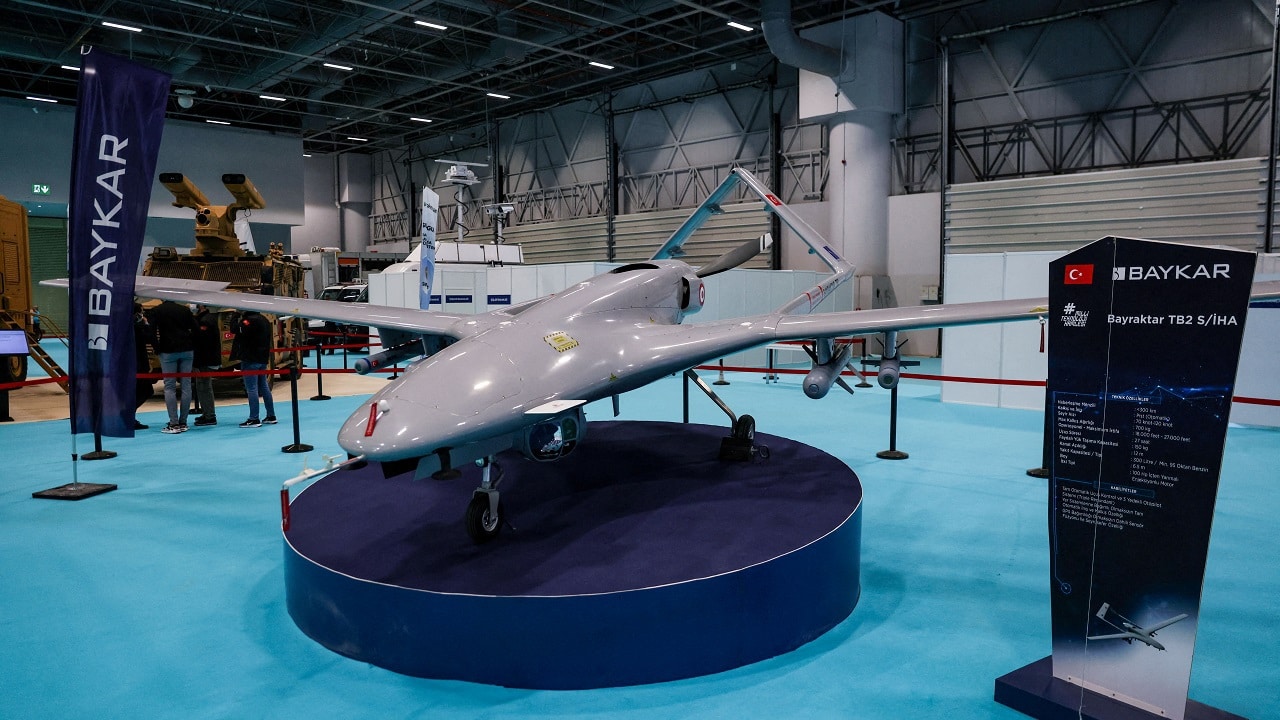
Turkey understands that better than some larger European economies. Baykar's TB2 became famous early in the war, then less decisive as Russian air defences adapted. That evolution is a useful warning. Drone success is not permanent. It depends on iteration, electronic warfare, production volume and the ability to replace losses quickly. Ankara's defence industry has built a business model around those lessons.
Europe's mistake would be to treat Turkey as a diplomatic inconvenience while quietly borrowing Turkish answers to the drone war.
Ankara Will Test NATO's Honesty
The easy headline from Guler's interview is that the United States is not leaving NATO. The better headline is that staying is no longer the same thing as carrying.
If Ankara produces another declaration about unity, defence spending and Ukraine, little will change. If it produces a concrete roadmap for a stronger European pillar that actually includes Turkey, it may mark a more serious shift. That would not erase the political problems Ankara brings into the alliance. It would simply admit that NATO cannot build a harder defence posture with only the allies it finds easy to like.
The next thing to watch is whether European defence initiatives open real industrial doors to Turkish firms, especially in drones, counter-drone systems and air defence. The second thing is whether Patriot or SAMP/T talks move beyond occasional technical discussions. The third is whether Ukraine support becomes a procurement machine rather than another pledge line.
Guler is right that this is not quite a NATO crisis. It is more uncomfortable than that. It is a test of whether the alliance can tell the difference between political neatness and military power.
Turkey is hosting 32 NATO leaders in Ankara on July 7-8 to discuss European security responsibilities. Turkish Defence Minister Yasar Guler emphasized the need for European allies to assume more security roles while maintaining the transatlantic bond. The summit aims to address NATO's global defense strategy and Turkey's military capabilities, including air defense and missile systems, amidst ongoing political concerns regarding Turkey's role in the alliance.
- Turkey is hosting 32 NATO leaders for a summit in Ankara on July 7-8.
- Turkish Defence Minister Yasar Guler emphasized the need for European allies to take more responsibility for security.
- Turkey's military capabilities include the second-largest army in NATO and a growing defense industry.
- The summit aims to address NATO's global defense strategy and Turkey's exclusion from European defense initiatives.
- Guler highlighted the importance of air defense and missile systems in NATO's future strategy.