
Turkey tests TAYFUN Block-3 against a moving maritime target in 2026 and changes calculations in the Eastern Mediterranean.
 Ahmed Al-Rashid
Turkey Tests TAYFUN Block-3 Against a Moving Naval Target in 2026, Changing Eastern Mediterranean Calculations
On July 4, 2026, the Turkish news was not just another missile test on the Black Sea coast. Roketsan tested the TAYFUN Block-3 missile with live ammunition against an unmanned surface vessel moving freely, approximately 7 meters long, and hit it in the terminal phase at hypersonic speed, according to a Defense Blog report. Militarily, this is the point where the ballistic missile transforms from a tool for striking fixed coordinates to a tool for threatening a ship that alters its course and speed at sea.
Any military personnel who has served in the region knows that the difference between hitting a fixed depot and hitting a moving ship is not an engineering detail. The ship does not wait for the missile in the same spot. Therefore, the terminal seeker and the linking of sensing to guidance in the final moments of flight become the essence of the matter. If the Turkish narrative about integrating a local seeker on a ballistic missile capable of correcting its path towards a moving naval target is true, then Ankara enters a narrow club, of which China was a prominent member with the DF-21D.
What Did Roketsan Actually Test
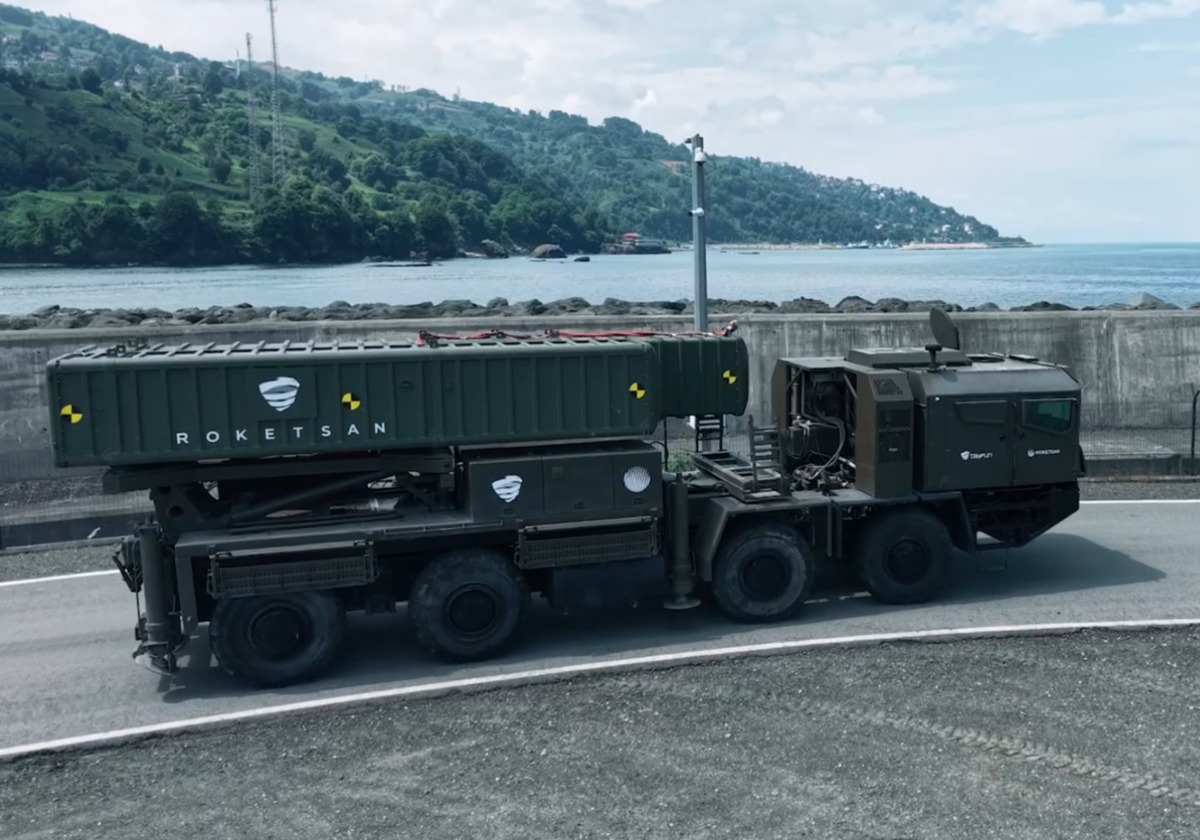
The basic version of the TAYFUN is approximately 6.5 meters long and weighs about 2,300 kilograms, using a guidance system that Roketsan calls GOLIS with in-flight corrections to achieve a declared circular error of less than 10 meters. These are important figures, but they pertain to a fixed target. Block-3 adds another layer: the ability to see the naval target in the terminal phase and track it. Here, the missile becomes an Anti-Ship Ballistic Missile rather than just a long-range surface-to-surface missile.
The test did not hit a destroyer or frigate, but a small boat simulating a limited-sized naval target. However, the choice of a 7-meter target is not without significance; it is much smaller than a warship and harder to distinguish if the sea is not ideal. Of course, we do not know from the Turkish announcement the conditions of jamming, the state of the sea, the exact launch distance, or the type of external tracking system. These details are what separate a successful demonstration from a mature weapon in warfare. Nevertheless, the transition of TAYFUN from hitting a point on the map to hitting a moving body raises the level of risk for any naval force operating near Turkish shores.
From Bora to TAYFUN and then Block-4
The TAYFUN family emerged from a Turkish industrial environment that has accumulated experience on the Bora, TRG, ATMACA, and ÇAKIR systems. Roketsan's official website today showcases a wide range of land, sea, and air missiles, from the ATMACA anti-ship missile to the UAV-230 air-launched ballistic missile, indicating that Turkey is no longer operating on a single track but is building a family of integrated strike capabilities. This is a point that many Arab observers overlook when they focus solely on Turkish drones.
In July 2025, Roketsan unveiled the larger TAYFUN Block-4, measuring nearly 10 meters in length and weighing around 7,200 kilograms, with ambitions for speeds exceeding Mach 5 and expected production in 2026 after testing. In June 2026, Turkish reports confirmed that the special forces command received another batch of TAYFUN Block-2. The practical meaning is that Block-3 is not a separate project in the lab, but a link in a chain of production, delivery, and development. Armies do not fear the prototype alone; they fear when they see industry, munitions, vehicles, and military acceptance moving together.
The Eastern Mediterranean Becomes More Constricted
The first to read this test with concern will not be in the Gulf but in Athens, Nicosia, and Tel Aviv. The Turkish-Greek dispute over islands and economic waters did not need a new layer of pressure, but a ground missile capable of threatening a moving ship changes the way naval deployment is calculated. The frigate that relied on staying away from the coast or maneuvering against relatively slow cruise missiles will find itself facing a ballistic trajectory that is faster and has a shorter response time.
This does not mean that aircraft carriers or destroyers will become helpless at the push of a Turkish button. Modern naval defense has long-range radars, intercept missiles, electronic warfare capabilities, and the ability to strike launch platforms. However, the cost of operating near the coast is rising. In military language, deterrence does not always require guaranteed hits; it is enough to make the naval commander think twice about every nautical mile.
Why This Development Matters to the Gulf
The TAYFUN may seem like a Turkish-Greek issue, but Gulf countries will view it from two angles. The first is commercial: Turkey has been positioning itself for years as a partial alternative to the American and European markets, offering products quickly and with less complicated political terms. If Ankara can present an anti-ship ballistic missile as part of an export package or limited industrial cooperation, it will find ears in countries that want maritime deterrent tools around the Strait of Hormuz, the Red Sea, and the Arabian Sea.
The second angle is more sensitive. Iran has built a significant part of its maritime deterrence on coastal missiles, fast boats, and drones. Gulf countries have purchased expensive ships and air defenses, but they have not always built a flexible coastal fire system that imposes costs on the adversary. If Turkey enters the market for this type of weaponry, it may entice Gulf capitals with the idea of having a rapid response against ships without building a heavy navy. Here, we must remember our old military adage: a weapon that does not fit into doctrine does not enter the battle.
The Triangle of Capability is Ruthless
The TAYFUN test reminds us of the triangle of capability: equipment, training, and organization. Turkey has made clear progress in the equipment side and has a defense institution that knows how to link testing with production and export. However, transforming ASBM into actual war capability requires a continuous maritime detection network, surveillance aircraft or drones, coastal radars, satellites, or allied intelligence, and then command and control that can withstand jamming and pressure. Without this network, the missile remains powerful on paper but limited at sea.
Arab countries that may look at TAYFUN or similar systems should ask the hard question before the financial one. Do we have an accurate and continuous maritime picture? Can we relay data on a moving target to a launch platform in minutes? Do we have rules of engagement that prevent political error if the target is close to a civilian ship? These questions are not bureaucratic; they are the difference between deterrence and a catastrophic incident.
Conclusion
The TAYFUN Block-3 test does not make Turkey the new China at sea, but it confirms that Ankara is moving towards a local maritime denial capability that does not rely solely on ships or aircraft. For the Eastern Mediterranean, this is new pressure on Greece, Cyprus, and Israel. And for the Gulf, it is more of a lesson than a purchase offer: a smart missile does not compensate for a foolish organization. The structural tension will remain as it is in our region, between the desire of states to quickly acquire deterrence and the reality that true deterrence is not sold in a single box.
Turkey tested the TAYFUN Block-3 missile against a moving maritime target on July 4, 2026, in the Black Sea. The missile successfully struck a 7-meter unmanned vessel, demonstrating its capability to engage moving targets. This advancement positions Turkey to enhance its maritime strike capabilities, impacting regional military dynamics.
- Turkey tested the TAYFUN Block-3 missile on July 4, 2026.
- The missile successfully hit a 7-meter unmanned surface vessel.
- The TAYFUN Block-3 is designed to target moving maritime threats.
- Roketsan is developing a family of integrated strike systems.
- The test indicates a shift in Turkey's military capabilities in the Eastern Mediterranean.