
Turkey's Test of the Typhoon Block 3 Missile with an 800 km Range Pressures Israel in 2026
 Ahmed Al-Rashid
Turkey's Test of the Typhoon Block 3 Missile with a Range of 800 km Pressures Israel in 2026
On July 4, 2026, Turkey struck a small maritime target measuring no more than seven meters in length with the Typhoon Block 3 A missile, according to a report published by Euro-SD regarding Israeli concerns over the development of Turkish missiles. The most important figure is not just the length of the target, but that the missile is designed to hit a moving maritime target at a distance estimated between 560 and 800 km, which connects the Turkish coast to the Eastern Mediterranean and the coasts of Syria and Cyprus, as well as the approach corridors to Israel.
From a military perspective, the test should not be read as merely a showcase for a new missile. The anti-ship ballistic missile is not a projectile that is launched and then left to its fate. It is the result of a complete network that includes coastal radars, drones, maritime platforms, electronic warfare, data links, and a command center capable of making a launch decision in a short time. This is where the problem begins for Israel, and this is also where the difference between possessing the metal and possessing the capability becomes apparent.
The Missile is Not Alone in the Battle
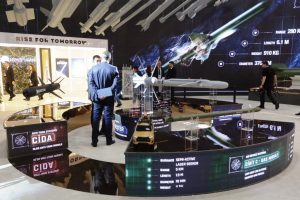
Published data indicates that the Typhoon Block 3 A is an extension of the Block 2 version that entered serial production at ROKETSAN in 2023. Estimates suggest a warhead weight between 250 and 500 kg, and an active radar seeker derived from the ATMACA naval family, with the ability to maneuver during re-entry into the atmosphere. These are significant numbers, but they are not enough on their own to close the sea to the adversary.
Any military personnel who has served in the region knows that the sea does not reward only those who possess the farthest weapon. The maritime target moves, deceives, sometimes turns off its signals, and enters under the cover of jamming or air defense. For the Typhoon Block 3 to transition from an industrial novelty to a deterrent capability, Ankara needs continuous maritime surveillance, the ability to update the missile's trajectory during flight, and damage assessment after the strike. This is the real kill chain, and the weakest link in it could render the expensive missile merely a political message.
Why Israel is Concerned Now
Israeli concern does not mean that Turkey has become a new Iran. The comparison with Iran is misleading, as the Iranian threat is based on the density of missiles, drones, and extended proxy networks. The Turkish challenge is different. Turkey is a NATO member state, has a rapidly advancing defense industry, and possesses a geographical position that allows it to influence Syria, the Eastern Mediterranean, and the Black Sea simultaneously. This is a political and military mix that is not addressed in the same way that Israel deals with a direct Iranian threat.
In recent weeks, the rhetoric between Ankara and Tel Aviv regarding Syria and Lebanon has intensified. President Recep Tayyip Erdogan stated that Israeli strikes in these two countries also affect Turkey's security, while Israeli circles believe that the Turkish presence in northern Syria could become an operational barrier to Israeli air and intelligence freedom of movement. When a maritime missile with a range of 800 km enters this equation, the dispute is no longer just diplomatic talk.
The Eastern Mediterranean is politically narrow even if it appears wide on the map. A reconnaissance ship, a gas platform, an airbase in Cyprus, or a maritime supply corridor can become part of the pressure equation. The Typhoon Block 3 does not need to sink a fleet to change the calculations. It is enough to force the adversary to increase security, expand warning areas, and allocate ISR aircraft and maritime defenses to routes that were previously less sensitive.
The Hidden Gulf Lesson
The issue may seem Turkish-Israeli, but it concerns the Gulf more than some officers in closed councils admit. Gulf states have purchased Patriot and THAAD systems and advanced aircraft, but they still sometimes treat missile defense as if it were a catalog of purchases. The experience of the Typhoon Block 3 reminds us that precision missiles are not only born in factories but also in a system of command, control, intelligence, and repeated training.
If a Gulf state were to possess a similar missile tomorrow, it would not automatically have maritime deterrence. It needs maritime patrol aircraft, long-range satellites or drones, secure data links, clear rules of engagement, and officers who know when not to press the button. This last statement is not favored by defense ministries in the region, but it is the essence of the matter. A weapon that does not integrate into a system of training, maneuvering, and accountability remains more expensive than its military value.
On the other hand, Turkey presents a model that disturbs Gulf capitals. It is not just buying; it is building interconnected weapon families from ATMACA to UAV-230 to Typhoon. Not all of these programs are fully mature, and some of their figures still require independent verification, but the trend is clear. The Turkish industry is trying to produce local operational options, while many Arab armies are still waiting for external suppliers' approval for ammunition, upgrades, and technical support.
Deterrence Calculations in the Eastern Mediterranean
For Israel, a direct military response to this development will not be to buy a missile for a missile. The likely response is to expand maritime and aerial surveillance, increase focus on electronic warfare against data links, and connect maritime defenses to air warning systems. If the Typhoon Block 3 requires a network to hit, then disrupting that network may be cheaper than intercepting the missile itself.
This opens an unannounced race in the electromagnetic domain. Turkey needs to see the target and update its trajectory, and Israel will seek to blind that vision or delay it. Here, investing in Ellyon and LITENING 5 and jamming and electronic intelligence tools becomes part of the response to a Turkish missile, even if no one mentions it in corporate statements. Modern warfare does not begin at launch but at the first signal detected by the sensor.
The old adage says that the sea conceals weakness as much as it reveals strength. The Typhoon Block 3 reveals Turkey's ambition, but it will also reveal the quality of its maritime network if a real crisis approaches.
Conclusion
The July 2026 test does not make Turkey a naval power capable of closing the Eastern Mediterranean, nor does it render Israel helpless against a single missile. However, it shifts the competition from the level of political discourse to the level of a maritime kill chain that transcends domains. This is more dangerous than just an 800 km range, as it affects freedom of movement, not just the number of ships.
In my opinion, the deeper message for Arabs is not to applaud a Turkish success or worry about a new missile. The message is that military capability is not measured by the shiny piece in the exhibition but by the ability to connect it to the sensor, the officer, the law, and the exercise. Here lies the gap that cannot be filled by budget alone. And as the old military saying goes, the sword in the hand of one who does not train with it is a burden before it is a strength.
Turkey tested the Typhoon Block 3 missile on July 4, 2026, successfully hitting a small maritime target. The missile, with a range of 800 km, poses a potential threat to Israel, as it can target moving vessels in the Eastern Mediterranean. This development raises concerns for Israel regarding Turkey's growing military capabilities and its implications for regional security.
- Turkey tested the Typhoon Block 3 missile on July 4, 2026.
- The missile has a range of 800 km and can hit moving maritime targets.
- Israel is concerned about the implications of this missile for its security.
- The Typhoon Block 3 is an extension of the Block 2 version produced by ROKETSAN.
- Turkey's military capabilities are advancing rapidly, affecting regional dynamics.