
Turkish KAAN Aircraft with Saudi Flag at Riyadh Exhibition — Are Riyadh and Ankara Creating an Alternative to Western Weapons or Paying the Price of Independence with Uncalculated Costs?
 Ahmed Al-Rashid
Turkish KAAN Aircraft with Saudi Flag at Riyadh Exhibition — Are Riyadh and Ankara Creating an Alternative to Western Arms or Paying the Price of Independence with Uncalculated Costs?
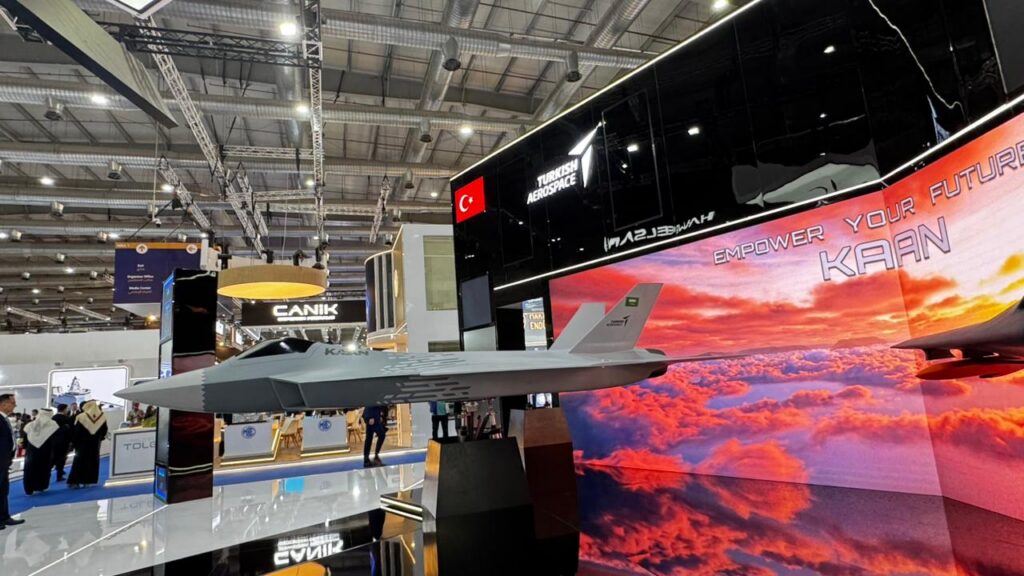
At the World Defense Show 2026 in Riyadh, the displayed model of the Turkish KAAN aircraft bore a Saudi flag on its tail. This was not just a marketing gimmick — it was a clear political message: Riyadh and Ankara are building something bigger than a mere arms deal.
On February 3, Turkish President Recep Tayyip Erdoğan visited Riyadh and met with Crown Prince Mohammed bin Salman. The defense industry was heavily represented in the outcomes of the summit. On the return flight, Erdoğan stated that the defense agreements are "major" and that the joint investment in the KAAN program could advance "at any moment."
What Riyadh and Ankara Signed in Ten Days
During ten days in February 2026, Turkey and Saudi Arabia signed a series of high-level defense industrial agreements covering three axes:
- KAAN Fifth-Generation Fighter Program: Turkish Aerospace Industries (TAI) is in the "final stages" of negotiations with the Saudi side
- Multi-Purpose Helicopter: Joint production cooperation
- Unmanned Maritime Platforms: Joint development of maritime capabilities
At the exhibition, Mohammed Demiroğlu, the general manager of Turkish Aerospace, announced that the negotiations include "everything" — timelines, benefits, costs, and feasibility studies. The proposed scenarios range from purchasing 20 aircraft ("a small squadron") to establishing a final assembly line in the Kingdom requiring 50 aircraft or more, or participating in the development of a future sixth-generation fighter.
The Military Calculation: What is Saudi Arabia Actually Buying?
Practically, Ankara understands before Riyadh that the KAAN has not yet completed its development path. The first prototype made its maiden flight in February 2024 — 13 minutes at an altitude of 8,000 feet. The second prototype has been delayed until April or May 2026. The first deliveries of serial production are not expected before 2029 at the earliest.
In my estimation, any military officer studying capability integration knows that this type of investment belongs more to industrial policy than to military procurement. Saudi Arabia needs to update its aircraft now — its fleet of F-15S/SA and Typhoon is aging, and the capability gap with Iran and Israel increases every year.
Turkey, for its part, needs a funding partner to reduce the high costs of the program. Indonesia signed a deal for 48 aircraft worth over $10 billion, including joint production. Saudi Arabia is capable of funding much more than that — and that is exactly what TAI wants.
"The Middle Block" — A Geopolitical Bet or a Strategic Illusion?
Western analysts describe what is forming between Ankara and Riyadh as the "middle block": a third channel for arms between Western suppliers (the United States, Britain, France) and Eastern ones (Russia, China). The KAAN project with Saudi participation, along with maritime platforms and drones, creates a production system that can be exported to countries rejected by Washington or Moscow.
The geopolitical logic is clear. What concerns me is something else.
I wrote days ago about the unsolvable Gulf equation: the Gulf refuses to allow strikes from its territory against Iran, yet it hosts American bases that would be subject to retaliation if an attack occurs. Now we add a new layer: Saudi Arabia relies on the American military umbrella (the aircraft carriers Abraham Lincoln and Gerald Ford are heading to the region as we speak), while simultaneously signing defense memorandums with Turkey, a NATO member that was expelled from the F-35 program.
"Militarily, true independence is not having a production line — it is the ability to use what you produce without external permission."
The 50% Requirement and the Pressure of Vision 2030
Saudi Vision 2030 requires 50% localization of defense production by 2030. Five years remain. Demiroğlu himself described the goal as "ambitious" — a diplomatic way of saying it is nearly impossible within the specified timeframe.
At the WDS 2026 exhibition, Emirati companies left the exhibition due to Saudi-Emirati tensions. At the same time, Saudi Arabia is injecting $88 billion into defense contracts. This is not an indicator of structural strength — it is an indicator of the wealth of oil states translating into massive defense numbers with an institutional structure that does not match.
KAAN is surrounded by a Saudi flag at the Riyadh exhibition. This scene summarizes the structural contradiction experienced by the Gulf: buying independence from the West, then buying independence from the West, while relying on the West to protect the ability to purchase.
What Does This Really Mean?
If the Saudi-Turkish KAAN deal is finalized in 2026, it will have real symbolic significance and delayed practical importance. The aircraft will not be delivered before 2031-2033 at best. In the meantime, Riyadh will continue to rely on Western systems for any actual combat readiness.
Ankara gains funding and momentum for the program. Riyadh gains a political message to Washington: "We have other options." But the structural contradiction cannot be resolved with an aircraft model and a memorandum of understanding. It is resolved by building defense institutions — something the Gulf states have not succeeded in achieving so far.
Turkey and Saudi Arabia signed multiple defense agreements in February 2026, focusing on the joint development of the KAAN fighter jet and other military platforms. The agreements signal a strategic partnership aimed at reducing reliance on Western military supplies. The KAAN jet is still under development, with first deliveries not expected before 2029, while Saudi Arabia aims for 50% localization of defense production by 2030.
- Turkey and Saudi Arabia signed multiple high-level defense agreements in February 2026.
- The KAAN fighter jet is in the final stages of negotiations for joint production.
- Saudi Arabia aims for 50% localization of defense production by 2030.
- The first deliveries of the KAAN are not expected before 2029.
- Turkey seeks funding from Saudi Arabia to reduce high program costs.