
Two Iranian Drones Near Bahrain and Houthi Threats to Saudi Arabia Test Gulf Defenses in 2026
 Ahmed Al-Rashid
Two Iranian Drones Near Bahrain and Houthi Threats to Saudi Arabia Test Gulf Defenses in 2026
On November 13, 2026, U.S. forces intercepted two Iranian attack drones heading towards Bahrain, while the Houthis announced the launch of two ballistic missiles towards Saudi forces in the Al-Tawal area of Jazan on the same day. Hours later, the Iranian Revolutionary Guard spoke of the explosion of two tankers after they collided with naval mines in the Strait of Hormuz. These may seem like separate incidents, but they actually paint a single picture of the current Gulf problem: the adversary does not need to completely close the waterways to raise the costs of defense, transport, and insurance to a political level.
Three Warnings in One Day
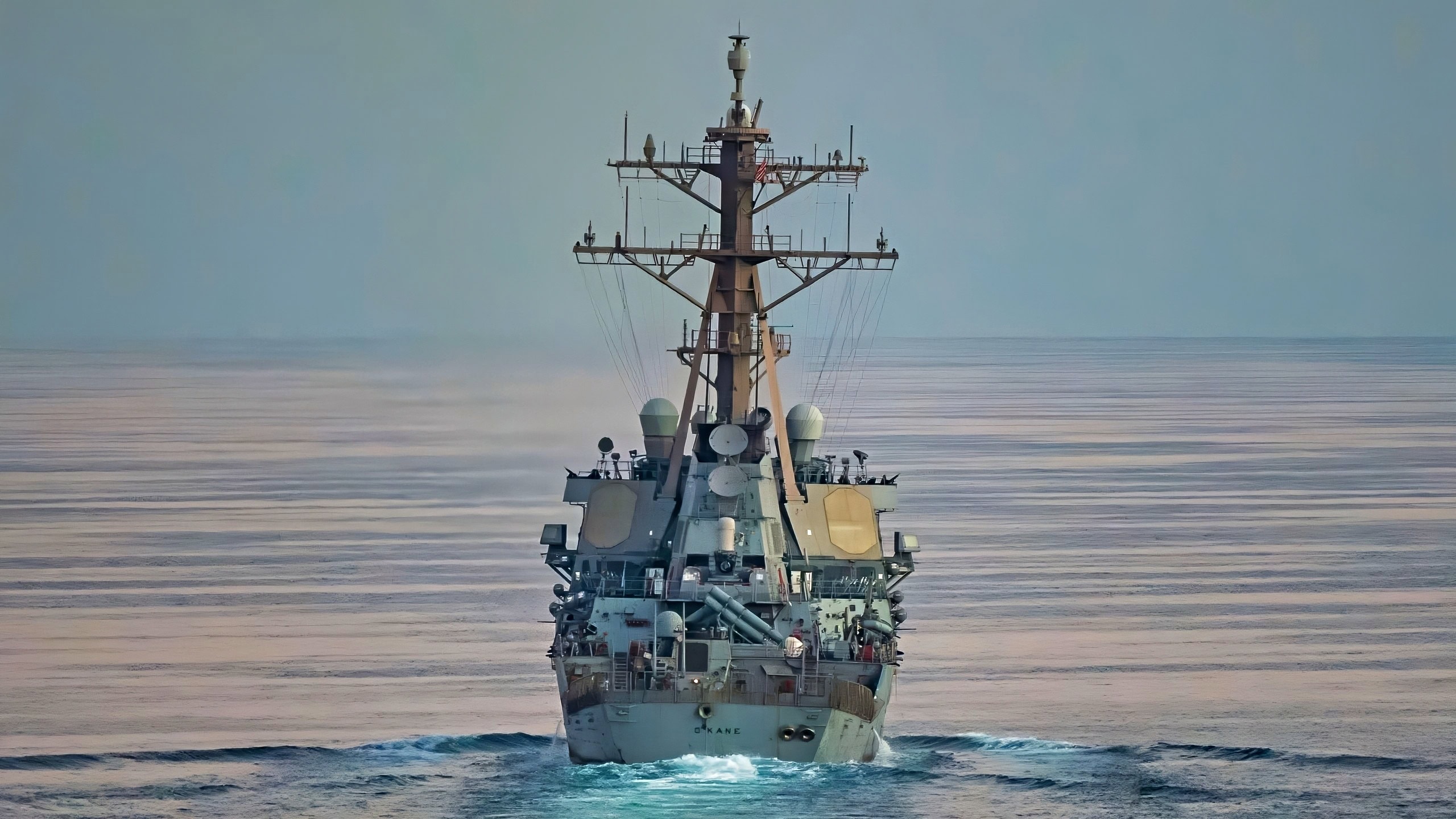
The U.S. Central Command confirmed that the interception of the drones near Bahrain did not cause any injuries or damage, while Tehran claimed that the Revolutionary Guard destroyed an American early warning radar. Washington did not confirm the radar story, but the difference between the two statements is militarily significant. Iran does not need to prove it hit an American facility as much as it needs to show that it can approach the network of bases spread around the Gulf and force them to activate their radars, patrols, and interceptions in all directions.
As for the Houthi claims regarding targeting King Khalid International Airport and a pumping station on the East-West pipeline, Saudi authorities have not confirmed them yet. What is certain is the group's announcement of targeting Saudi forces with two ballistic missiles. Practically, these claims are sufficient, even before being fully verified, to impose additional security measures, disrupt flights, and increase the caution of shipping companies. In modern warfare, the impact is not only measured by the number of destroyed targets but also by the number of hours the system is forced to operate under alert.
Hormuz, Bab al-Mandab, and the Saudi Pipeline
The importance of these developments becomes clear when placed on the energy map. Sources quoted by Gulf News stated that the East-West pipeline can transport about four million barrels of oil daily to Yanbu, bypassing the Strait of Hormuz. Therefore, threatening the station or ports on the Red Sea does not equate to a local economic strike; it is an attempt to hit the alternative that Riyadh has built to reduce its dependence on Hormuz. On the other hand, Bab al-Mandab remains a complementary artery linking the Red Sea to the Gulf of Aden, and the Houthis can pressure it without possessing a conventional fleet.
The Revolutionary Guard's navy stated that two tankers caught fire after colliding with naval mines while crossing Hormuz, and this account has not been independently verified. However, even the unresolved incident has a strategic impact. The International Maritime Organization reported about 134 security incidents in the Middle East since February, resulting in the deaths of 25 crew members. When insurance companies can no longer distinguish between a confirmed attack and a mysterious incident, the ambiguity itself becomes a weapon.
The Gulf Problem Is Not a Lack of Missiles
Look at these developments through the unchanging triangle of capability, regardless of the names of the systems: equipment, training, and institutions. Gulf states possess advanced radars, fighter jets, and air defense batteries, and the U.S. fleet provides a warning and interception umbrella that no Gulf state can replace alone. The interception of two drones is evidence that the equipment is functioning. However, it is not evidence of an independent capability to manage a multi-front battle extending from Bahrain to Jazan, Hormuz, and Bab al-Mandab simultaneously.
The more challenging problem is integrating information and decision-making. Who has the picture of the air and maritime space? Who decides to fire when the drone is low and slow? How do Bahrain, Saudi Arabia, the UAE, and the United States share warning data without each country turning into a separate operations room? These are institutional questions, and a new deal or military display does not answer them. A military officer who has served in the region knows that purchasing the system is much easier than building joint working procedures and personnel capable of operating it day and night.
U.S. Deterrence Between De-escalation and Dependence
On the same day, Reuters reported that U.S. President Donald Trump might postpone strikes against Iran if no new provocations occur, and quoted Secretary of State Marco Rubio as saying that additional military action is unnecessary and that economic pressure is weakening Tehran. This position sends a dual message to the Gulf. On one hand, the United States is still prepared to intercept threats and protect its forces. On the other hand, Washington wants to control the level of escalation and does not want to turn every attack or claim into a full-scale war.
For Riyadh, Abu Dhabi, and Manama, this means that reliance on U.S. protection provides valuable time but does not grant a permanent mandate to respond. While the multiple defensive alliances built by Gulf states may seem like a safety net, the network only works if the countries agree on the definition of an attack and the cost of a response. Otherwise, the systems become costly and technically excellent, but they await a political decision from outside the region.
The Real Test Began Before the First Missile Fell
The price of Brent crude fell to $95.84 on November 13 despite the risks, due to expectations of ample global supplies. This should not be interpreted as reassurance; markets can absorb a single incident, but they cannot easily absorb a recurring pattern of drones, mines, and threats to ports and pipelines. Additionally, the continued cancellation of some flights between Abu Dhabi, Riyadh, and Dammam until November 19 illustrates that the security impact reaches daily life before it appears in military loss data.
The most important lesson is not that the Gulf needs more missiles, but that air and naval defense must become a real regional capability, with joint training, announced rules of engagement, logistical stockpiles, and plans for continuing trade in the event of a partial closure of Hormuz or Bab al-Mandab. However, this leads to the contradiction that past purchases have not resolved: Gulf states want independence in decision-making, yet they still rely on the United States for warning, interception, and deterrence. As long as this dependence remains without building joint institutions, every cheap drone will be capable of exposing the cost of an expensive defense system.
Sources Gulf News and Reuters and reports from the International Maritime Organization referenced in the coverage.
On November 13, 2026, U.S. forces intercepted two Iranian drones near Bahrain while Houthi forces launched ballistic missiles at Saudi troops in Jazan. The Iranian Revolutionary Guard reported explosions of tankers in the Hormuz Strait, highlighting escalating tensions in the Gulf region. These incidents reflect ongoing military operations and threats impacting regional security.
- Two Iranian drones were intercepted by U.S. forces near Bahrain.
- Houthi forces launched ballistic missiles towards Saudi troops in Jazan.
- Iranian Revolutionary Guard reported explosions of tankers in the Hormuz Strait.
- The U.S. Central Command confirmed no casualties from the drone interceptions.
- Claims of Houthi missile targeting have not been verified by Saudi authorities.