
Ukraine confirms its jammed drone caused the Constanța port explosion

A Ukrainian naval drone lost control after Russian electronic warfare jammed its guidance system during a Black Sea mission, drifted into Romanian territorial waters, and detonated inside the civilian port of Constanța on Friday morning, the Ukrainian Navy confirmed.
The explosion, which shook windows across the city and triggered a mass evacuation of the coastline, produced no casualties but drew immediate responses from NATO allies, the European Union, and the Kremlin, each offering a different interpretation of who bears responsibility for what happened.
Ukraine’s Navy published a statement confirming that one of its unmanned surface vessels, an explosive-laden remote-controlled boat used for strikes against Russian naval targets in the Black Sea, lost control during operations in the Black Sea operational zone after Russian electronic warfare systems disrupted its navigation. The drone drifted toward the Romanian coast and entered the port of Constanța, where it was discovered at approximately 5:50 a.m. near berth 78, close to the headquarters of the Romanian Agency for Saving Human Life at Sea. The Ukrainian Navy stated that it provided the necessary information to Romanian naval forces promptly upon becoming aware of the situation, specifically to help prevent civilian casualties.
Ukrainian Foreign Ministry spokesperson Heorhii Tykhyi confirmed the sequence of events, stating that Ukraine’s Navy informed the Romanian side in a timely manner of a naval drone that had lost control because of Russian jamming, that both states’ relevant authorities had been in close touch, and that effective coordination allowed necessary measures to prevent harm to civilians.
“This incident shows once again that Russia’s ongoing full-scale aggression poses a threat not only to Ukraine, but to the entire region. Effective coordination is key to mitigate its consequences to neighbouring countries.” Tykhyi said.
Despite the advance notification, Romanian authorities were unable to neutralize the device before it detonated. Romania’s Deputy Interior Minister Raed Arafat acknowledged to reporters that awareness of the self-detonation risk came only minutes before the blast.
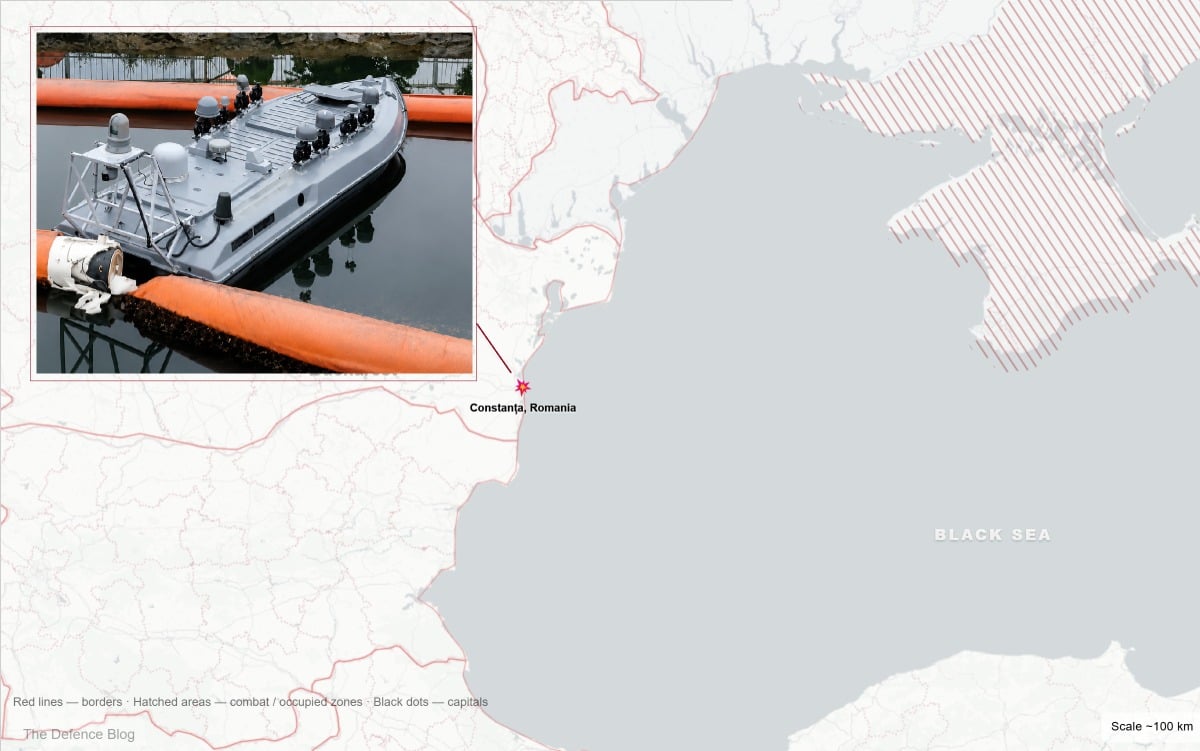
“At least at my level and at the level of the Ministry, I found out there was a risk of explosion a few minutes before it exploded. When I found out it was possible, we immediately began steps, and immediately the drone exploded,” Arafat said, crediting the prior evacuation of the immediate area for the absence of casualties.
Romanian President Nicusor Dan, responding publicly, described the incident as “the direct consequences of the war of aggression unleashed by Russia against Ukraine,” framing the detonation within the broader context of a conflict whose physical consequences have repeatedly spilled across Ukrainian borders into NATO member states. European Commission President Ursula von der Leyen expressed solidarity with Romania, stating that Russia’s war in Ukraine was “increasingly becoming a direct threat to countries on our Eastern border” and that “our solidarity with every Member State exposed to these threats is absolute.” Russia’s embassy in Romania denied that the drone was Russian, a position that Ukraine’s own admission rendered moot.
The electronic warfare dimension of the incident is significant and not without precedent. Ukraine has previously accused Russia of using electronic warfare systems to deliberately divert Ukrainian drones into NATO countries, arguing the tactic is designed to drive a wedge between Kyiv and its Western allies by creating exactly the kind of incident that occurred in Constanța on Friday. Whether this particular case involved deliberate Russian targeting of the drone’s navigation or was simply a byproduct of the dense electronic warfare environment that both sides maintain across the Black Sea operational zone remains a question that neither the criminal investigation opened by the Constanța Court of Appeal nor the ongoing military assessment has yet answered publicly.
Content preview only. Full article available at source. View Full Article
A Ukrainian naval drone lost control due to Russian electronic warfare and detonated in the civilian port of Constanța on Friday morning. The explosion, which caused no casualties, prompted immediate responses from NATO and the EU. Ukrainian officials confirmed the sequence of events and emphasized the need for effective coordination to prevent civilian harm. Romanian authorities acknowledged the risk of explosion only minutes before the blast, despite prior notifications.
- A Ukrainian naval drone lost control due to Russian electronic warfare.
- The drone detonated in the civilian port of Constanța.
- No casualties were reported due to prior evacuation measures.
- Romanian authorities were informed but could not neutralize the drone in time.
- The incident highlights the risks posed by Russian electronic warfare tactics.