
Ukraine Gets Stone Cloak as Britain Shares Drone War IP
 Alexandra Reeves
Ukraine Gets Stone Cloak as Britain Shares Drone War IP
Britain did something more useful than send Ukraine another exquisite weapon in a crate. It handed over the right to build one.
That is the real story behind Stone Cloak, the British-designed electronic jammer now moving from donation to Ukrainian mass production. According to the UK government announcement tied to President Volodymyr Zelenskyy's visit to Portsmouth on 27 July, London will share the intellectual property for Stone Cloak so Ukraine can produce the system itself. The device is roughly the size of a tablet computer and is designed to hinder Russian air defence systems from tracking and targeting the drones that carry it.
That sounds small because physically it is small. Strategically, it is not.
A Tablet-Sized Problem for Russian Air Defence
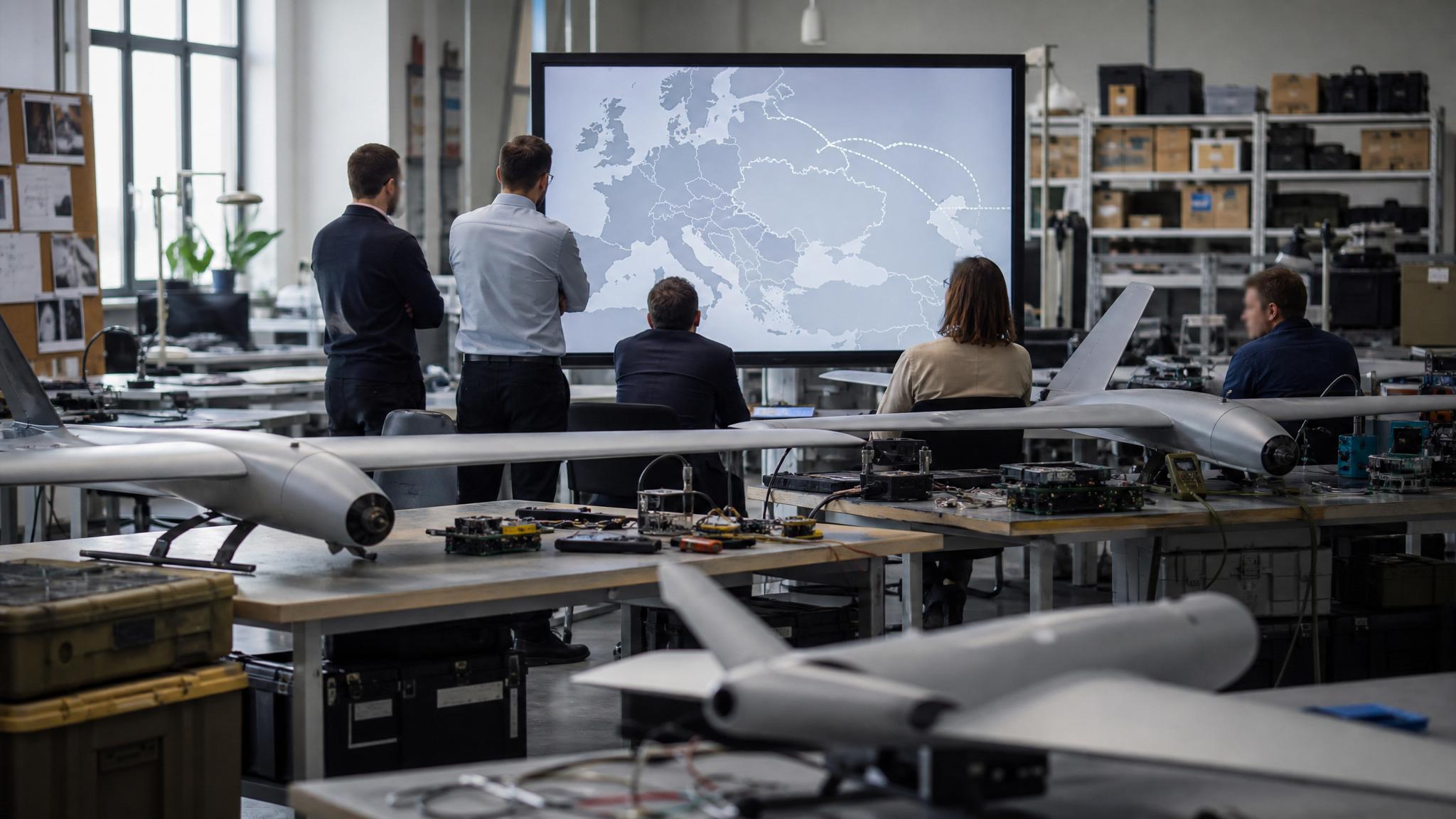
The UK says thousands of Stone Cloak jammers have already been gifted to Ukraine by the Ministry of Defence. The new step is different. Donations create dependency. IP transfer creates capacity.
Defense One reported on 29 July that Ukraine has already used British-built versions of Stone Cloak on long-range strike drones this year, and that the new agreement should let Ukrainian manufacturers scale the device across a much larger share of the drone force. Retired US Air Force officer Jeffrey Fischer told the outlet that, while full details remain undisclosed, the system will likely improve mission effectiveness against some Russian air defences.
That matters because Russia's defensive problem has changed. Moscow is no longer trying only to protect a handful of high-value sites in occupied Crimea or Belgorod. It is defending refineries, air bases, logistics hubs, rail nodes, command sites and industrial facilities across a huge depth of territory. Every additional Ukrainian drone that survives the approach forces Russia to spend more interceptors, move more radars, disperse more assets and accept more uncertainty.
Stone Cloak will not make Ukrainian drones invisible. Nothing in electronic warfare works that cleanly. But a low-cost jammer carried in large numbers can make Russian operators hesitate, misclassify tracks, lose lock at the wrong moment or waste interceptors on bad solutions. In a drone campaign built on saturation and attrition, that is enough.
The Shift From Missiles to Manufacturing
The obvious comparison is Storm Shadow. Britain gave Ukraine the air-launched cruise missile in 2023, and Kyiv used it to hit high-value Russian targets in occupied territory. It was a serious capability. It was also expensive, politically sensitive and limited by European supply chains. Defense One put the average cost around USD 2 million per missile.
Stone Cloak sits in a different category. It is not the strike weapon. It is the enabler that helps cheap strike platforms get through. That makes the economics more uncomfortable for Russia. A Storm Shadow launch asks whether Ukraine has enough missiles. A drone-jammer package asks whether Russia has enough layered air defence to cover everything worth hitting.
London seems to understand this. The UK announcement said Stone Cloak is expected to feed into the next generation of British deep-strike capabilities, including Project Brakestop, the UK's low-cost cruise missile effort. In plain English: Britain is not just helping Ukraine. Britain is using Ukraine's war to rebuild its own weapons development cycle.
That is not charity. It is overdue realism.
Ukraine Is Teaching NATO How Fast War Moves
The more interesting part of the Stone Cloak deal is not the hardware. It is the permission structure. NATO countries are comfortable donating finished kit. They are much less comfortable giving away design rights, production know-how and the messy industrial control that comes with them. Stone Cloak crosses that line.
It crosses it because Ukraine's adaptation cycle is now faster than the traditional defence procurement cycle by an absurd margin. Fischer told Defense One that Ukrainian battlefield lessons can be incorporated into new systems in less than 10 days. Anyone who has sat through a NATO capability planning meeting knows how embarrassing that sentence should be.
The Portsmouth context matters too. The UK government said more than 200 Ukrainian military personnel and sailors had been in Britain for three weeks for Exercise Sea Breeze, a maritime security and counter-mine exercise linked to future Black Sea missions. Defense One noted that Ukrainian, US and British sailors paid special attention this year to countering Russian air defences, citing Ukraine's national news agency.
That combination is the model: exercise, test, alter, produce, return to combat. It is not elegant. It is not how peacetime acquisition brochures describe innovation. It is how a country survives when the enemy is adapting every week.
Russia's Answer Gets More Expensive
For Russia, the operational headache is straightforward. If Ukraine can build Stone Cloak in volume, Russian air defence has to treat more incoming drones as more serious threats. That creates pressure in three places at once.
- First, Russian radars and command posts have to sort real tracks from distorted or degraded ones under time pressure.
- Second, short-range systems around oil, aviation and logistics targets will burn through missiles and gun ammunition faster.
- Third, Russian planners will have to spread electronic warfare and air defence assets across more of the rear, weakening density at the front.
None of this guarantees spectacular Ukrainian strikes. Russia has capable air defence crews, deep experience with electronic warfare and the advantage of fighting over its own territory. The point is narrower: Ukraine is making defence more expensive than attack in more places. That is the condition under which long-range drone campaigns begin to change strategic behaviour.
The Alliance Lesson Is Awkward
The easy Western line is that Ukraine needs NATO technology. True, but incomplete. NATO also needs Ukraine's production tempo, battlefield feedback and tolerance for imperfect systems that can be improved next week.
Britain's public numbers show why this relationship is now structural. The UK says it will provide GBP 3 billion a year to Ukraine for as long as it takes, and that total British support since the full-scale invasion has reached GBP 25 billion, including GBP 16 billion in military assistance. Those are serious sums. But the Stone Cloak transfer may matter more than another line in the aid ledger because it changes who owns the means of adaptation.
Everyone in Washington and Brussels likes to talk about arsenals. The harder question is whether allies are willing to share the intellectual machinery behind those arsenals before Ukraine is forced to improvise around another shortage.
Stone Cloak is not a wonder weapon. It is a small device attached to a brutal lesson: the side that can redesign, manufacture and field faster gets to make the other side's expensive systems look old. Britain appears to have learned that lesson. The next thing to watch is whether other NATO governments follow with their own IP, or keep congratulating themselves for sending yesterday's inventory slightly faster.
The UK transferred the intellectual property for the Stone Cloak electronic jammer to Ukraine on 27 July 2023, enabling mass production of the device designed to disrupt Russian air defenses. This move is part of a broader strategy to enhance Ukraine's military capabilities and reduce dependency on foreign donations. The UK aims to support Ukraine while simultaneously advancing its own defense technology development.
- UK shares intellectual property for Stone Cloak with Ukraine.
- Stone Cloak is designed to hinder Russian air defense systems.
- Thousands of Stone Cloak jammers have already been gifted to Ukraine.
- The system will likely improve mission effectiveness against Russian air defenses.
- The UK will provide GBP 3 billion a year to Ukraine for military support.