
Ukraine Hit Russia's Naro-Fominsk in 2026 to Open NATO's Baltic Problem
 Alexandra Reeves
Ukraine Hit Russia's Naro-Fominsk in 2026 to Open NATO's Baltic Problem
A Russian missile corvette was hit in the Gulf of Finland this week, and the most important part of the story is not whether the ship sank. It did not. The important part is that Ukraine appears to have carried a warship strike into a narrow, crowded stretch of the Baltic Sea where Russia, NATO members and civilian shipping operate almost on top of one another.
According to the BBC, Finnish officials confirmed that the Russian vessel Naro-Fominsk was attacked on Wednesday during a wider Ukrainian drone operation against the Ust-Luga oil terminal. Estonia's defence minister, Martin Herem, said smoke was seen coming from the ship at about 05:30 local time and that it returned towards St Petersburg. Reuters separately reported that Finland detected the strike. The damage and casualty figures remain unconfirmed, which matters: this is an operational signal, not yet a verified sinking.
The Ship Was Small but Not Trivial
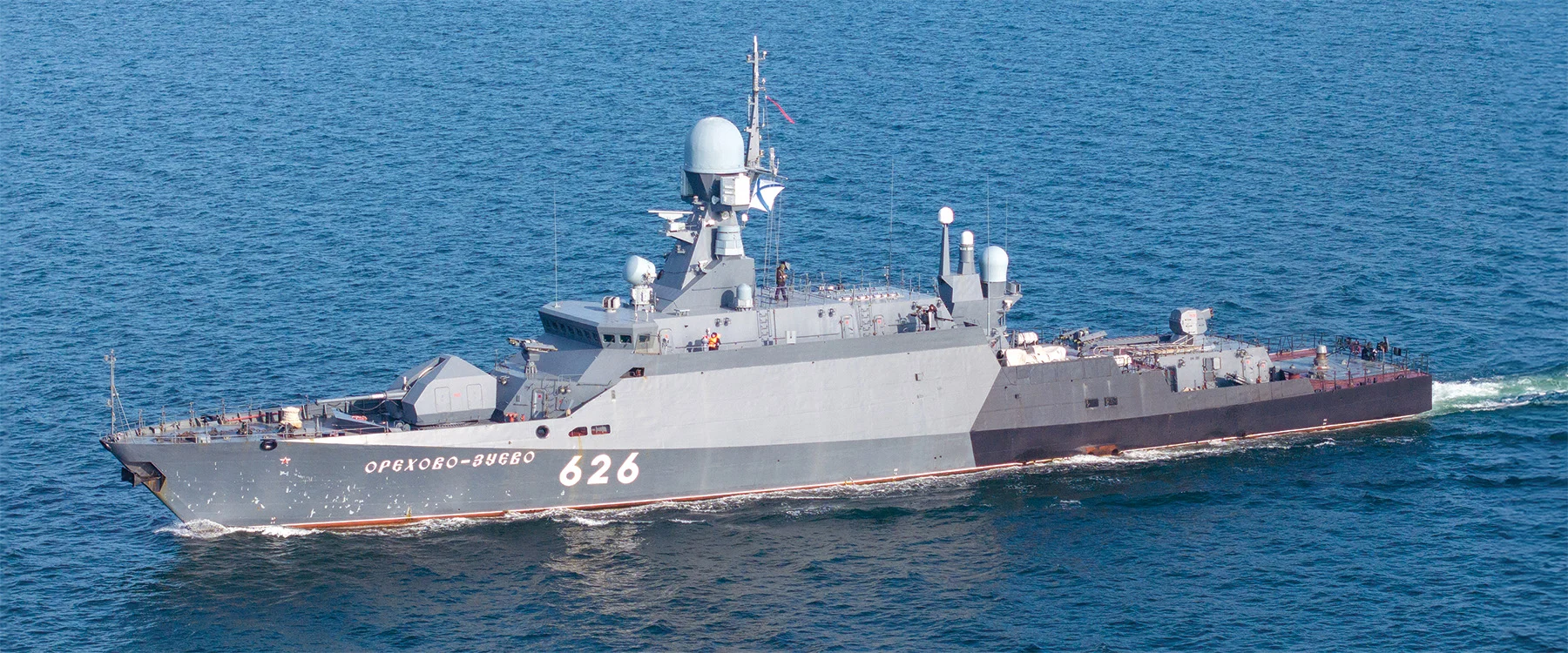
The Naro-Fominsk is a Buyan-M-class small missile corvette. These ships are compact by naval standards, but their size is a distraction. The class is designed to carry Kalibr cruise missiles and has also been associated with Oniks-capable strike missions. A vessel that can launch long-range missiles does not need to look like a cruiser to affect the war.
- Class: Buyan-M small missile corvette
- Primary threat: Kalibr cruise missiles, with Oniks capability reported for the class
- Operating area: The Gulf of Finland, a narrow waterway connected to Russia's Baltic Fleet infrastructure
- Reported result: Smoke and a withdrawal towards St Petersburg; the extent of damage is not independently confirmed
That distinction is central. Ukraine did not demonstrate that every Russian ship in the Baltic is now exposed. It demonstrated that a ship assumed to be protected by geography and proximity to home ports can still be found and reached. The difference between those two claims is the difference between analysis and advertising.
Why the Gulf of Finland Changes the Calculation
The Gulf is not an empty battlefield. It is a confined maritime corridor used by tankers, ferries and commercial vessels, with subsea data cables and critical port infrastructure below and around it. Finnish officials told the BBC that maritime traffic remained safe, while also making clear that the incident had created a new security concern. Estonia said Ukrainian drones flew close to its border during the wider operation, and one drone briefly entered Estonian airspace after being diverted by Russian electronic warfare, according to Herem.
NATO aircraft were airborne over the Baltic states, but Estonia said it was not considered safe to shoot down the drones. That sentence should make European planners uncomfortable. A Russian attack on NATO territory would trigger one set of decisions. A Ukrainian strike that passes near or briefly through allied airspace creates a far messier problem: allies must defend their own airspace without accidentally becoming a direct party to every Ukrainian deep-strike mission.
For Russia, the geography is equally awkward. The Baltic Fleet's bases near Kaliningrad and St Petersburg are close to NATO territory, but closeness is not the same as sanctuary. The fleet must now consider whether its small missile ships can operate, reload and move through the Gulf without exposing themselves to an expanding Ukrainian drone campaign. That could force Russia to spend more on escorts, electronic warfare and air defence for assets that were previously treated as relatively low-risk.
This Is Not Yet a NATO Escalation
There is a temptation to call the strike a major escalation because it happened near Finland and Estonia. That would be too easy. The BBC quoted analyst Emil Kastehelmi, of the Black Bird monitoring group, saying the incident was unprecedented but not a serious escalation. I agree with the second half.
The strike was directed at a Russian warship during Russia's war against Ukraine. It was not an attack on Finland, Estonia or civilian shipping. Moscow may claim that Baltic airspace was used, but Kyiv has rejected that allegation and suggested Russian electronic warfare could have diverted drones. Until there is evidence of deliberate Ukrainian use of NATO airspace, allied governments have every reason to keep the incident in the category of dangerous spillover rather than collective-defence crisis.
That does not make it harmless. The Baltic is already a high-friction environment shaped by cable incidents, GPS interference, Russian shadow-fleet activity and close military encounters. More Ukrainian strikes will compress the distance between combat operations and alliance territory. Every drone that crosses a border, every interceptor that hesitates and every civilian vessel caught near a military target adds another chance for miscalculation.
Ukraine's Message Is About Reach
Kyiv is also sending a message to Russia's wider military system. The Black Sea campaign showed that naval power can be pushed away from a coastline without a conventional fleet battle. The Baltic strike suggests Ukraine wants to apply the same logic to Russia's northern maritime flank, even though its access to the Baltic is indirect and its campaign must rely on drones and intelligence.
The target choice is telling. Hitting a missile corvette offers more military value than attacking a random patrol boat, but it avoids the symbolic leap of trying to destroy a flagship. Ukraine is testing a proposition: Russian long-range strike capacity is vulnerable wherever it can be located, including waters Moscow treats as a rear area.
For NATO, the lesson is not that Ukraine has solved Baltic maritime security. It is that the alliance's eastern flank is one connected battlespace. A warship in the Gulf of Finland, an oil terminal at Ust-Luga, an Estonian airspace incident and a NATO air-policing patrol are not separate headlines. They are one chain of risk.
What to Watch Next
Three indicators will tell us whether this was a one-off raid or a new campaign. First, whether the Naro-Fominsk returns to service or is moved for repair. Second, whether Russia changes the air-defence and electronic-warfare posture around Ust-Luga and St Petersburg. Third, whether Finland and Estonia publish more detail on drone routes, airspace incursions and deconfliction with Kyiv.
The bottom line is uncomfortable. Russia's Baltic Fleet has not been defeated, and NATO has not been dragged into the war. But the old assumption that the Baltic's narrow waters protect Russian missile ships is gone. The next strike may still fail. It will not need to succeed spectacularly to change how every navy in the region plans its next movement.
Sources: BBC News, “Russian warship hit by Ukrainian drone in Gulf of Finland,” 12 November 2026; Reuters, “Finland says it detects strike on Russian warship in Baltic Sea,” 13 November 2026; statements by Estonia's Defence Minister Martin Herem and Ukraine's Security Service as reported by the BBC.
Ukrainian drones attacked the Russian missile corvette Naro-Fominsk in the Gulf of Finland in November 2026 during a broader operation against the Ust-Luga oil terminal. The ship was reported to have sustained damage and retreated towards St Petersburg. This incident highlights Ukraine's ability to target Russian naval assets in a confined maritime corridor, raising security concerns for NATO and Baltic states.
- Ukrainian drones attacked the Russian missile corvette Naro-Fominsk in the Gulf of Finland.
- The attack occurred during a wider operation against the Ust-Luga oil terminal.
- Smoke was reported from the ship, which then retreated towards St Petersburg.
- The incident raises new security concerns for NATO and Baltic states.
- The strike demonstrates Ukraine's capability to reach Russian naval assets in the Baltic Sea.