
Ukraine sinks three Russian drone boats with Bayraktar strikes
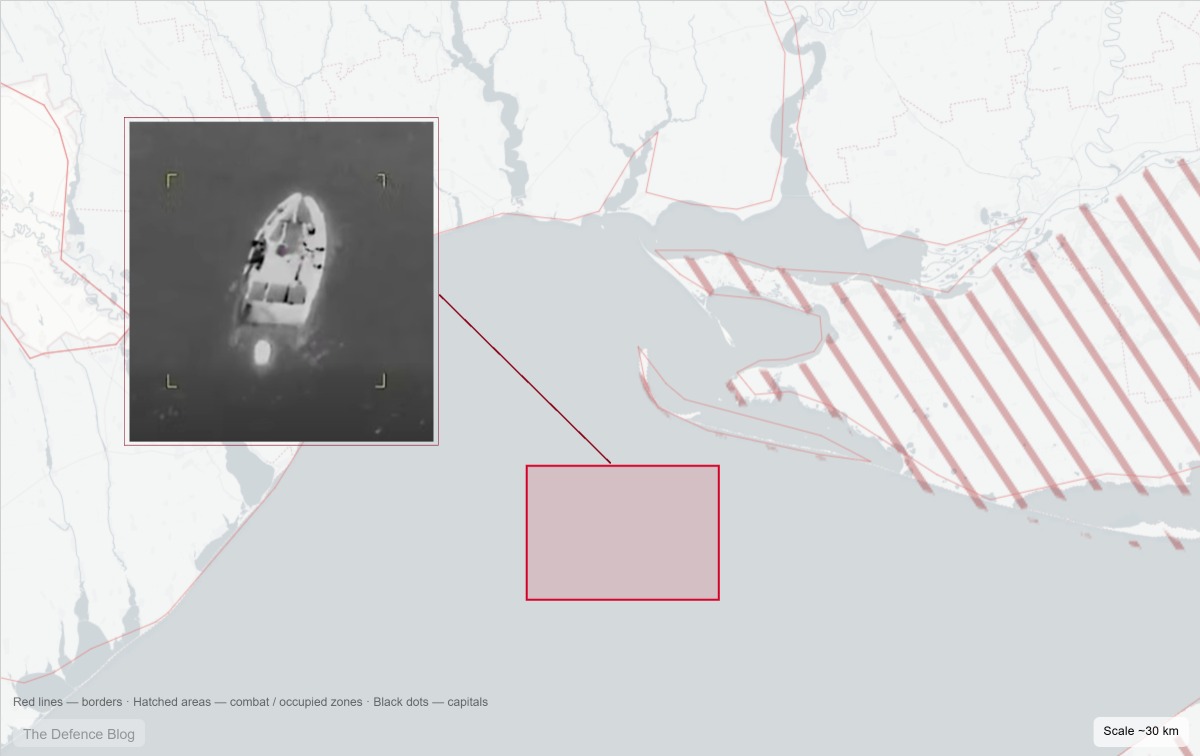
Ukrainian forces destroyed three Russian explosive drone boats attempting to attack the Ukrainian coastline in the early hours of June 23, with Bayraktar TB2 combat drones delivering the strikes that sank the uncrewed vessels at sea, marking one of the relatively rare instances in the current phase of the war where the Turkish-built aircraft have been used in a direct attack role rather than purely for reconnaissance and strike coordination.
The attack began at 4:00 a.m., when Russian maritime drone boats approached Ukrainian coastal waters, according to Serhii Flash, an adviser to Ukraine’s Minister of Defense, who posted details of the operation on his official social media account. Flash confirmed that coordinated action by multiple Ukrainian Armed Forces units detected and destroyed the boats before they reached their targets. The Ukrainian Navy subsequently confirmed the destruction of all three vessels, identifying them as maritime unmanned surface vehicles, the category of weaponized drone boats Russia has used with increasing frequency to strike Ukrainian port infrastructure, naval assets, and coastal positions throughout the war.
“Today at 4 a.m., the enemy attempted to attack our coastline with several unmanned strike boats. As a result of coordinated actions by a number of Ukrainian Armed Forces units, the boats were detected and destroyed at sea,” Flash stated, as posted on his official account.
Flash added a detail that carries significance beyond the immediate operational result, noting that the destroyed boats carried Starlink satellite internet terminals, the commercial broadband service operated by SpaceX. “As I said before, the destroyed boats had Starlink installed, since the enemy has no other control systems for long distances,” Flash wrote.
The observation identifies a persistent vulnerability in Russia’s maritime drone operations: the absence of viable alternatives to commercial satellite communications for controlling unmanned surface vehicles at the ranges required to reach Ukrainian coastal targets from Russian-controlled waters in the Black Sea. Russia’s own military communications systems have proven inadequate for the precision long-range datalink that controlling a fast-moving unmanned boat in contested waters requires, leaving Russian operators dependent on a commercial American service that Ukraine has repeatedly flagged as a concern and that SpaceX has stated it does not intentionally enable for Russian military use.
The Ukrainian Navy confirmed the engagement in its own statement, attributing the success to joint action between the Naval Forces of the Ukrainian Armed Forces and the Main Intelligence Directorate of Ukraine, the military intelligence agency that has been central to Ukraine’s maritime drone operations since the early months of the full-scale invasion. “Three enemy maritime unmanned combat boats destroyed. Thanks to the coordinated actions of the Naval Forces of the Armed Forces of Ukraine and the Main Intelligence Directorate, three enemy unmanned surface vehicles were detected and destroyed at once,” the Navy posted, adding that “every successfully repelled attack means saved lives and another blow to the aggressor’s plans.”
The video released alongside the Ukrainian Navy’s statement showed Bayraktar TB2 drones conducting the intercept, with the aircraft visibly engaging and destroying the Russian boats on the water’s surface. That footage provides the operational detail that distinguishes this engagement from typical maritime drone interceptions, which are more commonly handled by Ukrainian naval surface vessels, helicopters, or shore-based weapons. Using Bayraktar TB2s in the direct strike role against maritime targets is a notable tactical choice that reflects both the availability of the aircraft for this mission and the effectiveness of their Micro Munition MAM-L and MAM-C laser-guided smart micro munitions against small, fast-moving surface targets.
The Bayraktar TB2, built by Turkish defense company Baykar and supplied to Ukraine in significant numbers before and during the full-scale invasion, gained global attention in the early weeks of the war after footage emerged of the aircraft destroying Russian armored columns, supply convoys, and air defense systems with apparent impunity. That permissive operational environment did not last. As Russia deployed more capable short-range air defense systems closer to the front lines and improved its electronic warfare coverage, the TB2’s operational role shifted significantly. The aircraft, which cruises at approximately 130 km/h (81 mph) and operates at altitudes typically between 5,000 m and 8,000 m (16,400 ft and 26,247 ft), became increasingly vulnerable to Russian air defense systems in contested airspace, and Ukrainian operators adapted by using the TB2 primarily for reconnaissance, targeting, and the coordination of strikes by other systems, keeping the aircraft outside the effective range of Russian air defenses while its sensors gathered the intelligence that guided artillery, missile, and drone attacks.
The June 23 engagement, with TB2s striking Russian maritime drones at sea, reflects a pattern that has emerged as one of the aircraft’s sustainable attack applications in the current operational environment: missions over water, where Russian air defense coverage is thinner and less integrated than over land, allow the TB2 to operate in a more direct strike capacity without the same exposure to interception that overland attack missions carry. Ukrainian forces have used the TB2 to strike Russian naval vessels and maritime infrastructure in the Black Sea on previous occasions, and its employment against unmanned surface vehicles follows that same logic of finding the seams in Russian air defense coverage and exploiting them.
Content preview only. Full article available at source. View Full Article
Ukrainian forces destroyed three Russian explosive drone boats in the Black Sea on June 23 at 4:00 a.m. using Bayraktar TB2 combat drones. The operation involved coordinated actions by multiple units of the Ukrainian Armed Forces, marking a significant use of the drones in a direct attack role. The destroyed boats were equipped with Starlink satellite terminals, highlighting vulnerabilities in Russian maritime drone operations.
- Ukrainian forces destroyed three Russian explosive drone boats on June 23.
- The attack was conducted using Bayraktar TB2 combat drones.
- The destroyed boats were equipped with Starlink satellite internet terminals.
- The operation involved coordinated actions by multiple units of the Ukrainian Armed Forces.
- This engagement reflects a tactical shift in the use of TB2 drones for direct strikes against maritime targets.