
Ukraine spots “whiskered” Shahed aimed at power lines
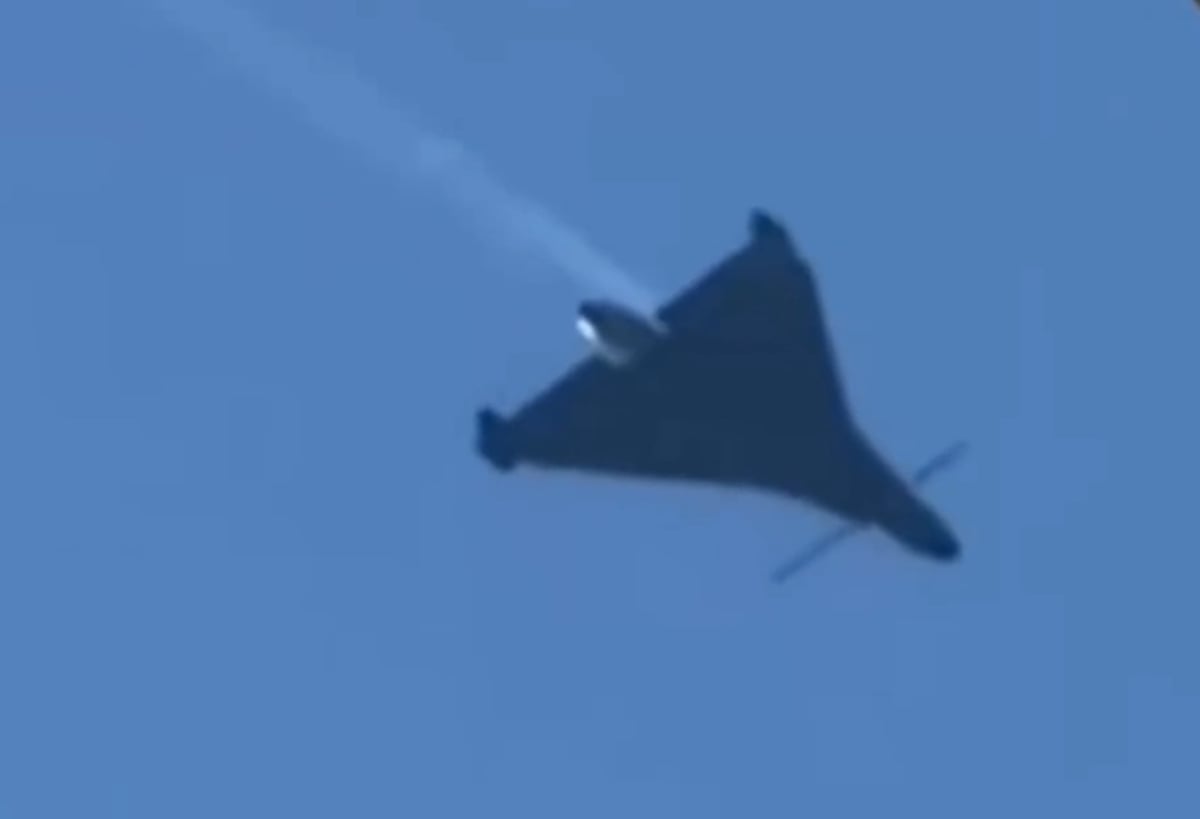
A previously unseen version of Russia’s jet-powered Shahed attack drone has appeared in Ukraine fitted with whisker-like rods on its nose, a modification that Ukrainian volunteer Serhii Sternenko says is designed to detonate the warhead on contact with high-voltage power lines.
Sternenko, a Ukrainian volunteer and activist who runs one of the country’s largest drone fundraising efforts, published video of the drone on X, saying the “whiskers” are most likely there to close an electrical contact and set off the charge when the drone strikes something as thin as a power cable. A similar modification has been seen at another location, though Sternenko did not say where either drone was found or whether it was intact.
“And this is a whiskered Shahed with a specialized warhead for attacks on high-voltage power lines. Most likely the whiskers were added to close a contact and initiate the warhead when hitting small targets such as power lines,” Sternenko wrote.
A standard impact fuse needs a solid surface to trigger, so a drone that clips a cable or the open lattice of a transmission tower may fly through or fall without exploding. Rods sticking out ahead of the airframe would let the drone detonate as soon as they touch a wire.
A second development points in the same direction. Serhii Beskrestnov, known as “Flash,” a specialist in drones and electronic warfare who serves as President Volodymyr Zelenskyy’s adviser on defense technology, said Russia appeared to use a special warhead on a jet-powered drone for the first time on Sept. 30. He identified it as a shaped-charge cutting payload, known by its Russian initials KRSN, designed specifically to destroy high-voltage transmission towers and steel bridge structures.
According to Beskrestnov, the KRSN consists of a 40-kg (88-pound) main charge and four additional strike modules. A cutting charge focuses its blast along a line to slice through metal, which makes it suited to severing the legs of a steel pylon or the girders of a bridge rather than causing broad blast damage. Beskrestnov did not say where the drone carrying it struck or what damage it caused.
Russia has attacked Ukraine’s power system throughout the war, mainly with missiles and Iranian-designed Shahed drones aimed at power plants and substations. Ukraine’s long transmission lines, which run across open country and are hard to defend, have been less frequent targets because individual towers and cables are small and difficult for a drone to hit and destroy. The jet-powered Shahed variants, which fly much faster than the original propeller-driven model, also give Ukrainian air defenses less time to react.
Content preview only. Full article available at source. View Full Article
Ukraine has identified a modified Shahed drone equipped with whisker-like rods intended to detonate on contact with high-voltage power lines. This modification, along with the introduction of a new KRSN warhead, enhances the drone's capability to target critical infrastructure. The developments were noted by Ukrainian volunteer Serhii Sternenko and defense adviser Serhii Beskrestnov, highlighting ongoing threats to Ukraine's power system from Russian drone attacks.
- A modified Shahed drone with whisker-like rods has been spotted in Ukraine.
- The modification is intended to detonate the warhead upon contact with power lines.
- A new warhead type, KRSN, has been identified for use on these drones.
- The KRSN warhead is designed to sever high-voltage transmission towers.
- Ukrainian air defenses face challenges against faster jet-powered Shahed variants.