
Ukraine's 2026 Homemade KAB Makes Russia's Glide Bomb Lesson Personal
 Alexandra Reeves
Ukraine's 2026 Homemade KAB Makes Russia's Glide Bomb Lesson Personal
Ukraine did not need another clever drone story. It needed a way to hit hardened Russian positions from the air without waiting for someone in Washington, Berlin, or Brussels to release another batch of precision kits. That is why the approval of Ukraine's first domestically developed guided aerial bomb matters more than its modest first production run suggests.
According to Defence Blog, citing Ukrainian Deputy Prime Minister and defence innovation lead Mykhailo Fedorov, the weapon has completed required testing, an initial experimental batch has been procured by Ukraine's Ministry of Defence, and pilots are already training on combat scenarios. The bomb was developed by DG Industry through Brave1, Ukraine's state-backed defence technology cluster.
The announcement is not a claim that Ukraine has suddenly matched Russia's industrial glide-bomb campaign. It has not. The point is narrower, and more interesting: Kyiv is building a sovereign answer to the weapon that has helped Russia grind down Ukrainian positions throughout 2024, 2025, and now 2026.
The Technical Clue Is the 250 Kilogram Warhead
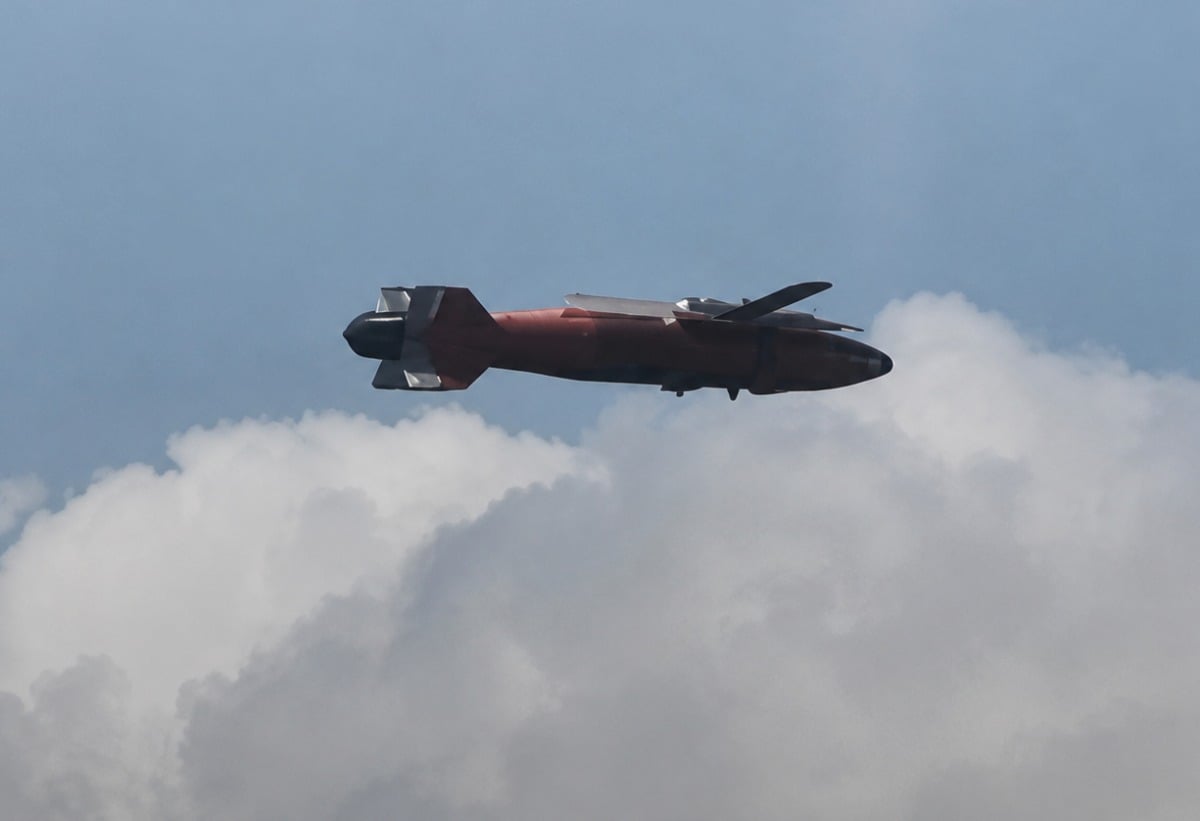
Brave1 described the munition as Ukraine's own KAB, using the regional shorthand for a guided aerial bomb. The reported specifications are deliberately incomplete, which is sensible in wartime. What has been disclosed is enough to show the intended role.
- Developer: DG Industry, a participant in Ukraine's Brave1 defence technology cluster.
- Development timeline: 17 months, according to the Brave1-linked announcement reported by Defence Blog.
- Warhead: 250 kilograms.
- Target set: fortifications, command posts, and other high-value battlefield targets.
- Range: described as dozens of kilometers beyond the release point.
- Status: testing completed, experimental batch procured, pilots training for combat use.
A 250 kilogram warhead is not in the same class as Russia's heaviest FAB-1500 glide bombs. It is closer to the practical middle of the precision strike problem: large enough to collapse field fortifications and damage protected command nodes, but not so large that integration becomes impossible on Ukraine's limited tactical aviation fleet.
That matters because Ukraine's air force is not operating from a clean NATO-style air campaign. It is flying inside a dense Russian air defence and electronic warfare environment. A weapon that can be released from some standoff distance, while carrying enough explosive weight to matter against prepared positions, is exactly the category Ukraine has been short of.
Russia Taught This Lesson the Hard Way
Russian glide bombs have become one of the ugliest answers to Ukraine's defensive depth. Moscow took old Soviet-era aerial bombs, added UMPK-style wing and guidance kits, and turned cheap stockpiles into standoff strike weapons. The result has been brutally practical: aircraft can release bombs from outside the most dangerous part of Ukraine's air defence envelope, while the bomb glides toward trenches, towns, logistics nodes, and command posts.
Defence Blog's source reporting notes that Russian FAB-series glide bombs have been able to travel roughly 60 to 70 kilometers in some configurations. Whether every strike reaches that figure is less important than the operational effect. Ukrainian units have repeatedly had to defend against explosive mass delivered from aircraft they often cannot reach.
ISW's May 17 Russian offensive campaign assessment shows the same problem still shaping the battlefield. In the Slovyansk direction, ISW cited a Ukrainian officer saying Russian forces were using guided glide bombs and Molniya-2 fixed-wing drones to strike Slovyansk and Kramatorsk, while using FPV and fiber-optic drones closer to the front. That mix is the Russian method in miniature: cheap drones to stalk the tactical zone, glide bombs to punish depth, and air defence pressure to keep Ukrainian aircraft cautious.
So when Ukraine announces its own KAB, the real comparison is not a spreadsheet fight against Russia's bomb inventory. It is a question of whether Ukraine can begin forcing Russian commanders to live under the same kind of standoff pressure they have imposed on Ukrainian brigades.
The Alliance Problem Hiding Inside the Bomb
Everyone in Washington says Ukraine needs more domestic production. That line is easy. The hard part is admitting why it is necessary.
Western precision strike support has been valuable but politically brittle. JDAM-ER kits, Storm Shadow, SCALP-EG, ATACMS, GLSDB, and other Western-provided systems all come with production limits, release conditions, maintenance chains, and political arguments. Some are superb weapons. None are fully sovereign Ukrainian answers.
A domestically produced guided bomb does not free Ukraine from Western support. It does something more realistic: it reduces the number of battlefield decisions that must wait for allied consensus. That is the distinction NATO should care about.
If DG Industry can move from experimental batches to repeatable production, Ukraine gains a capability that can be iterated in direct contact with front-line feedback. Guidance performance can be adjusted for Russian jamming patterns. Release profiles can be tuned to the aircraft Ukraine actually has. Warhead and fuze options can be modified for the fortified belts Russian forces have spent years building.
This is where Ukraine's defence sector has an advantage that Western prime contractors often lack. It is designing under fire. That does not make every Ukrainian product better. Some will fail. But the feedback loop is faster, less polite, and more honest than any peacetime procurement exercise.
The Limits Are Still Real
The uncomfortable part is that a guided bomb still needs aircraft, trained pilots, integration work, secure airfields, and survivable mission planning. Russia's advantage in glide bombs is not just the bomb. It is the combination of large stocks, more aircraft, release tactics, and a willingness to use mass even when accuracy is imperfect.
Ukraine's KAB will not erase that imbalance. An experimental batch is not a campaign. A 250 kilogram warhead is useful, but it is not magic. If Russian electronic warfare can degrade the guidance, or if Ukrainian aircraft cannot get into release position often enough, the weapon's battlefield effect will be limited.
There is also an integration question. Ukraine operates a mixed and stressed aviation fleet, now including Western aircraft alongside Soviet-origin platforms. A domestic bomb that can be adapted across platforms would be much more valuable than one tied to a narrow launch profile. The public reporting does not yet answer that question.
What To Watch Next
The next indicators are not dramatic videos. They are production rhythm, repeat strikes, and Russian adaptation. If Ukrainian aircraft begin using the weapon against command posts, logistics nodes, or hardened positions across multiple sectors, then this is more than a prototype milestone. If Russia starts moving air defence, dispersing headquarters, or complaining about a new Ukrainian guided bomb threat, Kyiv will know it has their attention.
For NATO, the lesson is awkward. Ukraine is not only consuming Western military technology; it is building battlefield systems faster than many alliance members can buy them. That should make European procurement officials a little embarrassed.
The short answer is that Ukraine's homemade KAB will not match Russia's glide-bomb mass in 2026. But it changes the direction of travel. Kyiv is no longer only asking allies for an answer to Russia's standoff airpower. It is starting to manufacture one. The question now is whether Ukraine can scale it before Russia changes the problem again.
Ukraine has developed its first domestically produced guided aerial bomb, the KAB, which features a 250 kg warhead and is designed to target fortified positions. Pilots are training for combat use as the weapon has completed testing and an experimental batch has been procured. This development marks a significant step in Ukraine's military capabilities in 2026.
- Ukraine has developed a domestically produced guided aerial bomb, the KAB.
- The bomb has a 250 kg warhead and is intended for use against fortified positions.
- Pilots are currently training for combat scenarios using the new bomb.
- The development took 17 months and is part of Ukraine's Brave1 defense technology cluster.
- The KAB aims to provide Ukraine with a sovereign capability to strike Russian positions.