
Ukraine's Freyja Missile Shield Tests Europe's 2026 Air Defence
 Alexandra Reeves
Ukraine's Freyja Missile Shield Tests Europe's 2026 Air Defence
Europe has spent years talking about strategic autonomy. Freyja is where that slogan meets a radar track moving at ballistic speed.
Ukraine says it has completed its part of the new multinational anti-ballistic system, leaving European partners to deliver the sensors, seekers and command architecture needed for testing by the end of 2026. That sounds like a manufacturing update. It is actually a test of whether Europe can turn battlefield urgency into a functioning weapons programme before the next crisis makes the question academic.
Ukraine Has Built the Hard Part, But Not the Whole System
According to Defense News, Fire Point is building the FP-7.X interceptor and its launcher. Norway's Kongsberg and Germany's Diehl Defence are among the partners developing the components that must find, track and guide the weapon to its target. The distinction matters: an interceptor is not an air-defence system until the missile, radar, fire control, communications and battle-management software work as one.
Freyja's first interceptor is designed around a blast-fragmentation warhead rather than the hit-to-kill method used by the newest Patriot PAC-3. Fire Point chief executive Iryna Terekh told Defense News that the initial version should intercept at roughly 20 to 25 kilometres altitude, or about 12 to 16 miles. A hit-to-kill version is planned later. That makes Freyja an ambitious first-generation shield, not a magic replacement for every Patriot mission.
The industrial target is more revealing than the brochure. Fire Point says it wants to produce at least 2,000 interceptors a year and eventually drive the unit price below $1.2 million. For comparison, the PAC-3 interceptor costs roughly $3.8 million and can take years to deliver, according to the same report. The exact Freyja price and performance remain claims that still need proving in trials. But the production logic is clear: Europe needs a larger magazine, not merely another exquisite missile.
The Clock Is Set by Russian Salvos
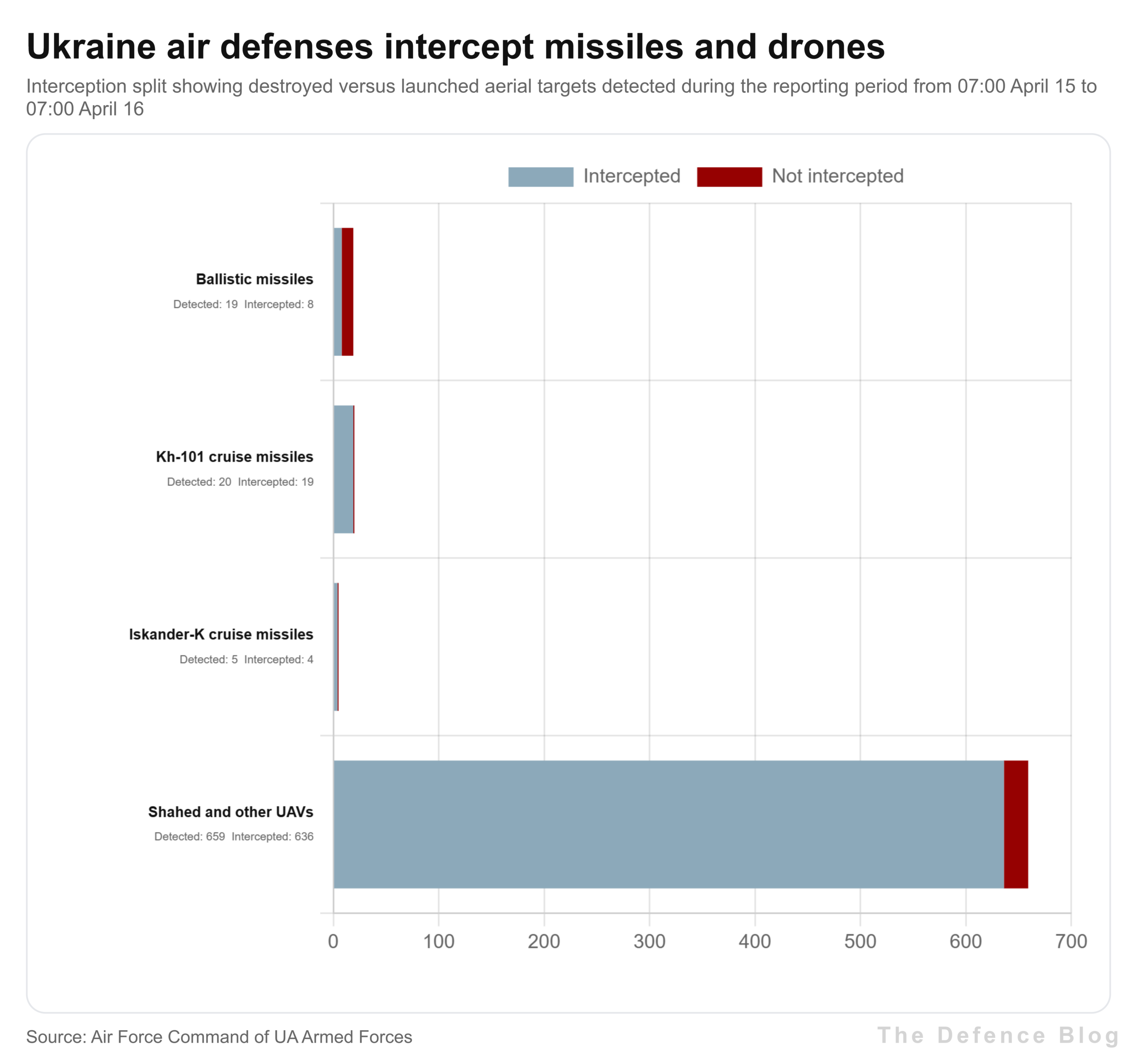
Ukraine is not developing Freyja in a laboratory. President Volodymyr Zelenskyy said Russia had fired more than 100 ballistic missiles at Kyiv and the surrounding region in the previous two weeks, after launching nearly 3,500 jet-powered drones across Ukraine in September. Those figures were cited by Ukraine's presidential office and Ukrainian Air Force reporting.
The pressure is tactical as well as strategic. Kyiv is being forced to spend scarce high-end interceptors against a mixed raid of ballistic missiles, cruise missiles and faster jet-powered Shahed drones. A defence network that uses its most expensive rounds against every threat eventually becomes a rationing system. That is why a cheaper interceptor matters even before it matches Patriot's best performance.
But the numbers also expose Freyja's vulnerability. A production rate of 2,000 missiles is meaningless if the system cannot generate a reliable track, discriminate a warhead from debris and pass a firing solution through a jammed network. The hardest component may be the seeker. Terekh told Defense News that Fire Point was integrating Diehl's infrared seeker while exploring other options with two unnamed partners. The seeker manufacturers are attempting this integration for the first time.
Freyja Is a European Coalition with Ukrainian Ownership
In July, Ukraine and nine European countries — Denmark, France, Germany, Italy, the Netherlands, Norway, Spain, Sweden and the United Kingdom — launched the coalition in Paris. Defense News reported that the partners agreed to develop common operational requirements and technical working groups while preserving national autonomy over how many systems they buy and where they deploy them.
That arrangement is politically sensible and operationally messy. Ukraine brings the urgent requirement, a domestic missile producer and years of experience under Russian bombardment. Europe brings radar companies, command systems, money and industrial depth. The division of labour is also a division of risk. Kyiv can finish the interceptor and still wait for a European partner to finish the part that makes it useful.
Under a June agreement, Germany's Hensoldt is supplying radar expertise, including the TRML-4D family, while the architecture is expected to connect to Ukrainian and NATO-linked networks through Link 16 and the Asterix data protocol. Kongsberg is associated with the command-and-control layer, and partners from Sweden, France, Denmark and Italy are involved in the possible radar and fire-control mix. Interchangeable components could reduce political leverage over any single supplier, but only if the integration standard is real rather than aspirational.
The Strategic Bet Is Bigger Than One Missile
Freyja challenges a comfortable assumption in Washington and Brussels: that European air defence can be fixed mainly by buying more American systems. Patriot remains indispensable for Ukraine, but stockpile shortages and competing global demands have made dependence visible. The coalition's founding declaration frames Freyja as a shared European capability, not simply an emergency Ukrainian purchase.
That is the political opportunity. Ukraine's war has supplied Europe with an operational problem, test data and an industrial partner at the same time. If Freyja works, European states gain a second source of anti-ballistic capacity and a programme shaped by the war they are trying to prevent from spreading. If it fails, the lesson will not be that Europe lacks engineers. It will be that ten governments could agree on a headline faster than they could agree on an interface, a budget and a delivery schedule.
Freyja therefore deserves scepticism and speed in equal measure. The next milestone is not another summit photograph. It is an end-of-year intercept test using the European seeker, radar and command components. If that test slips, Ukraine's dependence on Patriot will last longer and Europe's strategic-autonomy language will sound thinner. If it succeeds, the alliance will have demonstrated something more valuable than a new missile: that combat experience can move across borders and into production before bureaucracy kills the advantage.
The uncomfortable conclusion is simple. Ukraine has done its share. Europe now has to prove that its bottleneck is not courage, money or technology, but merely time — and time is exactly what Russia's missile campaign is designed to take away.
Ukraine has completed its part of the Freyja missile shield system, which is set to be tested by European partners by the end of 2026. Fire Point plans to produce at least 2,000 interceptors annually, with the first designed to intercept at altitudes of 20 to 25 kilometers. A coalition of Ukraine and nine European countries is collaborating on this project, responding to increased Russian missile threats.
- Ukraine has completed its part of the Freyja missile shield system.
- Fire Point aims to produce at least 2,000 interceptors annually.
- The first interceptor is designed to intercept at altitudes of 20 to 25 kilometers.
- Ukraine and nine European countries launched a coalition to develop the Freyja system.
- Russia has launched over 100 ballistic missiles at Kyiv in the past two weeks.