
Ukraine’s small air defense network downs 3,500 drones in May

Ukrainian drone interceptors destroyed more than 3,500 Russian unmanned aerial systems in May alone across three layered tiers of air defense, Commander-in-Chief of the Ukrainian Armed Forces General Oleksandr Syrskyi announced, with the result reported by Ukrainian defense outlet Militarnyi citing Syrskyi’s official statement.
Syrskyi attributed the results directly to the systematic development of what Ukrainian commanders call “small air defense,” the expanding network of drone interceptors, electronic warfare systems, and light weapons crews that operate below the altitude ceiling of conventional surface-to-air missile systems and fill the gaps those systems cannot cost-effectively cover. Ukraine has been building this architecture since Russia began its mass drone campaign using Iranian-supplied Shahed-series loitering munitions, and the May figures represent the most significant monthly interception total the Ukrainian military has publicly reported.
“Today, the majority of neutralized Russian Shaheds, Geraniums, and other aerial attack means are the result of the work of our drone interceptors,” Syrskyi stated.
The breakdown across the three tiers reveals where the interception effort is most concentrated. The second tier, for which Ukraine’s Unmanned Systems Forces bear primary responsibility, accounts for more than 1,200 of the drones destroyed in May, the highest single-tier contribution and a figure that reflects the rapid expansion of Ukraine’s dedicated drone-hunting units over the past year. The Unmanned Systems Forces were established as a separate branch of the Ukrainian military in 2024, an institutional acknowledgment that drone warfare had become a distinct domain requiring its own command structure, doctrine, and procurement pipeline rather than being managed as an adjunct to existing branches already stretched across a front line spanning hundreds of kilometers.
The Russian systems being intercepted in these numbers are primarily Shahed-series drones, which Russia rebrands as Geranium for domestic consumption. The Shahed-136 and its variants are Iranian-designed one-way attack systems, essentially small flying bombs with a distinctive delta-wing shape, flying at altitudes typically between 50 m (164 ft) and 200 m (656 ft) at speeds of roughly 185 km/h (115 mph), navigating via GPS combined with inertial guidance to strike fixed targets deep inside Ukrainian territory. Their estimated unit cost of between $20,000 and $50,000 makes them attractive as mass-strike weapons against Ukrainian infrastructure, and Russia has deployed them in salvos of dozens to hundreds in a single night specifically to saturate and overwhelm Ukrainian defenses through volume rather than sophistication.
Ukraine’s drone interceptors counter them by flying small, fast unmanned aircraft directly into or alongside the Shahed’s flight path, destroying them before they reach populated areas or critical infrastructure. The interceptors operate at the same low altitudes where conventional air defense missiles are either unavailable, too expensive to justify against a cheap target, or constrained by minimum engagement envelopes that leave the lowest-flying threats unaddressed. A surface-to-air missile costing hundreds of thousands of dollars is an economically unsustainable response to a drone costing tens of thousands, and Ukraine’s entire small air defense concept is built around closing that cost gap by meeting cheap threats with comparably cheap responses.
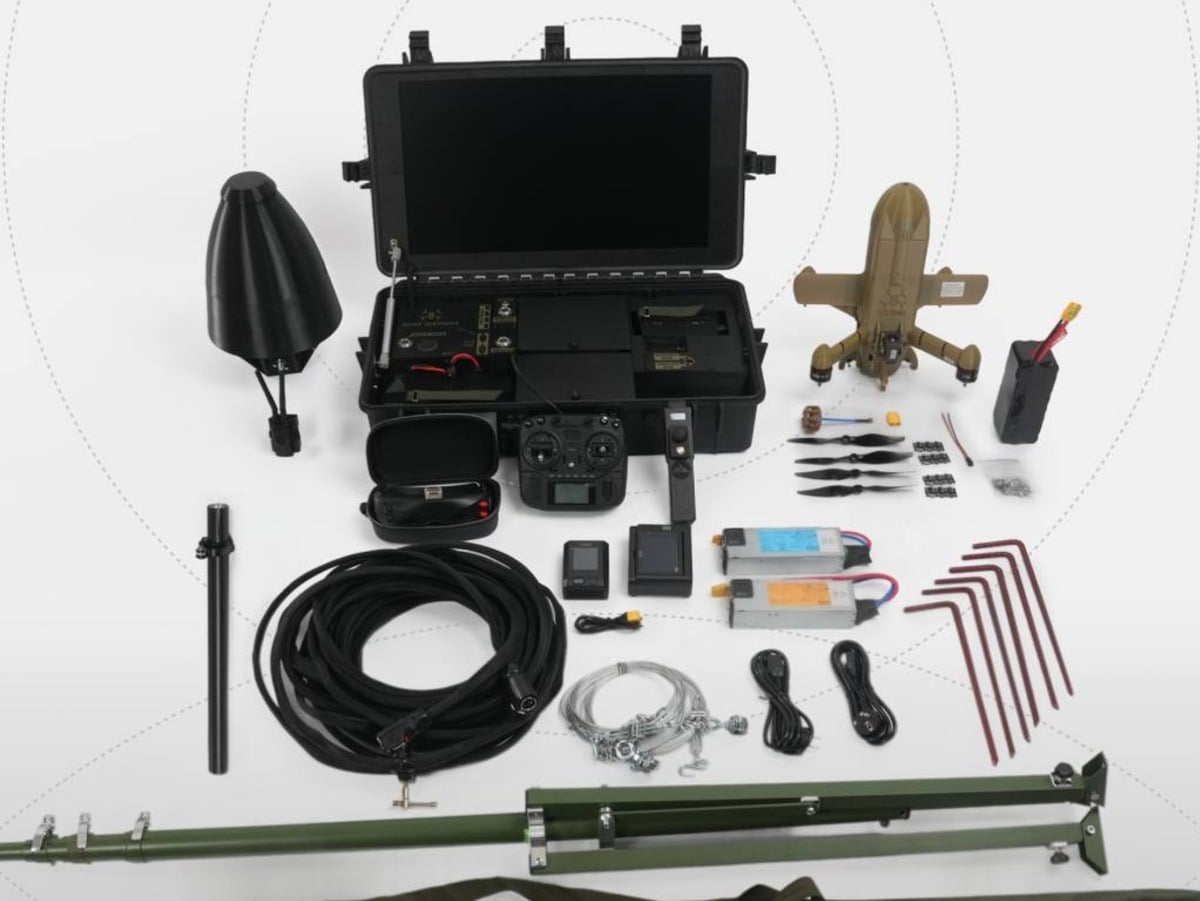 Ukrainian-made Sting drone interceptor system. Photo by Wild hornets.
Ukrainian army aviation contributed significantly to May’s total as well, with helicopter crews destroying more than 440 Russian drones during the month. Those helicopters have been equipped with updated detection and targeting systems, and Syrskyi noted that crews are now armed with new missile types that are already demonstrating strong results against drone targets. The helicopter contribution adds a mobile, repositionable layer to the interception network, one capable of shifting quickly as Russian attack routes change and engaging threats across a broader geographic area than fixed ground-based systems alone can cover.
Ukraine is simultaneously extending the architecture further, and Syrskyi confirmed that work is underway to establish a fourth interception tier that will extend drone defense coverage to two additional regions currently outside the network’s reach, with crew numbers growing and operator training running continuously in parallel. The expansion reflects both the operational success of the existing three-tier system and the recognition that Russia’s drone campaign is not contracting but growing, with more systems launched against more targets across a wider area than at any previous point in the war.
Russia is adapting its approach in ways that will stress Ukraine’s interception capabilities directly. According to Militarnyi, Russia plans to increase the share of jet-powered drones in its attack formations to as high as 50 percent of total strike volume, a shift that poses a direct challenge to interception techniques optimized for the slower, propeller-driven Shahed profile. Jet-powered drones fly significantly faster, compressing the detection-to-engagement timeline and reducing the window during which interceptors can position themselves for a kill. Ukraine will need to adapt its interceptor capabilities and crew tactics to match that acceleration, and Syrskyi was explicit that the adversary’s continuous evolution in drone quantity and quality demands a correspondingly continuous Ukrainian response.
Defense Minister Mykhailo Fedorov confirmed in May that Ukrainian engineers have developed low-cost interceptor missiles specifically designed to shoot down Shaheds, with testing currently underway. Fedorov disclosed the program without providing technical specifications or a deployment timeline, but the existence of a domestically developed missile interceptor alongside the drone-based interception network signals that Ukraine is pursuing multiple technological paths simultaneously rather than betting on a single solution to a threat that keeps changing shape.
More than 3,500 Russian drones destroyed in a single month by Ukrainian interceptors is a number that would have seemed impossible to defense planners two years ago. Ukraine built that capability from scratch, under fire, and Russia is now racing to make it obsolete.
Content preview only. Full article available at source. View Full Article
Ukrainian drone interceptors destroyed over 3,500 Russian unmanned aerial systems in May 2023, primarily targeting Shahed-series drones. The Unmanned Systems Forces were responsible for over 1,200 of these interceptions, reflecting a significant expansion in Ukraine's drone defense capabilities. Additionally, Ukrainian helicopters contributed to the destruction of more than 440 drones, showcasing a multi-tiered air defense strategy. Ukraine is actively working to enhance its interception capabilities in response to evolving Russian drone tactics.
- Ukrainian forces destroyed over 3,500 Russian drones in May 2023.
- The majority of destroyed drones were Shahed-series, rebranded as Geranium.
- Ukrainian Unmanned Systems Forces accounted for over 1,200 of the destroyed drones.
- Ukrainian helicopters contributed to the destruction of more than 440 drones.
- Ukraine is expanding its air defense network to counter evolving Russian drone tactics.