
Ukraine's Terra A2 Makes Russia's 100 Drone Nights NATO's Problem
 Alexandra Reeves
Ukraine's Terra A2 Makes Russia's 100 Drone Nights NATO's Problem
Russia is trying to make Ukraine's air defence math unbearable. Ukraine's answer is increasingly to stop playing by Russia's preferred arithmetic.
That is the useful way to read two developments that landed within the same news cycle. On Tuesday, the Associated Press reported that Russia had fired more than 100 drones and two ballistic missiles at Ukraine overnight, with Kyiv warning of the possibility of a larger barrage. A week earlier, Japan's Terra Drone announced that its fixed-wing Terra A2 interceptor drone had begun operational deployment in Ukraine, developed with the Ukrainian defence technology firm WinnyLab.
One event is a strike report. The other is a product deployment. Put them together and they point to the same problem: Europe cannot missile-intercept its way through the next phase of the Ukraine war. Not at scale. Not at acceptable cost. Not while Russia keeps treating cheap one-way drones as a daily pressure campaign against cities, power systems and morale.
The Numbers That Matter
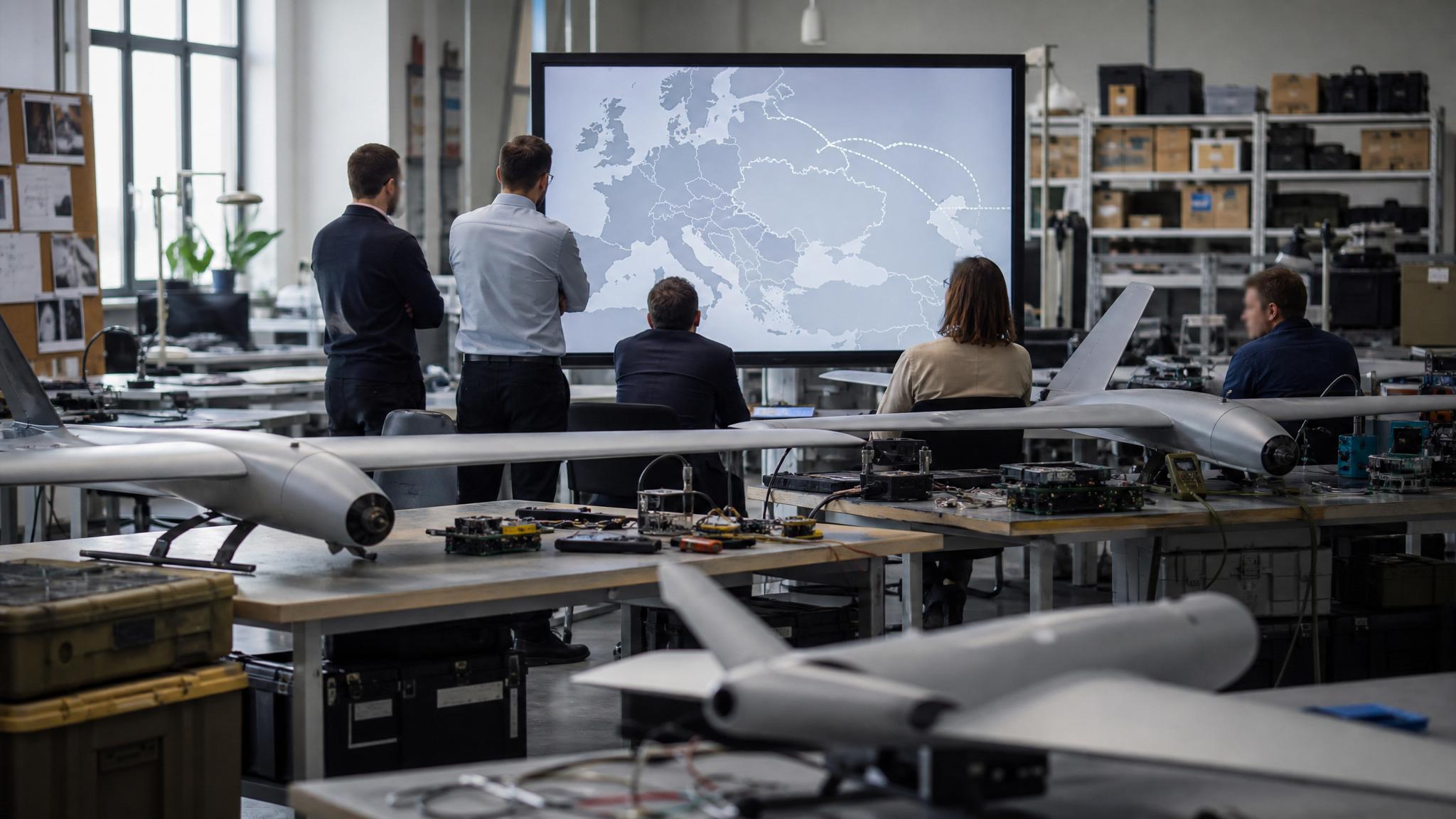
Terra Drone says the Terra A2 is designed for wide-area air defence rather than point defence. Its published specifications are the point: a top speed of 312 km/h, a coverage range of 75 km, more than 40 minutes of endurance, and integration with radar systems for detection, tracking and interception. It is meant to complement the company's already deployed Terra A1 rocket-type interceptor, creating a layered defence model.
Those figures do not make Terra A2 a Patriot battery, and that is precisely why it matters. Patriot, NASAMS, IRIS-T and SAMP/T remain essential for ballistic missiles, cruise missiles and higher-end aerial threats. But using expensive missile interceptors against massed Shahed-type drones is the defence-industrial equivalent of paying London rent for a garden shed. It may be necessary in moments of crisis. It is not a strategy.
Ukraine's Ministry of Defence has been moving in the same direction with domestic systems. In March, it authorized the JEDI Shahed Hunter interceptor for operational use, describing a vertically launched multirotor system weighing just over 4 kg, able to carry a payload of up to 500 grams, reach speeds above 350 km/h, and operate up to 6 km altitude. The ministry said the system can receive radar data automatically and protect airspace within a radius of up to 40 km.
Different airframes, same logic. Ukraine is building a lower-cost layer between machine guns and high-end missiles. It is not glamorous. It is not the sort of procurement line that makes ministers look grand at summit podiums. It is exactly the kind of ugly, iterative capability that wins attrition contests.
Russia Is Betting On Saturation
The latest Russian barrages are not just terror attacks, though they are certainly that. They are also an experiment in exhaustion. Every Shahed-style drone that forces an air defence crew to respond consumes operator attention, radar time, ammunition, fuel, maintenance hours and political patience. Even when the drone is shot down, Russia may still have imposed a cost.
This is why the conversation in NATO capitals often misses the point. The question is not only how many advanced systems Ukraine has. It is whether Ukraine and its partners can build enough cheap interceptors, sensors, launch teams and trained operators to make nightly drone raids economically irrational for Moscow.
Russia's drone campaign has also become a form of strategic signalling. Moscow does not need each aircraft to hit a target. It needs Ukrainians to sleep badly, engineers to reroute power, air defenders to guess which wave is the real one, and Western officials to worry that their stockpiles are disappearing into the Ukrainian night. That is a fairly sophisticated use of cheap technology, even when the individual drones are crude.
Interceptor drones complicate that model. If a Shahed can be met by a reusable or low-cost drone interceptor rather than a scarce missile, the economics begin to shift. Russia can still launch large salvos. But the defender is no longer forced into a losing exchange every time a low-end target appears on radar.
Japan Quietly Crosses A Line
There is another part of the story that should not be missed. Terra Drone is a Japanese company. Tokyo has been edging away from its post-war reflexes on defence exports for years, but Ukraine has accelerated the practical question: can Japan's advanced technology sector contribute to an active battlefield without pretending it is only doing civilian engineering?
Terra Drone's language is careful. The company frames Terra A2 as a sustainable security infrastructure product, stresses the protection of critical infrastructure and civilian life, and says combat data from Ukraine will inform future discussions with defence authorities in Japan, Europe, the Middle East and the Asia-Pacific. That is corporate diplomacy. It is also a map of the future market.
Everyone is watching Ukraine's drone war. Gulf states are watching because Iranian-designed systems have already shaped their threat environment. European governments are watching because Russian drones crossing or approaching NATO airspace are no longer hypothetical. Asian militaries are watching because Taiwan, Japan and South Korea all have to think about saturation attacks from missiles, drones and decoys.
Ukraine is not merely receiving aid here. It is validating defence products under the harshest conditions available. That makes Kyiv a customer, a test range and a design partner at the same time. Western procurement systems are not built for that speed. Ukrainian units are.
NATO's Uncomfortable Lesson
NATO foreign ministers meeting in Sweden last week talked about stronger defence industrial production, higher spending and continued support for Ukraine. According to NATO's own account, Secretary General Mark Rutte pushed allies to chart a credible path toward 5 percent defence investment. Fine. But money without the right production priorities will only produce a more expensive version of yesterday's force.
The lesson from Ukraine is not that every army should buy the Terra A2 specifically. The lesson is that air defence now has to be layered down as well as up. NATO has spent decades thinking about defeating aircraft and missiles. It now has to defend power stations, ports, logistics hubs and forward units against drones cheap enough to be used in the hundreds.
That means procurement officers need to become less precious. They need field trials measured in weeks, not years. They need permission to buy imperfect systems, send them to units, collect feedback and iterate. Ukraine has been forced into that model by survival. NATO still treats it as an innovation seminar.
Here is the uncomfortable part: Russia may be learning faster than Europe is buying. Moscow has taken losses, absorbed sanctions and still kept adapting its long-range strike packages. If NATO's answer is only more exquisite interceptors and longer committee cycles, then Ukraine will remain the alliance's most advanced air defence laboratory while the alliance itself stays behind the glass.
What To Watch Next
The immediate question is whether systems like Terra A2 can scale beyond useful prototypes and small-unit deployments. Published specifications are helpful, but the real indicators will be interception rates, loss rates, operator training time, radar integration reliability, resistance to electronic warfare and production tempo. Those are the metrics that decide whether this becomes a battlefield layer or a press release with wings.
The second question is whether European governments will buy into the concept before they are forced to do so by a drone incident over NATO territory. The Baltic states, Poland and Romania do not need another white paper to understand the problem. They need affordable counters that can sit below national missile defence and above rifles on rooftops.
Russia's latest drone nights are meant to prove that Ukraine can be worn down. Terra A2 and its Ukrainian counterparts suggest a different possibility: that the cheap-drone revolution may finally produce a cheap-defence revolution. If NATO is serious about learning from this war, it should stop admiring Ukraine's improvisation and start copying it.
Russia launched over 100 drones and 2 ballistic missiles against Ukraine, prompting concerns about air defense capabilities. Ukraine has deployed the Terra A2 interceptor drone to enhance its defense against these threats. The report emphasizes the need for cost-effective air defense solutions as Russia continues its drone campaign, which aims to exhaust Ukrainian defenses and disrupt daily life.
- Russia launched over 100 drones and 2 ballistic missiles at Ukraine overnight.
- Ukraine deployed the Terra A2 interceptor drone developed with WinnyLab.
- The Terra A2 is designed for wide-area air defense with a speed of 312 km/h and a range of 75 km.
- Ukraine's Ministry of Defence authorized the JEDI Shahed Hunter interceptor for operational use.
- The report highlights the need for affordable air defense solutions against mass drone attacks.