
Ukrainian drone unit hit U.S. tank brigade hard in drills
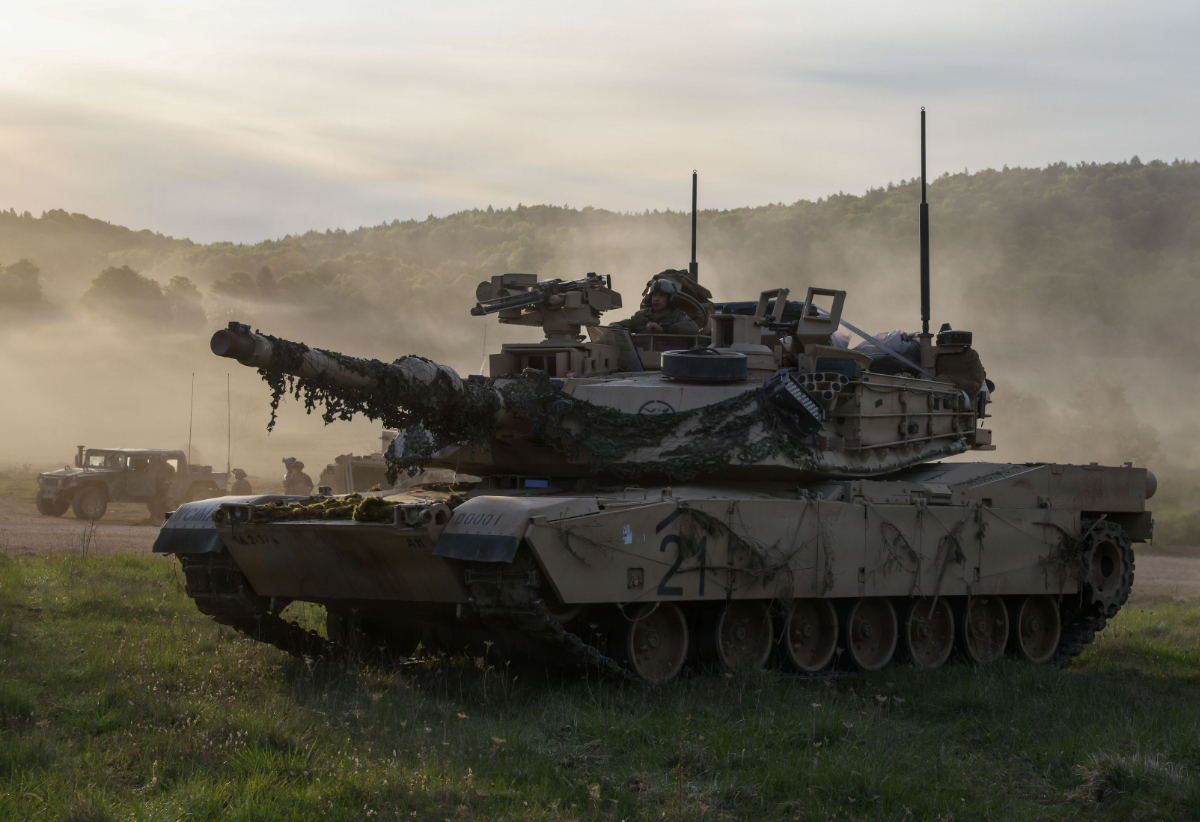
Ukrainian drone operators playing the enemy in a U.S. Army training exercise in Germany caused about 70% of an American armored brigade’s casualties in the first three days, according to an account by the brigade’s own commander and staff.
The figures come from an article in Military Review, the U.S. Army’s professional journal, written by Col. Michael Ziegelhofer, commander of the 3rd Armored Brigade Combat Team, 1st Cavalry Division, known as “Greywolf,” and six of his officers. They describe Combined Resolve 26-07, held in spring 2026 at the Hohenfels Training Area in Bavaria, where the brigade fought an opposing force reinforced by a detachment from the 412th Regiment of Ukraine’s Unmanned Systems Forces, a unit known as “Nemesis.”
Enemy drones either struck Greywolf’s troops directly or spotted for artillery that did. Over the roughly 10-day rotation, the opposing force initiated contact with drones more than 750 times. By the end of the third day, the share of casualties caused by drones had fallen below 30%, and the authors say the enemy had not eased off. “Greywolf changed how it fought,” they wrote.
Much of that change came down to basic soldiering. The brigade’s counter-drone and electronic warfare systems jammed drone control signals in protective “bubbles” up to 2 km (1.2 miles) wide, but they had to be set up at fixed sites and moved forward in bounds, leaving units exposed on the move. The systems were also less effective against the smaller number of fiber-optic drones, which are guided through a thin cable and cannot be jammed. More than half the formation had to rely on cover, concealment, dispersion, smaller routes and fast battle drills to get away before artillery landed.
The authors estimate that roughly 60% of the counter-drone fight at brigade level is fieldcraft and drills. They said only the heavy simulated losses of the first days forced soldiers to apply what they had practiced. Survival came at a price: crews switched off Blue Force Tracker, cut radio use and even dropped Starshield satellite links to shrink their electronic signature, and resupplying the brigade took twice as long as planned because the enemy hunted its supply lines.
Greywolf also had drones of its own. For the offensive phase, it brought in the 3rd Battalion, 504th Parachute Infantry Regiment, then an experimental drone battalion, and employed more than 700 drones from platoon to brigade level. Using relay drones to extend their reach, nearly all of the battalion’s aircraft could fly 25 to 40 km (16 to 25 miles), enough to cover the entire training area, a box roughly 14 by 27 km.
That abundance initially swamped the brigade headquarters. Collection planning tools built for a handful of sensors broke down, the operations floor struggled to absorb the flood of reports, and an airspace system that opened and closed individual blocks for each drone could not keep up. The staff never had a complete picture of how many drones were in the air.
The brigade adapted by handing drone units clear priorities and letting them hunt within the commander’s intent instead of directing each aircraft. It moved its coordinated fire line forward of its cavalry squadron so drones and artillery could hit anything beyond it without extra clearance, made enemy drone ground control stations a top target, and held back part of its drone munitions for the decisive moment. Most crewed and uncrewed aircraft were separated by altitude, with narrow corridors reserved for attack helicopters and medical evacuation flights.
By the end of the rotation, Greywolf carried out two simultaneous breaches through dense forest about 6 km (3.7 miles) apart. The authors say the enemy could not tell which was the main effort, failed to stop either, and lost its reserve before committing it.
A company commander in the brigade, writing in Task & Purpose, described Nemesis drones already overhead as his company drove through the only gate into the training area.
“They showed us ways to effectively fly cheap drones incredible distances. They put on a masterclass in sensor-to-shooter kill chain management and speed using tactics, techniques, and technology that we can now use in our formations,” wrote Allan Watson.
The officers recommend that armored brigades house their drones in multifunctional strike troops, each with three platoons for long-range surveillance out to at least 40 km, medium and heavy bomber drones, and strike drones paired with relays, along with smaller armored strike platoons for each battalion. They also call for every drone in a brigade to share one common operational picture, pointing to Ukraine’s Delta battlefield management system as the model, and for counter-drone defenses that work on the move, from hard-kill protection on every vehicle up to brigade-level radar and defeat systems.
Ukrainian units and equipment have become a regular feature of U.S. Army training in Europe this year. Soldiers at Hohenfels were photographed during the following rotation, Combined Resolve 27-01, assembling a Ukrainian-designed Stork reconnaissance drone.
Content preview only. Full article available at source. View Full Article
Ukrainian drone operators inflicted approximately 70% of casualties on the U.S. 3rd Armored Brigade Combat Team during training exercises at Hohenfels Training Area in Bavaria, Germany, in Spring 2026. The brigade adapted its tactics in response to the drone threat, employing over 700 of its own drones and implementing counter-drone measures. The exercises highlighted the effectiveness of Ukrainian tactics and technology in modern warfare.
- Ukrainian drones caused about 70% of casualties in the first three days of drills.
- The opposing force initiated contact with drones over 750 times during the rotation.
- Greywolf brigade adapted tactics in response to drone threats, including counter-drone measures.
- The brigade employed over 700 drones from platoon to brigade level during the exercises.
- Ukrainian units and equipment have become a regular feature of U.S. Army training in Europe.