
Ukrainian Long-Range Drones in September 2026 Close the Sky Over Russia and Break the Logic of the Rear
 Dmitri Volkov
Ukrainian Long-Range Drones in September 2026 Close the Sky Over Russia and Disrupt Rear Logistics
Vladimir Zelensky's statement that Ukrainian drones have effectively closed Russian airspace sounds like a political hyperbole only to those who still think in terms of 2022. In reality, this is already a description of a new mode of warfare. If the President of Ukraine publicly advises airlines to assess the risks of flying over Russia themselves, and the Kremlin responds the same day not by seeking de-escalation but with words that Moscow has no intention of negotiating with "terrorists," it means the blow has struck not only at rear targets but also at the very idea of a safe strategic depth (Reuters, September 1-2; France 24; The Hindu).
For the Russian military system, this is particularly painful because the late Soviet and post-Soviet schools have always operated under a simple assumption: the front can be heavy, the border vulnerable, but the true rear must maintain controllability. It is from the rear that maintenance, aircraft transfers, fuel logistics, ammunition dispersal, staff operations, crew training, and air defense rotations are ensured. When a long-range drone makes uncertainty the norm not in Belgorod but in a significantly deeper contour, not just one specific cycle is disrupted. The entire architecture of risk distribution, on which the Russian war of attrition was built, is violated.
Why the Problem Is Not the Drones Themselves, but the Cost of Their Interception
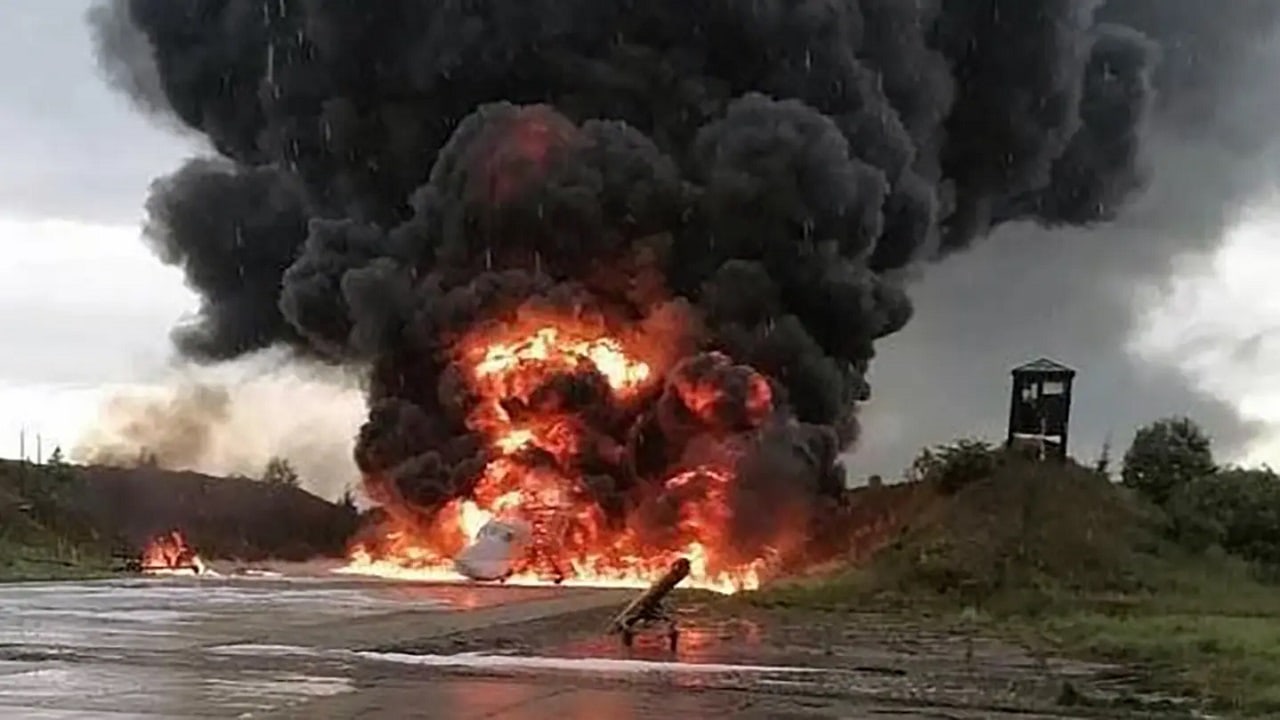
Western and Ukrainian reports of long-range strikes are often described as episodes: airport closures, flight delays, fires at facilities, troop redeployments. But the military significance accumulates here not through one major breakthrough, but through the sum of small coercions. Russia is forced to keep more air defense assets not where they are theoretically more needed at the front, but where even a limited incident is politically unacceptable. It must more frequently disperse its aviation, change routes, secure airfield infrastructure, enhance radar surveillance, and spend expensive interceptors on relatively cheap targets. In the economy of war, this is always a bad exchange.
In fact, this is why Zelensky's statement is more important than it seems. He is not claiming that Ukraine has achieved air superiority over Russia. He is saying something else: the familiar mode of operation of Russian airspace is being blurred. And in such wars, the blurring of norms is often more dangerous than a single catastrophe. One closed airport is unpleasant. The constant expectation that tomorrow another will have to be closed, another division repositioned, and another restriction imposed changes the behavior of the entire system. It begins to operate not by plan, but by alarm.
Russia's Response Shows Strategic Choice
Putin's reaction in this context is noteworthy. If the Kremlin truly believed the rear was sufficiently protected, it could use diplomatic rhetoric as a tool for de-escalation. Instead, we hear the familiar formula: Russia is supposedly winning on the battlefield and therefore is not obliged to negotiate on the enemy's terms (Reuters, September 1). This is typical of a system that tries to compensate for its growing vulnerability by demonstrating political toughness. When material security becomes less reliable, symbolic inflexibility becomes even more mandatory.
Hence the parallel refusal of Moscow to see grounds for returning to the Black Sea grain deal. At first glance, this is a separate diplomatic issue. In reality, it is connected to the same calculation. The Kremlin does not want to return to a regime of partial normalization while it believes that military pressure still brings more benefits than economic concessions. And the strikes on the Odessa region reported on September 2 confirm this line: if the Russian rear becomes less calm, the response will not be softening, but an attempt to raise the cost for Ukrainian infrastructure and exports (Reuters, September 2).
Russian Depth Is No Longer a Free Resource
The most important change is that the concept of "depth" for Russia is ceasing to be a free resource. In the Soviet military tradition, depth meant space for accumulating forces, a second echelon, resilience after the first strike. Today, however, depth requires increasingly greater expenditures to protect itself. It is almost an irony of history: a country that has built its strategy on the scale of territory for decades is facing the reality that scale no longer guarantees security automatically. It only increases the number of assets that potentially need protection.
Ukraine, of course, is not capable of physically paralyzing all of Russian airspace. But it does not need to. It is enough to create uncertainty for Russian command about which specific areas of the rear will remain outside the war in the usual sense tomorrow. Such uncertainty is already affecting resource distribution and political imagination. In other words, Kyiv is not destroying Russian depth; it is transforming it from an advantage into a growing obligation.
This is the most unpleasant effect of long-range drones for Moscow: they do not necessarily destroy a key asset, but they almost always destroy the old confidence that the rear exists separately from the front.
Therefore, September 2026 will likely enter the chronicle of this war not as a moment of sudden turning point, but as a point at which it became finally clear: Russian airspace can no longer be described in the language of peaceful rear. It is not yet lost, but it is already contested. And contested skies always come at a high cost for the defender, especially if they are used to considering it their own by default. Russia will be able to adapt to this regime, but only at the cost of further dispersal of air defense, complicating logistics, and increasing dependence on reaction to threats instead of strategic freedom. For a protracted war, this is a bad symptom, even if official Moscow continues to say otherwise.
Ukrainian long-range drones are impacting Russian airspace and logistics in September 2026, creating uncertainty in the rear areas of Russia. President Zelensky has advised airlines to evaluate risks for flights over Russia, while the Russian military is reallocating air defense resources in response to these threats. This shift indicates that the traditional concept of strategic depth for Russia is becoming increasingly costly and uncertain.
- Ukrainian drones are reportedly closing Russian airspace.
- President Zelensky advises airlines to assess flight risks over Russia.
- Russia is forced to allocate more air defense resources due to drone threats.
- The concept of strategic depth for Russia is becoming a costly liability.
- Russian military responses indicate a shift in their operational strategy.