
Under Assault — JNIM Tests Bamako's Security Belt with Drones and Armored Vehicles
 Marie Dubois
San under assault — JNIM tests the security perimeter of Bamako with drones and armored vehicles
On August 9, at 5:30 AM, a column from JNIM attacked the barracks of the 23rd Infantry Regiment of San, about 400 kilometers from Bamako on the RN6. Two hours of fighting, an armored vehicle in the perimeter wall, drones above the courtyard: the city did not fall, but the message is clear. The Sahel jihad is no longer confined to the North.
A combined assault at dawn
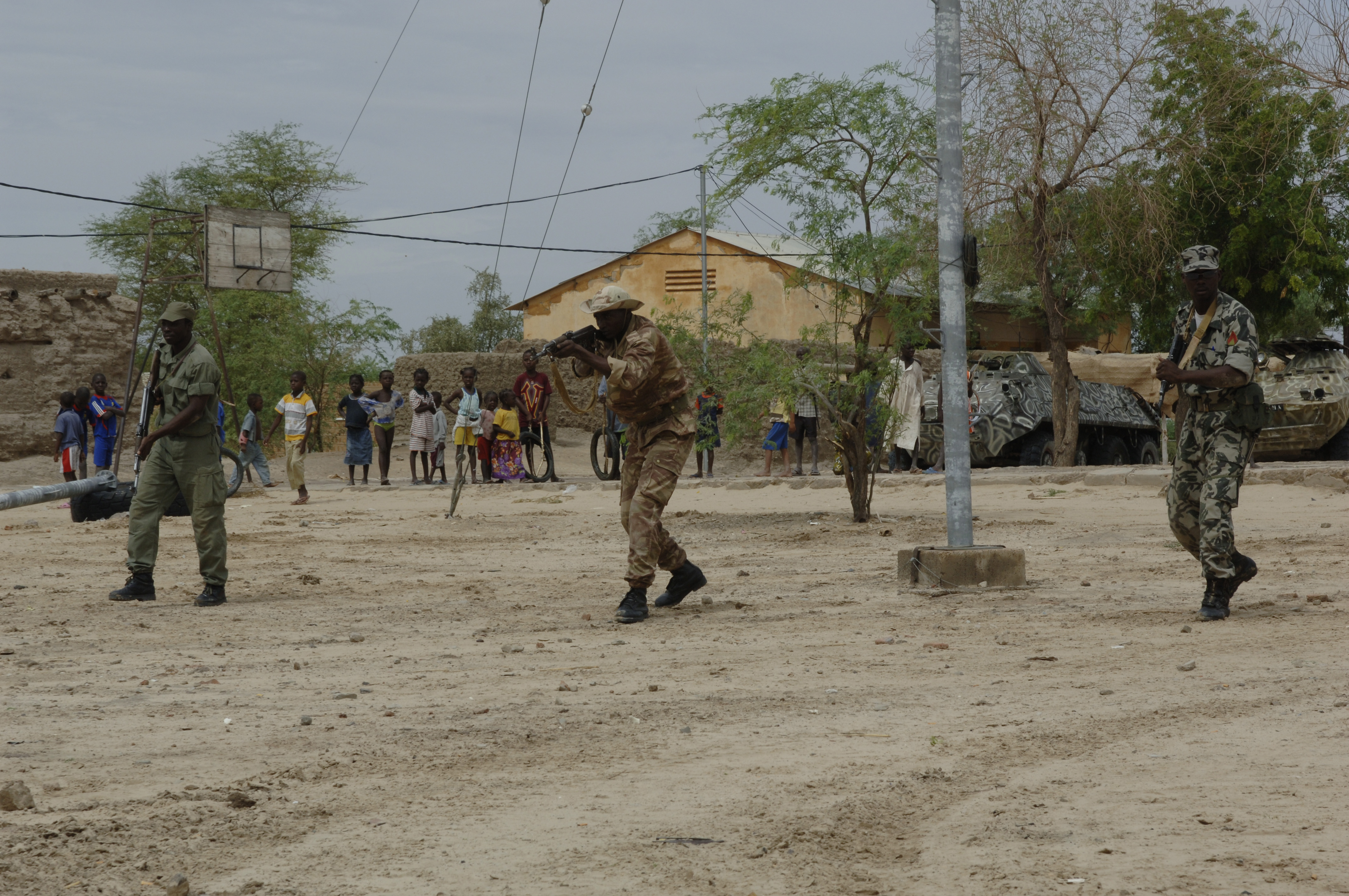
The general staff of the FAMa describes a "complex" operation: heavy machine guns, suicide drones, drop drones, and two armored vehicles, one of which was reportedly used to breach the perimeter of the barracks. Some of the attackers arrived by motorcycle and on foot, some disguised in Malian army uniforms to infiltrate.
- Target: barracks of the 23rd Infantry Regiment of San (Ségou region)
- Time: 5:30 AM, Sunday, August 9, 2026
- Means: suicide drones, drop drones, heavy machine guns, two armored vehicles
- Duration: about two hours, according to witnesses cited by RFI
Lieutenant Colonel El Oumrani, commander of the regiment, states in a video that "the enemy has been eliminated" and that "40 terrorists" were killed. The general staff mentions "more than fifty" neutralized. Witnesses describe fighting 200-300 meters from the camp, attackers retreating into houses or the forest, and wounded being carried away during the retreat.
Two accounts, one reality
JNIM claimed responsibility for the operation and asserted that it had taken control of the base. The army denies this, while acknowledging — a rare occurrence — that it had "temporarily retreated" before regaining the camp. AFP, citing security and local sources, reports at least ten soldiers killed and a partial takeover of the barracks by the attackers.
When both sides recount the same battle, one can draw a certainty: the camp was breached, soldiers died, and JNIM withdrew with most of its forces.
The statement from the general staff "bows to the memory of the soldiers who fell in the line of duty" without providing any figures. When an army does not publish its losses, it is often because they are heavy.
San, the lock of central Mali
San is not a lost outpost in the bush. The city is a hub of the RN6, the route that connects Bamako to Sévaré and then to Gao — the supply road to the north. Striking San is to test the second belt around the capital, the one that Bamako believed was secure.
The center of the country has once again become the heart of the problem since the coordinated offensive in April, led by JNIM with the Azawad Liberation Front: Defense Minister Sadio Camara was killed near Kati, the Kidal base fell on April 25. Raids on isolated garrisons have followed — Boulkessi in June, where around sixty security personnel were killed according to reports, followed by strikes claimed in the regions of Timbuktu, Kayes, and Ségou.
What the tactics reveal
The combined use of suicide drones and drop drones confirms an evolution that JNIM has been systematizing since 2023: the technological threshold is no longer an obstacle. The recovered uniforms, the ram armored vehicle, the synchronization of axes: this is no longer the classic ambush. It is a prepared breakthrough operation, with infiltration, light air support, and coordinated maneuver — the same know-how that was used in Kidal in April.
And a perfectly honed information war: immediate claim of responsibility, propaganda disseminated, while Bamako speaks of "victory." The truth, from experience, lies somewhere in between: the defense held, but the initiative still belongs to the attacker.
What it changes for Bamako
The strategic question is not how many attackers died. It is whether the chain of garrisons in the center can hold the RN6 axis. If San falls one day, Sévaré is directly threatened, and with it the road to the north and the supply to Gao.
The immediate risk, in my opinion, is not a new takeover of a barracks: it is the blockade. Cutting the RN6 through repeated ambushes and improvised devices would be enough to economically strangle the entire north of the country, without a single camp falling.
The next target may not be a base. It will be a convoy, a bridge, a stretch of asphalt. It is there, between San and Sévaré, on these 200 kilometers of axis still nominally under Bamako's control, that the war in central Mali will be fought this fall. And this time, no one will be able to say it was unexpected.
JNIM launched a combined assault on the 23rd Infantry Regiment barracks in San at 5:30 AM on August 9, 2026, resulting in significant casualties. The attack lasted approximately two hours, with reports of at least ten soldiers killed and over fifty terrorists neutralized. The Malian Armed Forces temporarily retreated before regaining control of the barracks, highlighting a shift in JNIM's operational tactics involving heavy weaponry and drones.
- JNIM attacked the 23rd Infantry Regiment barracks in San.
- The assault lasted approximately two hours.
- The Malian army acknowledged a temporary retreat before regaining control.
- At least ten soldiers were reported killed, with conflicting casualty figures from both sides.
- The operation involved heavy weaponry and drones, indicating a shift in tactics by JNIM.