
Unified Force AES 2026 — 6,000 Men Seek a Way Out of the Sahel Trap
 Marie Dubois
AES Unified Force 2026 — 6,000 Men Seek a Way Out of the Sahel Trap
In Niamey, the headquarters of the Unified Force of the Alliance of Sahel States is no longer just a political announcement. Since the launch of the 6,000-man deployment, the staffs of Mali, Burkina Faso, and Niger are trying to transform a solidarity of juntas into a military tool. It is few in numbers for three such vast countries. It is a lot if this force actually achieves what the G5 Sahel has never had — a command chain capable of moving units across borders without waiting for the agreement of three capitals.
The timeline gives weight to this experimentation. The Security Council Report from July 2026 emphasizes that the Security Council must revisit West Africa and the Sahel this month, with a briefing from UNOWAS, as the coordinated attacks on April 25 in Mali, the pressure on the roads to Bamako, and the assault on June 18 against Niamey International Airport have shown that jihadist groups know how to strike command centers, logistical routes, and state symbols. In this theater of operations, a common force will be judged neither on its press releases nor on its flags. It will be judged on the tracks between Ansongo, Tillabéri, Dori, and Gao.
The New Factor is Command
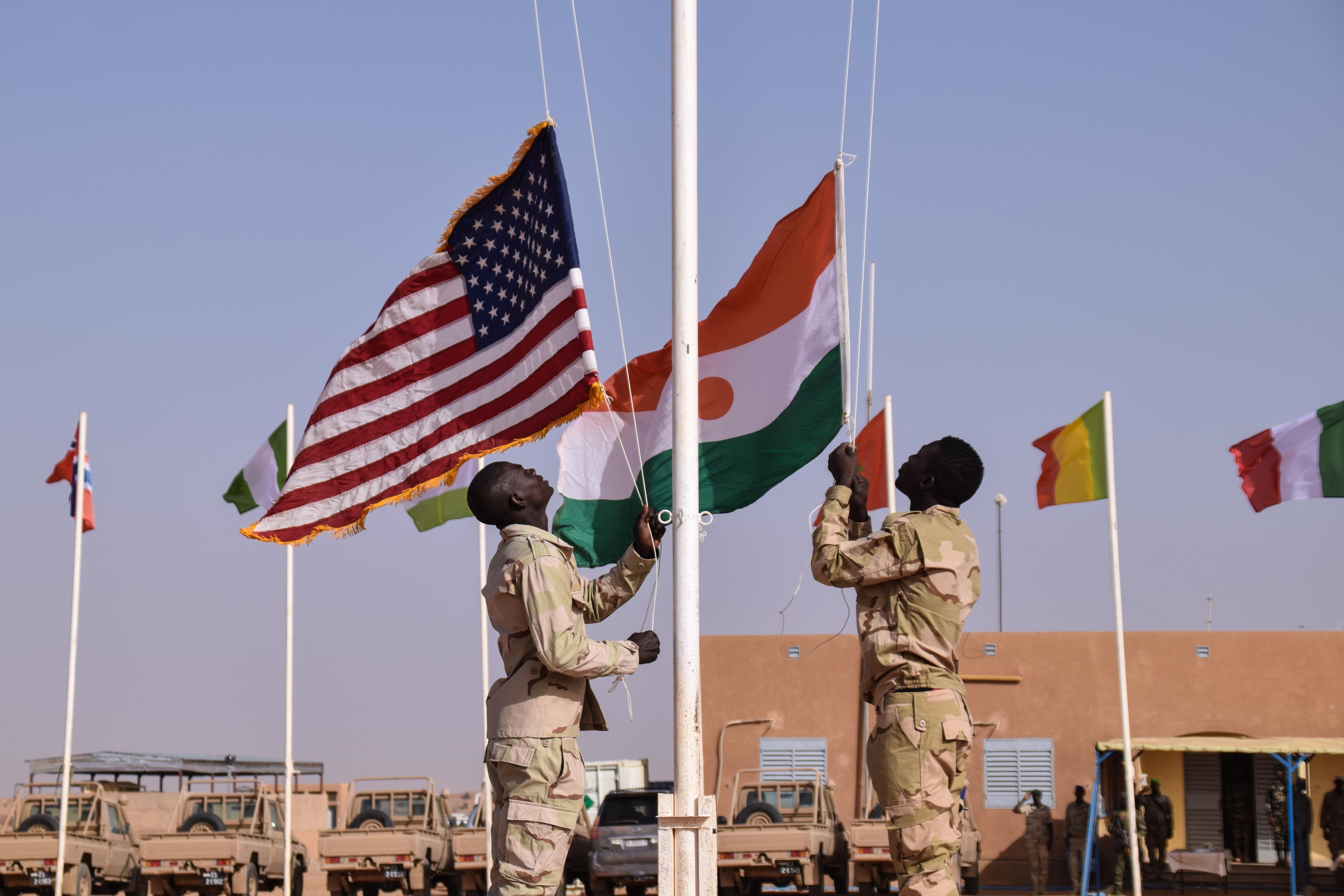
The Institute for Security Studies reminds us that the AES Unified Force, based in Niamey, succeeds two unfinished or weakened attempts — the multinational force of Liptako-Gourma announced in 2017 and the G5 Sahel Joint Force. The G5 had conducted operations, seized equipment, and neutralized fighters. But it never imposed a decisive presence, lacking stable funding, sufficient air assets, and above all, a functional intelligence system.
The difference announced by the AES lies in the freedom of movement. The former G5 battalions were confined to geographical sectors, with a pursuit right limited to about 100 kilometers on either side of the borders. The new structure aims to allow its headquarters to move units within the three countries without having to go through each national staff again. On paper, this is a real break.
On the ground, it is harder. A column leaving Tillia towards the three-border area must solve very ordinary problems — fuel, tires, radio relays, evacuation of the wounded, identification of friendly or hostile villages. In the Sahel, a staff map can quickly lie. The season, the state of the tracks, and the ability to hold an advanced base count as much as the sovereignist discourse.
The Yereko 2 Precedent Provides a Hint, Not Proof
The Yereko 2 operation, conducted between February and March 2025 in Liptako-Gourma by the forces of the three countries, now serves as a reference for AES supporters. It demonstrated a minimal capacity to coordinate units in an area where borders are more administrative than operational. It also confirmed an obvious fact that Western armies have sometimes taken too long to understand — armed groups do not think in terms of borders, but in corridors.
These corridors are known. They transport motorcycles, fuel, light weapons, commercial drones, informants, and sometimes forcibly taxed food. They pass through markets, secondary tracks, and villages that change loyalty depending on the actual presence of the state. When Jama’at Nusrat al-Islam wal-Muslimin, or JNIM, exerts pressure on the roads leading to Bamako, it is not just seeking a tactical victory. It is testing the state's ability to feed, supply, and reassure its own capital.
This is where the Unified Force can be useful. Not as a parade army, but as a reaction tool in the gray areas between national armies. An ambush near the Burkinabé border can no longer wait for Ouagadougou, Bamako, and Niamey to negotiate the authorization for pursuit. From experience, the enemy disappears while the procedures circulate.
The Trap of Closed Autonomy
The AES presents its model as a way out of dependence on Paris. On this point, the political argument is strong. The three capitals have built their legitimacy on the rejection of the old French architecture and on the idea that Sahelian security must be decided by Sahelians. This claim is not artificial. Many Malian, Nigerien, or Burkinabé soldiers have experienced Barkhane as a necessary but humiliating presence, useful in combat, politically costly.
But autonomy can become a cage. ISS Africa notes that the flows of weapons, fuel, motorcycles, and drones also cross Nigeria, Benin, Ivory Coast, Togo, Ghana, Guinea, and Senegal. However, the AES has separated from ECOWAS. A Sahelian force that cuts intelligence channels with its coastal neighbors will offer jihadists exactly what they seek — harder political borders for states, but more porous for armed networks.
The Niger case is telling. The attack on June 18 against Niamey Airport, claimed by JNIM according to reports cited by the Security Council Report, killed eleven soldiers and two civilians according to authorities, while twenty-two assailants were reportedly shot dead. This site is not an isolated village in Tillabéri. It is a strategic installation linked to the capital and the AES architecture. If JNIM can hit this type of target, it can also exploit the gaps between intelligence services, air forces, and protection units.
Russia, Turkey, Iran, and China Do Not Replace Local Intelligence
The equipment of the AES now comes from several directions — Russia, Turkey, Iran, China. This diversification reduces dependence on a single partner, but it does not solve the main problem. An army can buy drones, armored vehicles, or radios. It cannot instantly buy the trust of a village that has seen three patrols and two armed groups in the same week.
The role of the Africa Corps remains central, especially in Mali, where the Russians participate more directly in operations than in the other two countries. However, recent setbacks around Kidal and the consolidation of Russian forces near Bamako show the limits of external support focused on firepower. The Sahelian war is not just a war of strikes. It is a war of presence, human intelligence, and open roads.
The AES Unified Force thus has a narrow window. If it becomes a mobile, sober structure capable of supporting local units and communicating with neighbors despite diplomatic breaks, it can correct an old weakness of central Sahel. If it becomes just another political banner, it will join the G5 on the list of architectures that promised integration without dominating the ground.
The Next Test Will Be Logistical
The next test will likely not be a large battle. It will be more discreet — a fuel route to reopen, an advanced base to maintain during the rainy season, a cross-border pursuit to coordinate before nightfall. That is when we will know if the 6,000 men of the AES form a force or just a number.
In the coming weeks, I will mainly monitor three axes: Gao–Ansongo–Tillabéri, Dori–Téra, and the southern routes towards Benin and northern Nigeria. If JNIM or the Islamic State in the Sahel manage to impose lasting checkpoints there, the AES will have failed its first operational test even before delivering its grand demonstration.
Sources: Security Council Report, July 2026 West Africa and the Sahel Monthly Forecast; Institute for Security Studies, “Will the AES Unified Force succeed where the G5 Sahel failed?”; UN Security Council statement SC/16360.
The Unified Force of the Alliance of Sahel States (AES) is deploying 6,000 troops to seek a route out of the Sahel trap, focusing on military coordination among Mali, Burkina Faso, and Niger. In July 2026, the AES aims to establish a command chain for cross-border operations, responding to recent jihadist attacks on strategic locations. The operation Yereko 2 has shown minimal coordination capabilities, highlighting the challenges faced by the AES in the region.
- 6,000 troops are deployed in the Sahel region.
- The AES aims to establish a command chain for cross-border operations.
- Recent attacks by jihadist groups have targeted strategic locations in Mali and Niger.
- The AES seeks to improve military coordination among Mali, Burkina Faso, and Niger.
- The operation Yereko 2 serves as a reference for AES's operational capabilities.