
Upgraded Stryker variant debuts on NATO’s east flank
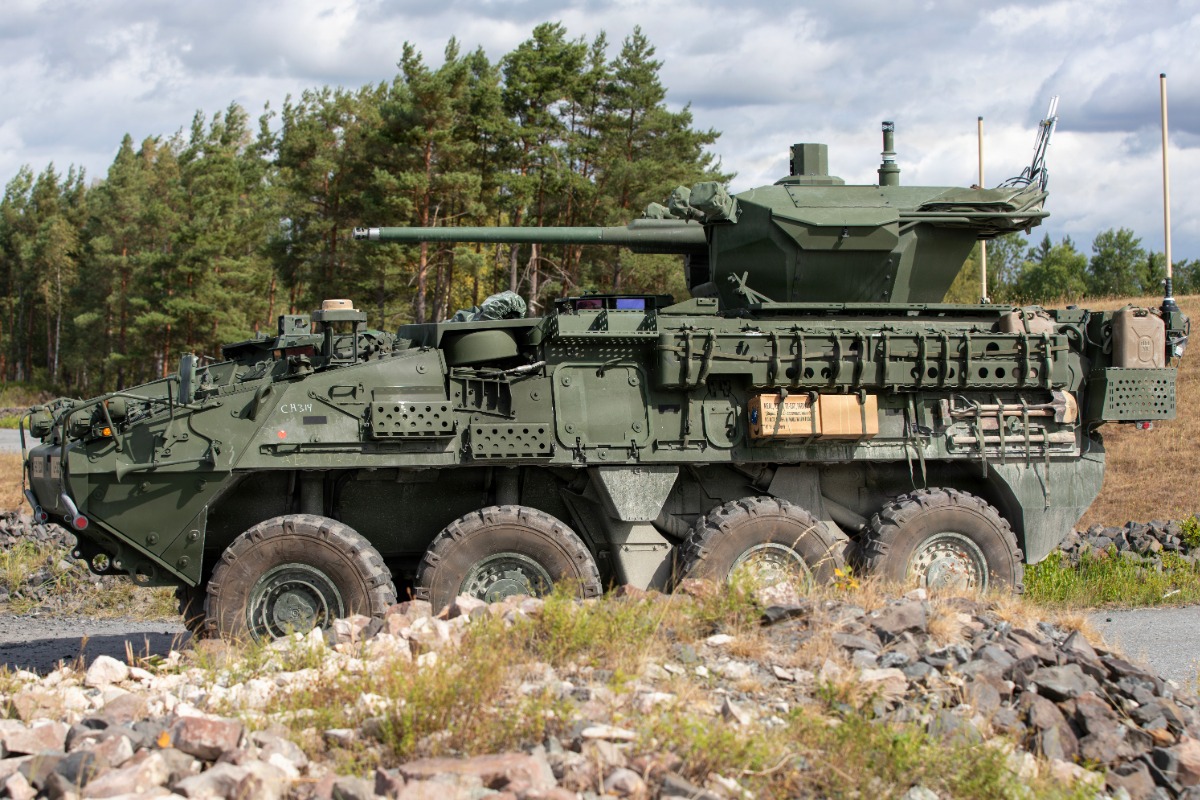
A Stryker squadron based in Vilseck, Germany, fired live ammunition from newly upgraded Stryker vehicles for the first time in Europe this week, Stars and Stripes reported.
The 3rd Squadron, 2nd Cavalry Regiment conducted the gunnery exercise August 20 at the Grafenwoehr Training Area, using the new ICVVA1-30mm variant of the Stryker Double-V Hull Infantry Carrier Vehicle.
The unit is the first outside the United States to receive the upgraded vehicles, according to Stars and Stripes. Twenty of the new Strykers began arriving in February and will be fielded across the rest of the regiment, Capt. Alexander Stamatiou, commander of the squadron’s Killer Troop, told the outlet.
The vehicles carry a 30 mm semiautomatic cannon in addition to M240 machine guns. Some are also equipped with self-contained 120 mm mortars, .50-caliber machine guns and mounted Javelin anti-tank launchers, Stamatiou said.
“Versus a peer adversary, for an infantry carrier vehicle these are unmatched,” Stamatiou said.
The Army selected Oshkosh Defense in June 2021 to integrate the 30 mm Medium Caliber Weapon System onto the Stryker ICVVA1, under a six-year requirements contract with partners Pratt Miller Defense and Rafael Advanced Defense Systems worth up to $942.9 million. The weapon system is based on Rafael’s SAMSON turret family. The Army has since ordered 269 upgraded vehicles for $356 million to outfit three Stryker Brigade Combat Teams, along with additional units for testing and logistics development. Oshkosh delivered the first upgraded vehicle to the Army’s Aberdeen Test Center in August 2022, and fielding began in 2023 with the 1-2 Stryker Brigade Combat Team at Joint Base Lewis-McChord in Washington state.
The new variant also gives infantry squad leaders independent sights that let them designate targets for the vehicle’s gunner, Spc. Spencer Riley told Stars and Stripes.
“There’s actually a feature where I can flip a switch and my gun will automatically move to what he’s looking at,” Riley said. “And then I can engage straight from there.”
Soldiers said the upgraded vehicle also lets crews reload weapons and perform maintenance from inside the vehicle rather than climbing outside it. Sgt. Oliver Estela demonstrated that capability during the exercise when a round jammed in his machine gun. Estela climbed into the vehicle’s unmanned turret, cleared the jam and resumed firing within minutes.
“It’s more convenient,” Estela said, calling the new Stryker variant “way more capable than our older platforms.”
The vehicles also feature improved engines, optics, communications and targeting systems compared with earlier Stryker models, Stamatiou said.
Separately, the Army has been testing vehicle-mounted and wearable counter-drone systems through an initiative called Project Flytrap, aimed at detecting, tracking and jamming hostile drones. Personnel transport vehicles have increasingly come under attack from first-person-view and commercial drones during the war between Russia and Ukraine.
“I’ll take one of these any day of the week,” Riley said of the upgraded Stryker. “You can reach out and touch somebody pretty far with these things. You got a nice armor-piercing round.”
Content preview only. Full article available at source. View Full Article
The 3rd Squadron, 2nd Cavalry Regiment conducted a live ammunition gunnery exercise with upgraded Stryker vehicles at the Grafenwoehr Training Area in Germany on August 20, 2023. This marked the first use of the new ICVVA1-30mm variant in Europe, featuring advanced weapon systems including a 30 mm cannon and Javelin anti-tank launchers. The upgraded vehicles enhance operational capabilities for the unit.
- The 3rd Squadron, 2nd Cavalry Regiment conducted a gunnery exercise with upgraded Stryker vehicles.
- The exercise took place at the Grafenwoehr Training Area in Germany on August 20, 2023.
- The upgraded Stryker variant includes a 30 mm cannon and other advanced weaponry.
- Twenty upgraded Strykers were delivered to the unit, with plans for more to be fielded.
- The vehicles allow for improved operational capabilities and maintenance from within the vehicle.