
US Air Force's 2026 6,000-Sortie Pacific Plan Tests Four Airfields Against Chinese Missiles
 Marcus Chen
US Air Force's 2026 6,000-Sortie Pacific Plan Tests Four Airfields Against Chinese Missiles
The U.S. Air Force wants to conduct more than 6,000 aircraft operations a year across four airfields in the Northern Mariana Islands. That sounds like resilience. It is also a warning that Washington no longer believes Guam, or any single major base, can absorb the opening salvo of a Pacific war.
The Numbers Behind the Plan
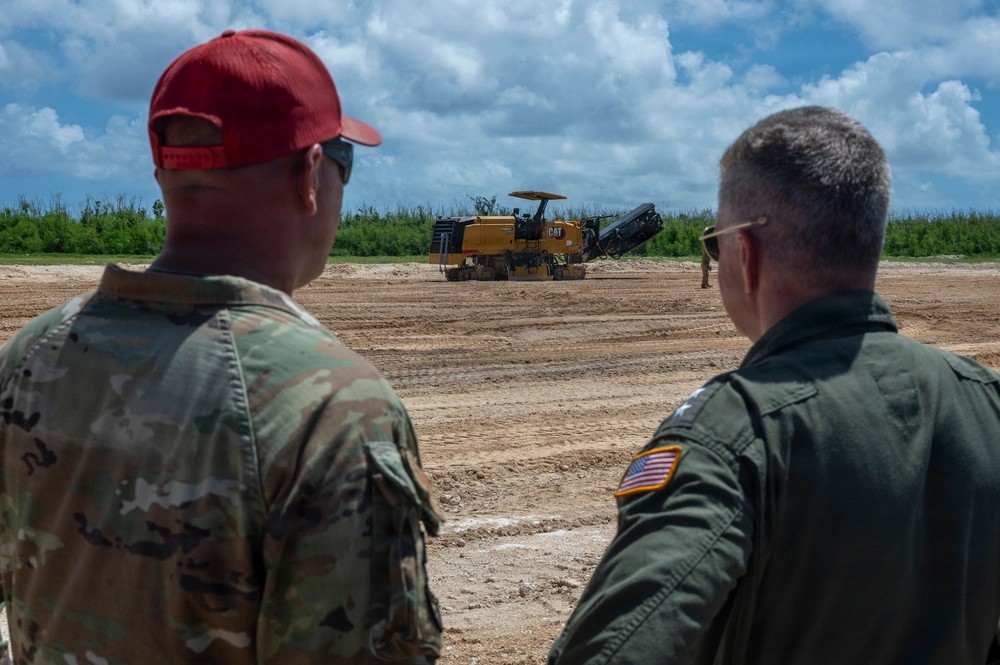
The Department of the Air Force's October 28 notice covers Saipan International Airport, Tinian International Airport, Tinian North Field and Rota International Airport. Under the preferred training scenario, each field could support as many as 1,200 fixed-wing and 320 rotary-wing operations annually. Multiplied across four locations, that is up to 4,800 fixed-wing and 1,280 rotary-wing movements.
The proposed footprint is not just aircraft. The notice allows for up to 550,000 gallons of fuel and 1,000 personnel at each airfield, plus temporary expeditionary infrastructure and the handling of chaff, flares and munitions. In aggregate, the planning ceiling approaches 2.2 million gallons of fuel and 4,000 personnel. Those are useful measures of the sustainment problem the Air Force is trying to solve.
Why Tinian Matters
Tinian is the most politically resonant site in the package. U.S. bombers operated from its North Field during World War II, but the runways later disappeared beneath vegetation. In 2024, the Air Force awarded Fluor roughly $409 million to complete a Tinian airfield project over five years. Defense News reported that the island sits about 1,500 miles east of the Philippines and north of Guam, placing it inside the operating geography that matters for a Taiwan contingency.
The four fields are separated by only a few dozen nautical miles and sit less than 100 nautical miles north of Guam. That geography is valuable for training: aircraft and support teams can practice moving between a commercial airport, a refurbished wartime field and expeditionary sites without the transit burden of a long island-hopping exercise.
Dispersal Solves One Problem and Creates Three
Agile Combat Employment is built around a straightforward premise. If Chinese missiles can find and suppress one runway, the United States should have several other runways available. Smaller force packages also complicate targeting and make an adversary spend more weapons for less operational effect.
But a runway is not a sortie. The Air Force must move fuel, spare parts, weapons, maintainers, air-defense teams and communications equipment to each location. Four sites with 1,000 personnel apiece do not create four independent bases if all of them depend on the same tanker routes, satellite links or Guam-based command nodes. Dispersal without distributed logistics is merely a larger list of targets.
The second problem is runway recovery. A Chinese missile campaign would not need to destroy every airfield permanently. Cratering one runway, damaging fuel storage or cutting the port and road links could create a pause long enough to break the sortie cycle. The CATE proposal's temporary infrastructure is useful for exercises, but combat survivability requires hardened fuel, redundant power, rapid repair equipment and crews that can work under attack.
The third problem is political. The Department of the Air Force is only beginning an environmental impact statement. Public meetings are scheduled for November 18 on Saipan, November 19 on Tinian and November 21 on Rota. The draft is not expected until fall 2027, with a final version in summer 2028. A concept intended to answer a near-term missile threat is still moving through a multi-year approval process.
The Strategic Tradeoff
The Pacific basing plan is still worth pursuing. A force concentrated on Guam presents China with an attractive first-day target; a force distributed across the Marianas raises the cost of suppressing U.S. airpower. The islands also give the Air Force more options for rotating fighters, bombers, tankers and unmanned systems through the first island chain's rear areas.
However, the 6,000-operation figure should be read as a planning aspiration, not combat power. Training sorties are scheduled, supported and conducted in a permissive environment. Wartime sorties are constrained by missile attacks, weather, maintenance, fuel deliveries and the availability of weapons. The real test will be whether the Air Force can sustain meaningful sortie generation after the first 72 hours, when damaged runways and depleted stocks matter more than the number of airfields on a map.
Four runways can complicate China's targeting problem. They cannot, by themselves, solve America's logistics problem.
Conclusion
Washington is rebuilding Tinian because the old model of one large Pacific base is too brittle. That is the correct diagnosis. But the cure will fail if the Pentagon counts concrete and runway movements while underfunding fuel resilience, air defense, repair crews and sealift. The Air Force has until 2028 to finish the environmental process. China will not wait until 2028 to improve its missile force. The math only works if the support network arrives before the aircraft do.
Sources
The U.S. Air Force plans to conduct over 6,000 aircraft operations annually across four airfields in the Northern Mariana Islands, including Saipan, Tinian, and Rota, to enhance military resilience against potential Chinese missile threats. Each airfield will support significant personnel and fuel logistics, with a focus on dispersing operations to complicate targeting by adversaries. The initiative reflects a shift from reliance on single major bases like Guam to a more distributed operational approach.
- U.S. Air Force plans over 6,000 aircraft operations annually across four airfields in the Northern Mariana Islands.
- Each airfield can support up to 1,200 fixed-wing and 320 rotary-wing operations annually.
- The planning includes up to 550,000 gallons of fuel and 1,000 personnel at each airfield.
- The Air Force is rebuilding Tinian airfield for strategic military purposes.