
U.S. Army awards $2.2 billion to build nuclear microreactors
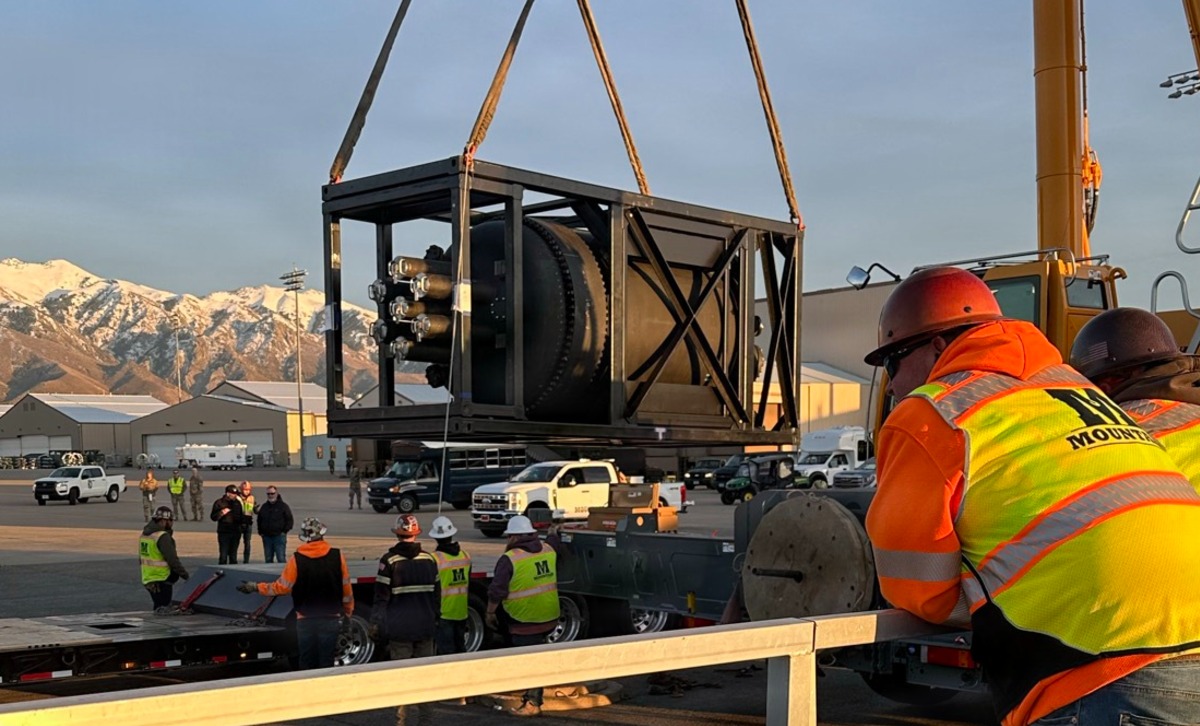 A containerized nuclear power reactor at Hill Air Force Base, Utah, Feb. 15, 2026. Photo by Anthony Pham
The U.S. Army has selected five companies to build and operate nuclear microreactors at military installations across the country, awarding up to $2.2 billion in combined funding under its Janus Program, the Army announced.
Westinghouse Government Services will supply its eVinci microreactor to Fort Drum, New York. Antares Nuclear will build at Fort Bragg, North Carolina. BWXT Advanced Technologies is set for Fort Campbell, Kentucky. General Atomics Electromagnetic Systems will deliver to Fort Hood, Texas. Radiant Industries will build at Fort Benning, Georgia.
The Janus Program is run in partnership with the Department of War Innovation Unit and is intended to move advanced microreactor technology beyond test programs and into sustained operation at defense installations, according to the Army.
“Reliable energy is fundamental to mission assurance, operational readiness and national security,” said Rich Rademacher, President of Westinghouse Government Services. “The selection of the eVinci microreactor for the Janus Project highlights the important role advanced nuclear technology can play in providing resilient, long-duration power to the warfighter.”
“The Janus Program is about transitioning from designs and experiments to reliable commercial hardware which secures our energy independence,” said Dr. Jeff Waksman, Principal Deputy Assistant Secretary of the Army for Installations, Energy and Environment. “The Janus Program vendors were selected through a deeply rigorous evaluation on technical, financial, and organizational capabilities conducted by an All-Star panel of dozens of experts from across the nation.”
The eVinci is a heat-pipe reactor Westinghouse says is designed to provide continuous electricity for eight years without refueling. The planned microreactors across the five installations will generate under 20 megawatts of electricity each and occupy less than five acres of land, according to the Army.
Radiant disclosed the largest agreement among the five vendors: up to $750 million to deploy 15 factory-built, 1-megawatt Kaleidos microreactors by 2030, beginning with a three-unit installation at Fort Benning. Radiant’s Kaleidos reactor is transportable by land, sea or air and is designed to be deployed directly at customer sites, according to the company.
“The Army’s $750 million award shows confidence in Radiant’s product and ability to manufacture, deploy and safely operate nuclear microreactors for the American military,” said Tori Shivanandan, president and chief operating officer of Radiant.
None of the planned reactors will use highly enriched, weapons-grade uranium, according to Waksman.
The Janus Program follows the Pentagon’s 2022 Project Pele initiative, which developed a portable 40-ton reactor capable of generating 1 to 5 megawatts of power. Army officials said the current program is funded for five years, with a target of having at least one microreactor producing usable electricity at an installation by September 30, 2028.
The five sites selected represent the first tranche of installations under Janus, with Army officials anticipating that additional private investment from the companies could bring the total number of microreactors across all installations to more than 20.
The push into military nuclear power comes as private companies increasingly move into a fuel-cycle sector long dominated by government programs. Christo Liebenberg, co-founder of uranium enrichment company LIS Technologies, told The Defence Blog in March that domestic enrichment capacity sits at the center of both civilian and defense nuclear infrastructure, and that private firms can move faster than institutional programs in developing fuel supply for smaller reactors built for remote or secure military installations.
Content preview only. Full article available at source. View Full Article
The U.S. Army awarded contracts totaling $2.2 billion to five companies for the construction of nuclear microreactors at military installations, including Fort Drum and Fort Bragg. This initiative, part of the Janus Program, aims to enhance energy independence and operational readiness by deploying advanced nuclear technology. Each microreactor will provide under 20 megawatts of electricity and is designed for long-term operation without refueling.
- U.S. Army awarded $2.2 billion for nuclear microreactors under the Janus Program.
- Five companies selected for construction at various military bases.
- Each microreactor will generate under 20 megawatts of electricity.
- The program aims to enhance energy independence for military operations.
- No highly enriched uranium will be used in the reactors.