
U.S. Army to stress test its depots with cheap attack drone production
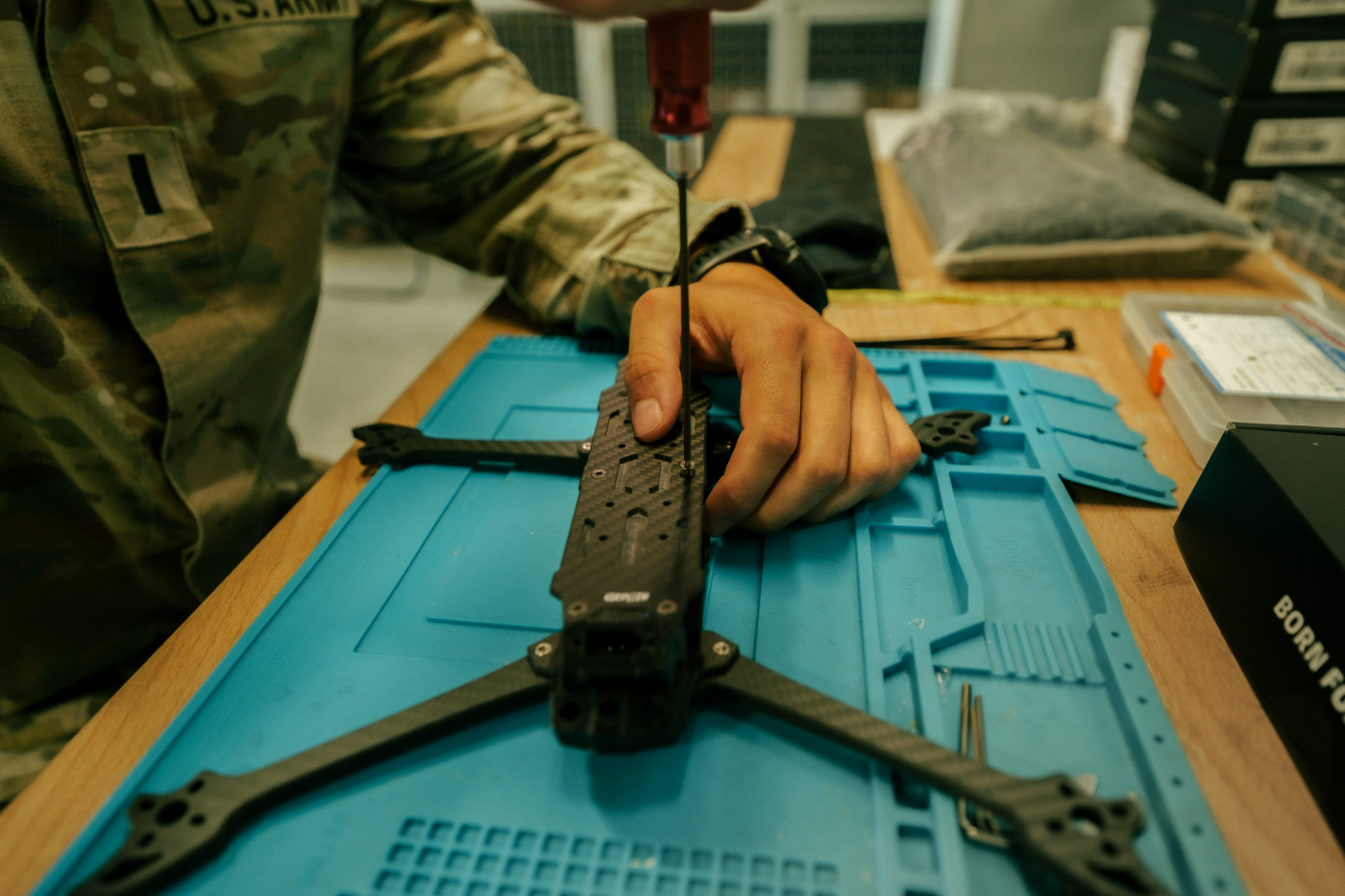
The U.S. Army wants companies to build 400 one-way attack drones that cost no more than $3,000 apiece, using motors, batteries and frames supplied by the government, as the first event of its new Manufacturing Rodeo, according to a solicitation from Army Contracting Command.
Selected companies would also deliver 20 ground control stations, with everything due by March 1, 2027. Ten percent of the aircraft and control stations have to arrive early, on Feb. 15, for testing and operator training. The winners then fly in their own category at the Drone Dominance Gauntlet III event in March 2027, and the best performers could unlock options to build up to 10,000 aircraft inside Army depots.
The U.S. Army asked companies to “help stress test our supply chain to deliver better tech to Soldiers,” and said Phase 1 solution briefs are due Friday, Nov. 20. The service said the rodeo covers drones and night vision devices. This solicitation is the drone portion.
Acting Secretary of the Army Adam Telle announced the rodeo at the Association of the U.S. Army conference on Oct. 12. He described it as a race between industrial base partners that “shows us exactly where it breaks.”
The aircraft are Group 1 first-person-view, or FPV, attack drones. Group 1 is the military’s smallest drone class, covering aircraft of up to 9 kg (20 pounds), as noted in our earlier reporting. The $3,000 cap is “strictly restricted,” the solicitation said. Every bidder has to submit a full bill of materials that lists each subcomponent and its manufacturing origin, down to wafer fabrication.
Companies will receive depot-made battery packs in 6S2P and 6S4P configurations, along with brushless motors in 2807 and 3115 sizes and 7-inch and 10-inch frame kits. The kit also includes MK118 lethality kits. The contractor’s job is to turn those parts into 400 “flight-ready” aircraft.
Building drones on Army-supplied motors and frames could show whether government depots can feed several commercial designs from one common parts pool. That would make it easier to swap suppliers or add new ones if a factory goes down.
The drones have to work under heavy jamming. The solicitation calls for frequency-agile, multi-band control links, fiber-optic tethered options with no radio signature, and backup navigation such as visual odometry, which uses a camera to track movement over the ground when GPS is unavailable. One operator has to be able to control 20 drones from a single durable ground station, a 1-to-20 ratio. The drones must also use open standards, including MAVLink-M and ATAK Cursor-on-Target messaging.
Targets listed in the solicitation include personnel in defilade, armored fighting vehicles and command posts, from close range out to “extended standoff depths.” Payload interfaces must accept training weights, inert payloads, live government-furnished lethality kits and commercial warheads.
Inspectors will check the work. The Defense Contract Management Agency will audit plants and tear down drones to confirm 100% assembly in the continental United States. The teardowns will also enforce “complete exclusion of covered foreign-adversary hardware, silicon, and firmware,” per the solicitation. Drones and ground equipment must meet the Drone Dominance Supply Chain Framework, which the Army says is more restrictive than the National Defense Authorization Act.
The second stage moves production into government plants. Companies that win the follow-on options would assemble drones on shared co-production lines inside Army depots, such as Rock Island Arsenal and Tobyhanna Army Depot, using government Level 2 technical data packages. The Army then plans to stress those lines with simulated feeder disruptions, raw material blockades and multi-shift surge transitions.
The Army framed the idea as pairing the “massive capital infrastructure” and explosives handling of its Organic Industrial Base with the speed of commercial drone makers. It also wrote that the effort avoids “subsidizing the buildout of bespoke, isolated commercial factories” that could shrink in peacetime.
The background section is blunt about why. Small drones and loitering munitions “are being consumed at consumption rates and volume comparable to conventional tube artillery,” the Army wrote. It said earlier efforts, including Project Jailbreak and the Drone Dominance Program, showed that commercial vendors “often struggle” with surge capacity, supply chain assurance and military safety and lethality standards.
The Department of War is already buying FPV drones in bulk through the Drone Dominance Program. After Gauntlet II, it is preparing orders for 60,000 attack drones from nine companies. That program grew out of Secretary of War Pete Hegseth’s July 2025 drone memo. The rodeo’s $3,000 cap matches the price target the Drone Dominance program set for close-quarters battle drones in its third phase.
The Army is running the competition as a Commercial Solutions Opening, which allows fixed-price awards for commercial products. It has three phases: written solution briefs, then pitches, then full proposals. Traditional and nontraditional defense contractors can both compete. The contracting office sits at Red River Army Depot in Texarkana, Texas, and the solicitation’s schedule lists Dec. 18 as the target award date.
Bidders must also submit a supply chain analysis with a plan to handle shortages. The Army says the whole effort is meant “to definitively validate the United States’ capacity to mass-produce lethal, affordable autonomous systems during sustained national security emergencies.”
Content preview only. Full article available at source. View Full Article
The U.S. Army is soliciting companies to produce 400 one-way attack drones and 20 ground control stations by March 1, 2027, with early delivery required by February 15 for testing. This initiative aims to stress test the Army's supply chain and validate its capacity for mass-producing affordable autonomous systems. The drones will be classified as Group 1 FPV attack drones, and the solicitation includes stringent requirements for components and assembly to meet military standards.
- The U.S. Army is soliciting the production of 400 one-way attack drones costing no more than $3,000 each.
- Companies must deliver 20 ground control stations by March 1, 2027, with 10% due by February 15 for testing.
- The drones are classified as Group 1 FPV attack drones, weighing up to 9 kg.
- The Army aims to stress test its supply chain and validate mass production capabilities for autonomous systems.
- The solicitation includes strict requirements for components and assembly to ensure compliance with military standards.