
US Army's 100 Drone Boats Won't Fix the Pacific Lift Gap
 Marcus Chen
US Army's 100 Drone Boats Won't Fix the Pacific Lift Gap
The U.S. Army had about 70 Pacific-based watercraft in 2024, down from 134 in 2018. The more important number is worse: the mission-capable rate had fallen from above 70 percent in 2020 to below 40 percent by 2024, according to Government Accountability Office figures cited by Defense News. That means the Army is not short a few boats. It is short a working maritime logistics system for the theater where geography matters most.
Maj. Gen. Gavin Gardner, commander of 8th Theater Sustainment Command in Hawaii, has now put a number on the possible answer. He told reporters this month that the command wants industry to deliver an autonomous vessel for testing as early as next summer, with the goal of building a fleet of 30 to 100 heavy-duty drone boats. Each vessel, he said, should carry eight to 10 standard shipping containers and operate forward from places such as Korea, Japan, the Philippines, Australia, Singapore and Thailand.
That is a serious move in the right direction. It is also a reminder that the Army is trying to solve a math problem it allowed to get too large.
The Container Count Is Not the Combat Count
A fleet of 100 autonomous vessels sounds large until the cargo is translated into combat requirements. At eight to 10 containers per trip, the theoretical lift is 800 to 1,000 containers if every boat is available, loaded, routed, protected, unloaded and returned on schedule. In peacetime briefings, that sounds like distributed logistics. In a shooting war, every verb in that sentence becomes a separate problem.
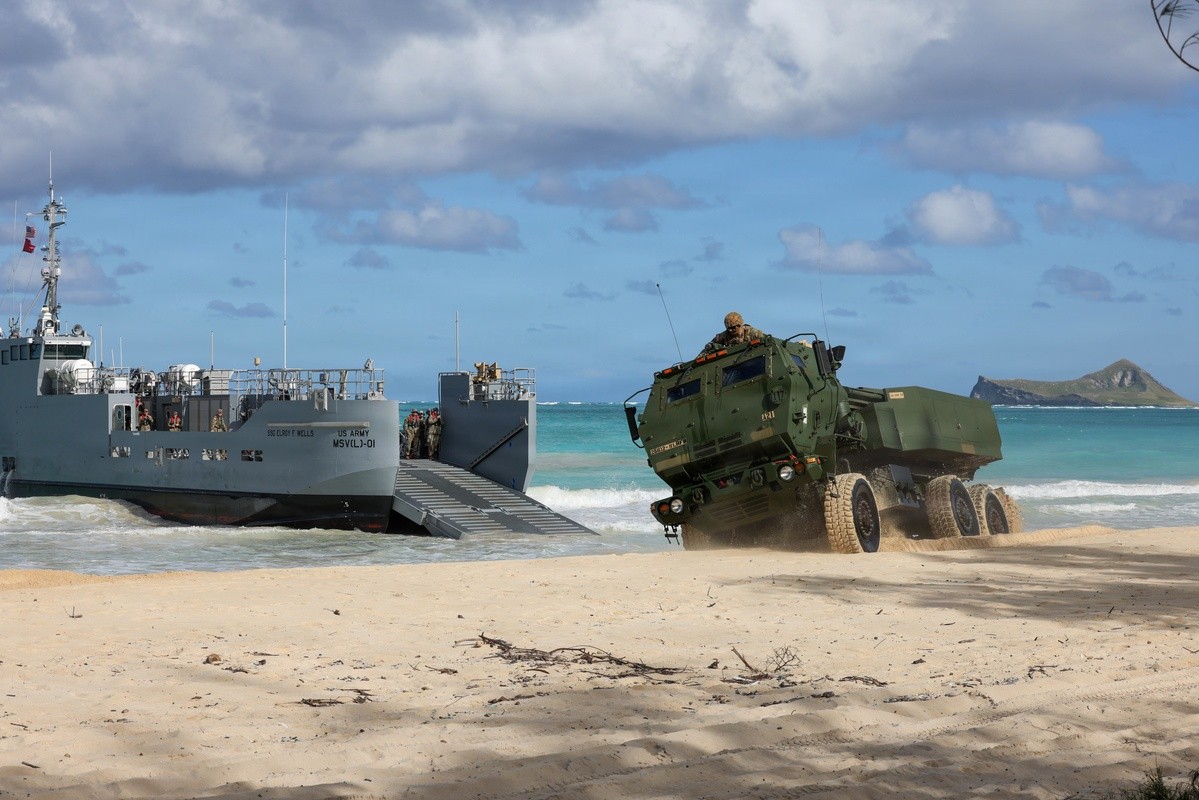
The Army's stated concept is sensible: use autonomous boats for routine port-to-port delivery, while keeping manned Army watercraft for operational maneuver onto beaches and austere landing sites. That distinction matters. A drone boat that can move containers from a friendly pier to another friendly pier is useful. It is not the same thing as a landing craft that can put a HIMARS launcher, fuel bladder, radar trailer or air-defense system onto a narrow beach under time pressure.
Anyone who has served on a ship understands the difference between a transit plan and an offload. The transit is the easy part. The hard part is the last mile, when weather, surf, pier damage, enemy surveillance, communications loss and beach gradients decide whether the cargo becomes combat power or a traffic jam.
The Army Is Rebuilding What It Nearly Walked Away From
The Army considered divesting much of its watercraft fleet around 2019. That decision now looks like a near miss. Since then, it has activated the 5th Transportation Company in Yokohama, pulled vessels out of prepositioned stocks, contracted U.S.-flagged offshore support vessels and planned additional composite watercraft companies. Gardner said the next company is expected to stand up in October, with another to follow next year.
This is not glamorous force design. It is the kind of work that decides whether long-range fires survive beyond the first salvo. A Precision Strike Missile launcher on Luzon or a radar on a small island is only as useful as the sustainment chain behind it. Missiles, generators, repair parts, tires, batteries, fuel and replacement crews all have to move across water at the same time that Chinese sensors are hunting predictable ports and airfields.
The Army's newest Maneuver Support Vessel (Light), MSV-L, shows what the service is trying to recover. In Hawaii this year, 8th TSC used an MSV-L to insert and extract a HIMARS launcher from an unimproved beach, a first for that platform. Army officials said the vessel can operate in shallow, reef-lined waters and land in less than four feet of water with a dry ramp. That is exactly the kind of capability an island-chain fight would demand.
But the Army expects only six more MSV-Ls, forward positioned in Japan. Seven shallow-draft landing craft are useful. They are not a theater logistics architecture.
Autonomy Helps Most Where Risk Is Repetitive
The best case for autonomous watercraft is not that they replace soldiers or mariners. It is that they absorb routine, repetitive, predictable movements that would otherwise burn scarce crew time. Gardner framed the concept this way: autonomous boats handle regular delivery, while manned vessels preserve commander options for beach landings and time-sensitive maneuver.
That division is realistic. It also imposes requirements that are easy to understate. Heavy autonomous boats operating from Korea to Australia need maintenance crews, pier access, cyber protection, communications pathways, fuel or charging arrangements, spare parts, legal permissions and host-nation confidence. A vessel that can carry 10 containers but cannot reliably clear port, avoid collision, communicate under jamming or get repaired forward is inventory, not logistics.
The Army's smaller tests in the Philippines show both promise and scale limits. During Salaknib 2026, U.S. soldiers used unmanned surface vessels to escort a Logistics Support Vessel approaching Casiguran, with the drones operating about six miles out and helping build the local operating picture. The movement supported transportation of Philippine personnel and vehicles more than 260 miles to Port Casiguran. That is useful reconnaissance and force protection. It is not yet heavy lift.
China Will Target the Pattern, Not the Platform
In a conflict with China, the vulnerability will not be one drone boat. It will be the pattern formed by dozens of them. Regular routes between known ports can be mapped. Loading cycles can be watched. Host-nation political constraints can slow dispersal. Commercial satellite imagery, maritime militia reporting, cyber collection and over-the-horizon sensors all make routine logistics more visible than commanders prefer.
This does not make autonomous vessels a bad idea. It means they must be treated as expendable components in a larger system, not as a clean technological workaround for missing hulls. The Army needs deception routes, decoy cargo, distributed maintenance sites, redundant control methods and enough manned craft to recover or bypass failed autonomous nodes. A 100-boat fleet with a 40 percent effective availability rate would leave commanders back where they started.
The U.S.-Philippine Maritime Cooperative Activity on June 27-28, which included maritime domain awareness and division tactics inside the Philippine Exclusive Economic Zone, shows the wider operating environment. The South China Sea is not an empty logistics lane. It is crowded, watched and politically sensitive. Moving supplies through it will require Coast Guard coordination, local permissions and disciplined escalation control, not only more hulls.
The Real Measure Is Days of Sustained Fire
Washington likes platforms because platforms can be counted. The better measure is days of sustained fires and maneuver after Chinese forces start targeting fixed infrastructure. If autonomous vessels can keep missiles, fuel and repair parts moving after the first week, they matter. If they only reduce peacetime transportation costs, they are a useful efficiency dressed up as wartime resilience.
The Army deserves credit for reversing course on watercraft before a crisis forced the issue. It also deserves pressure. The Pacific does not reward slogans about distributed operations. It rewards lift, maintenance, crews, beach access and the ability to keep moving when the map stops looking permissive.
One hundred drone boats would help. They would not fix the gap by themselves. The Army's problem is not autonomy. It is that for too long, it treated water as someone else's problem in the one theater where water is the battlefield.
The U.S. Army is addressing the Pacific lift gap by developing a fleet of 100 autonomous drone boats for logistics support, aiming for testing by summer 2025. The mission-capable rate of existing Pacific-based watercraft has significantly declined, prompting the activation of additional transportation units. The Army's new Maneuver Support Vessel (Light) has demonstrated capabilities for shallow-water operations, essential for island-chain conflicts.
- The U.S. Army's mission-capable rate for Pacific-based watercraft fell from above 70% in 2020 to below 40% in 2024.
- The Army plans to test autonomous vessels capable of carrying 8 to 10 shipping containers.
- The Army activated the 5th Transportation Company in Yokohama and is planning additional watercraft companies.
- The Army's newest MSV-L can operate in shallow waters and land in less than four feet of water.
- The report highlights the need for a robust logistics system in the Pacific theater.