
US Carrier George Washington Enters South China Sea but Deterrence Remains Thin
 Marcus Chen
US Carrier George Washington Enters South China Sea but Deterrence Remains Thin
One U.S. carrier strike group crossed the Luzon Strait on July 22 and entered the South China Sea after two Chinese confrontations with Philippine forces in five days. That is a useful signal. It is not a campaign plan.
The USS George Washington is the Navy's only forward-deployed nuclear-powered carrier, homeported in Yokosuka and now operating with Carrier Air Wing 5, the cruiser USS Robert Smalls, and the destroyers USS Benfold and USS Shoup. Navy Times reported that the strike group moved into the South China Sea after a July 20 Second Thomas Shoal incident in which Chinese Coast Guard personnel on an inflatable boat struck a Philippine Navy member with a wooden baton, followed by July 24 water-cannon attacks near Scarborough Shoal.
The timing matters because the U.S., Japan, and the Philippines had just completed a five-day maritime exercise from July 21 to 25 involving warships, coast guard vessels, surveillance aircraft, and fighter aircraft, according to Reuters. The exercise showed alliance coordination. The carrier movement showed escalation management. Neither resolves the central problem: China's coercion campaign is designed to operate below the threshold where a carrier's main firepower is usable.
The Carrier Changes the Air Picture
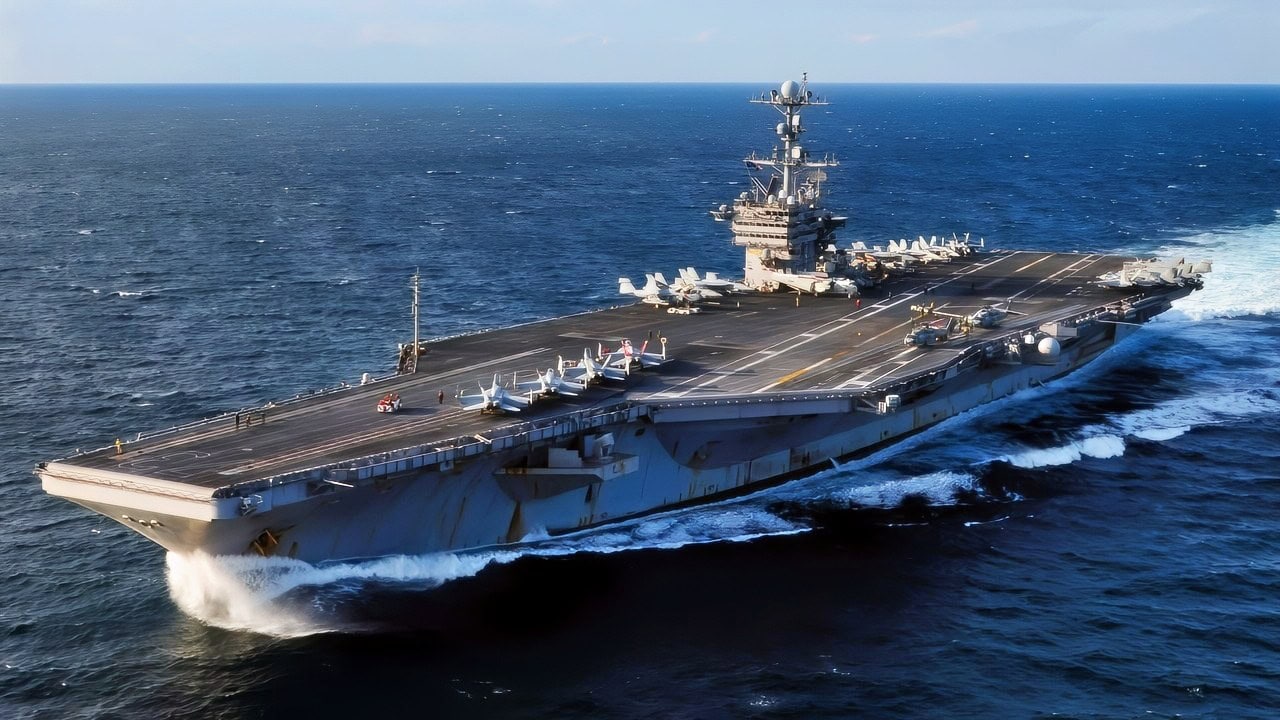
A Nimitz-class carrier still brings a concentrated package that Beijing has to respect. George Washington can launch F/A-18E/F Super Hornets, EA-18G Growlers, E-2D airborne early warning aircraft, MH-60 helicopters, and, in this deployment cycle, F-35C capability through Carrier Air Wing 5 integration. The ship itself displaces about 100,000 tons and can generate sustained flight operations for days if logistics ships keep pace.
From a naval officer's view, that changes the local risk calculation immediately. A Chinese commander near Scarborough Shoal or Second Thomas Shoal cannot assume the fight is only against Philippine patrol craft and a U.S. Coast Guard cutter. The carrier gives U.S. commanders airborne surveillance, electronic attack, combat air patrols, and long-range strike options within the theater. It also gives Manila visible proof that treaty language has metal behind it.
But carriers are good at sea control against military forces. They are awkward tools against coast guard ramming, water cannons, inflatable boats, and maritime militia swarms. The more China keeps its operations in gray hulls and white hulls, the harder it is for Washington to translate carrier presence into day-to-day denial.
The Geography Still Favors Friction
Second Thomas Shoal sits roughly 105 nautical miles west of Palawan. Scarborough Shoal is about 120 nautical miles west of Luzon. Both are close enough for Philippine forces to contest and close enough for Chinese coast guard units to pressure repeatedly from their South China Sea outposts and mainland-supported logistics network.
A carrier can move fast, but it cannot be everywhere. If George Washington is positioned for flight operations in the central or northern South China Sea, it can influence events across a wide arc. If it is held farther east for missile-defense prudence, sortie distance rises and persistence drops. Anyone who has served on a destroyer knows the chart looks cleaner in a briefing room than it does after weather, maintenance, replenishment schedules, and command restrictions are added.
That is why the small details in Secretary of State Marco Rubio's remarks at the ASEAN meetings are important. Rubio said a U.S. Coast Guard vessel in the region helped stand between the parties after the July 20 clash and enabled medical evacuation of the injured Filipino. That is the force actually suited to the incident pattern: cutters, maritime patrol aircraft, unmanned surveillance, legal messaging, and Philippine hulls that can remain on station without turning every encounter into a naval crisis.
China Is Testing the Treaty Without Triggering It
The U.S. State Department condemned China's July 20 actions and reaffirmed both the 2016 arbitral ruling and U.S. support for the Philippines. The legal position is clear. The operational question is less comfortable: what happens on the third, fourth, and fifth incident if China uses the same tools and accepts the same diplomatic cost?
Beijing's pattern is not random. It is pressure by repetition. A baton strike at Second Thomas Shoal, water cannons at Scarborough Shoal, surveillance around Philippine movements, and information claims that Manila intruded first all create a rhythm. Each action is aggressive enough to impose cost and mild enough to complicate an armed response. The carrier's arrival raises the ceiling of U.S. response, but China is working on the floor.
That creates a mismatch. Washington is deploying high-end naval power to reassure an ally while Beijing is using low-end maritime pressure to change behavior. The carrier can deter a People's Liberation Army Navy surface action group. It does not automatically stop a China Coast Guard captain from maneuvering dangerously against a Philippine vessel tomorrow morning.
The Useful Metric Is Days on Station
The real deterrence metric is not whether a U.S. carrier appears in the South China Sea. It is how many days allied forces can keep credible presence around the flashpoints after the carrier leaves.
George Washington began its 2026 deployment from Yokosuka on May 10, according to Forbes, and is expected to patrol for roughly six months. That forward-deployed model is exactly why the ship matters: it shortens response time from Japan compared with a carrier sailing from San Diego. Yet even a Yokosuka carrier must cycle through maintenance, training, liberty, replenishment, and broader Seventh Fleet tasking. The South China Sea cannot be held by one flattop making episodic appearances after each clash.
The United States and its partners need a layered answer: Philippine resupply and patrol capacity at the shoals, U.S. and Japanese surveillance that stays aloft when the carrier is gone, Coast Guard presence that can meet white-hull coercion on equal terms, and rules that make Chinese commanders doubt the payoff of the next push. The carrier is the top cover, not the fence line.
The Bottom Line
George Washington's presence is not empty symbolism. It forces Chinese planners to account for U.S. airpower, reassures Manila after a physical clash, and reminds Beijing that the Luzon Strait is not a private gate into the South China Sea.
But the math remains thin. China is creating tactical facts with coast guard hulls and controlled collisions. The United States is answering with a carrier built for a higher-end fight. Unless Washington and Manila can turn this moment into continuous allied presence at the shoals, the carrier will be remembered as a strong signal that arrived after the pressure campaign had already set the tempo.
The USS George Washington carrier strike group entered the South China Sea on July 22 following confrontations between Chinese and Philippine forces. This deployment comes after a joint maritime exercise involving the U.S., Japan, and the Philippines. The carrier enhances U.S. military presence and deterrence in the region, although challenges remain due to China's ongoing coercive tactics.
- USS George Washington entered the South China Sea on July 22.
- The carrier group includes F/A-18E/F Super Hornets and other aircraft.
- The deployment follows confrontations between Chinese and Philippine forces.
- The U.S. conducted a maritime exercise with Japan and the Philippines prior to the carrier's entry.
- China's actions are part of a coercion campaign against the Philippines.