
U.S. clears Jordan to buy 1,500 APKWS drone-killing rockets
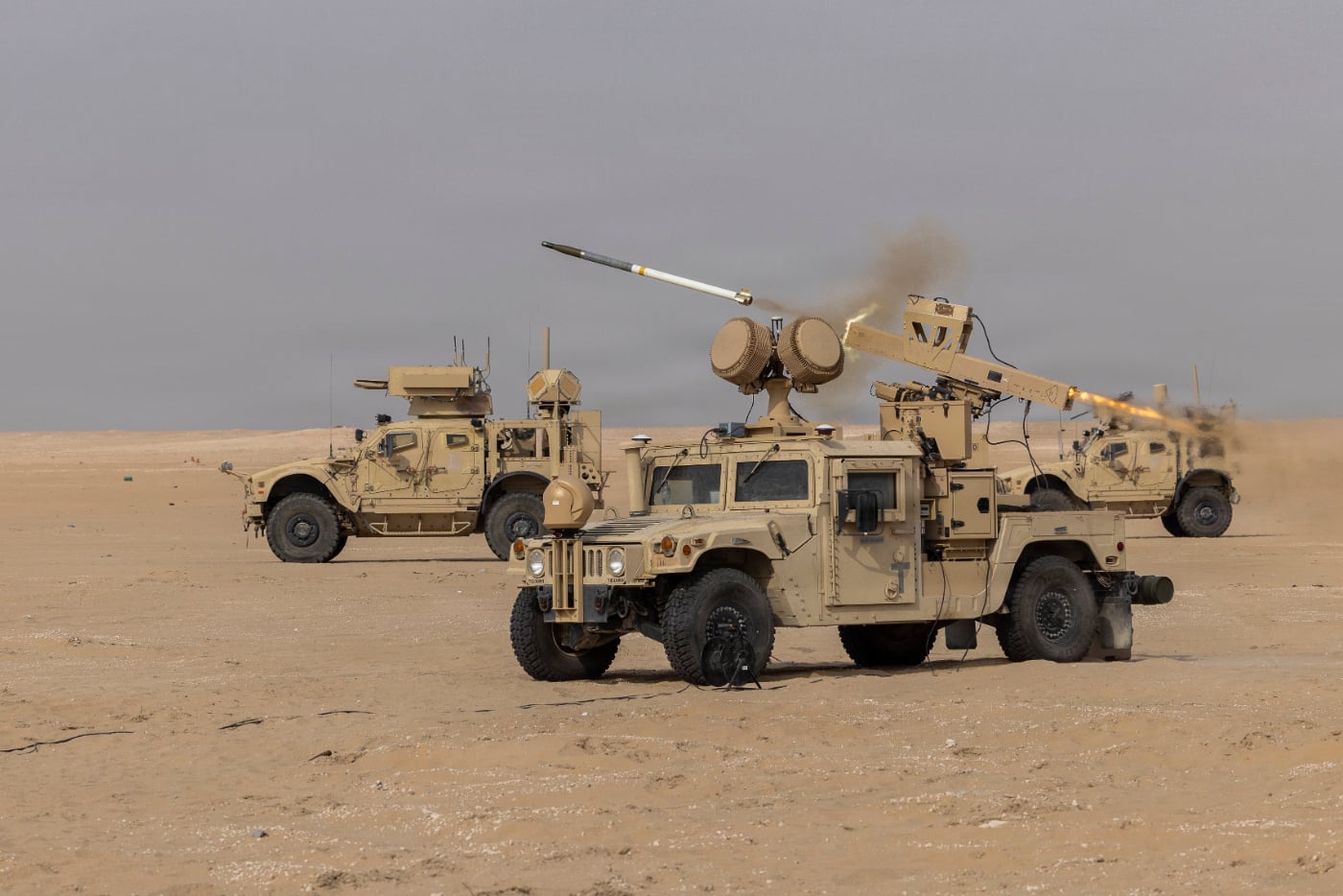
The U.S. State Department has approved a possible $100 million sale to Jordan of up to 1,500 Advanced Precision Kill Weapon System II laser-guided rockets, a weapon Gulf and Middle Eastern air forces have been buying in large numbers to shoot down drones, according to a congressional notification, Transmittal 26-95, published on Nov. 2.
The request covers WGU-59A/B or B/B guidance sections in what the notice calls a single variant block upgrade, configured for air-to-air, ground-to-air or air-to-ground use and supplied either as complete rounds or as guidance sections alone, with BAE Systems of Nashua, New Hampshire, as principal contractor. The notice describes the rockets as “additional,” which means Jordan already operates APKWS, but it does not say which Jordanian aircraft or ground launchers will fire them, how the purchase will be funded or when deliveries would start.
The rest of the package covers the parts needed to build complete rounds and train with them: launchers, Mk 152 high-explosive warheads, MK66 rocket motors, proximity fuzes, WTU-1/B practice warheads and inert MK66 motors, plus support equipment, publications, transportation and U.S. government and contractor engineering, technical, training and logistics support. No additional U.S. personnel would be assigned to Jordan beyond periodic program and technical reviews.
The State Department said the rockets would strengthen Jordan’s air defense in support of the Middle East Air Defense pillar of the Regional Security Construct, a U.S. framework for coordinating regional defenses against missiles and drones, and would let Jordan defend itself with less sustained U.S. support over time while adding protection for U.S. military assets stationed in the kingdom.
U.S. Air Force fighters, attack aircraft and transports operate from Muwaffaq Salti Air Base at Al Azraq, and in February U.S. troops leaving the al-Tanf base in Syria were reported to be relocating to Jordan. Iran and Iran-aligned militias have targeted bases in Jordan during the war that began in February 2026.
Because Jordan lies under the most direct flight paths between Iran and Israel, its air force and air defenses have repeatedly intercepted Iranian drones and missiles crossing its airspace: during Iran’s attacks on Israel in April and October 2024, and again during the June 2025 Israel-Iran war, when the military said the projectiles were on course to fall on Jordanian territory, including populated areas. Debris from intercepted drones has landed on homes inside the country several times.
APKWS is a mid-body guidance kit that fits between the warhead and the motor of a standard 70 mm (2.75-inch) Hydra rocket, with folding wings carrying laser seekers that home on a spot marked by a designator, so an unguided area weapon becomes a precision one that still fits the same launchers. For the counter-drone mission, a proximity fuze lets the warhead detonate as it passes close to the target instead of needing a direct hit, which matters against small, slow drones with little structure to strike.
Published estimates put an APKWS guidance section at about $15,000, with a complete round a few thousand dollars more, against several hundred thousand dollars or more for an AIM-9X Sidewinder or AMRAAM air-to-air missile, while an Iranian-designed Shahed-type one-way attack drone costs tens of thousands of dollars. A fighter carrying pods of APKWS rockets also carries far more shots than one armed with a handful of missiles, although the weapon has a short range and a small warhead, and the laser version needs the target illuminated until impact.
APKWS entered U.S. service in 2012 as a helicopter weapon against ground targets, and the air-to-air role came later, when U.S. Air Force F-16s and F-15Es began firing an air-launched counter-drone version at Houthi and Iranian drones in the Middle East; in March 2025, U.S. Central Command released footage of the rockets destroying Houthi one-way attack drones. In February 2026, the U.S. Air Force awarded BAE a contract worth up to $145 million for a counter-drone APKWS with an infrared seeker that would remove the need to keep the target lit by laser.
Jordan’s order is the smallest in a run of 2026 APKWS approvals for the region: Israel was cleared for 10,000 rounds worth $992.4 million in May, Saudi Arabia for up to 20,000 guidance sections, half air-to-air and half air-to-ground, worth $1.96 billion in July, and the United Arab Emirates for up to 10,000 guidance sections worth $1.041 billion in October, while Italy was cleared for more than 5,000 air-to-air rounds in August. Dividing Jordan’s $100 million ceiling by 1,500 rounds gives about $66,700 each, but that figure includes launchers, motors, warheads, training and support, so it does not represent the price of a rocket.
The rockets would join other counter-drone equipment Washington has cleared for Jordan this year, including a $280 million sale of Ku-band Multi-Function Radio Frequency System radars approved in February, which are RTX-built 360-degree sensors that detect drones, rockets, artillery and mortar fire and are paid for with Foreign Military Financing. In March, the State Department used emergency authority to approve $70.5 million in aircraft and munitions repair and spares for Jordan without the usual congressional review period.
BAE delivered its 100,000th APKWS guidance kit in February, and on Oct. 19 the U.S. Department of War signed a framework agreement with BAE to buy up to 25,000 kits a year for up to seven years, with a path to 35,000 a year as allies file formal Foreign Military Sales requests for kits built in Hudson, New Hampshire, and Austin, Texas. The U.S. Navy’s current five-year APKWS contract, awarded in August 2025, covers up to 55,000 kits for U.S. and foreign customers through December 2031.
Content preview only. Full article available at source. View Full Article
The U.S. State Department approved a $100 million sale of 1,500 Advanced Precision Kill Weapon System II rockets to Jordan on November 2, 2026. This procurement aims to enhance Jordan's air defense capabilities against drone threats and reduce reliance on U.S. support over time. The package includes various support equipment and training, with BAE Systems as the principal contractor.
- The U.S. approved a $100 million sale of 1,500 APKWS rockets to Jordan.
- The rockets are intended for air-to-air, ground-to-air, and air-to-ground use.
- Jordan already operates APKWS and will receive additional equipment for training and support.
- The sale aims to strengthen Jordan's air defense capabilities against drone threats.
- This is part of a broader trend of U.S. military support to Jordan and other regional allies.