
U.S. Navy skips competition on TETRA II to avoid a year of delay
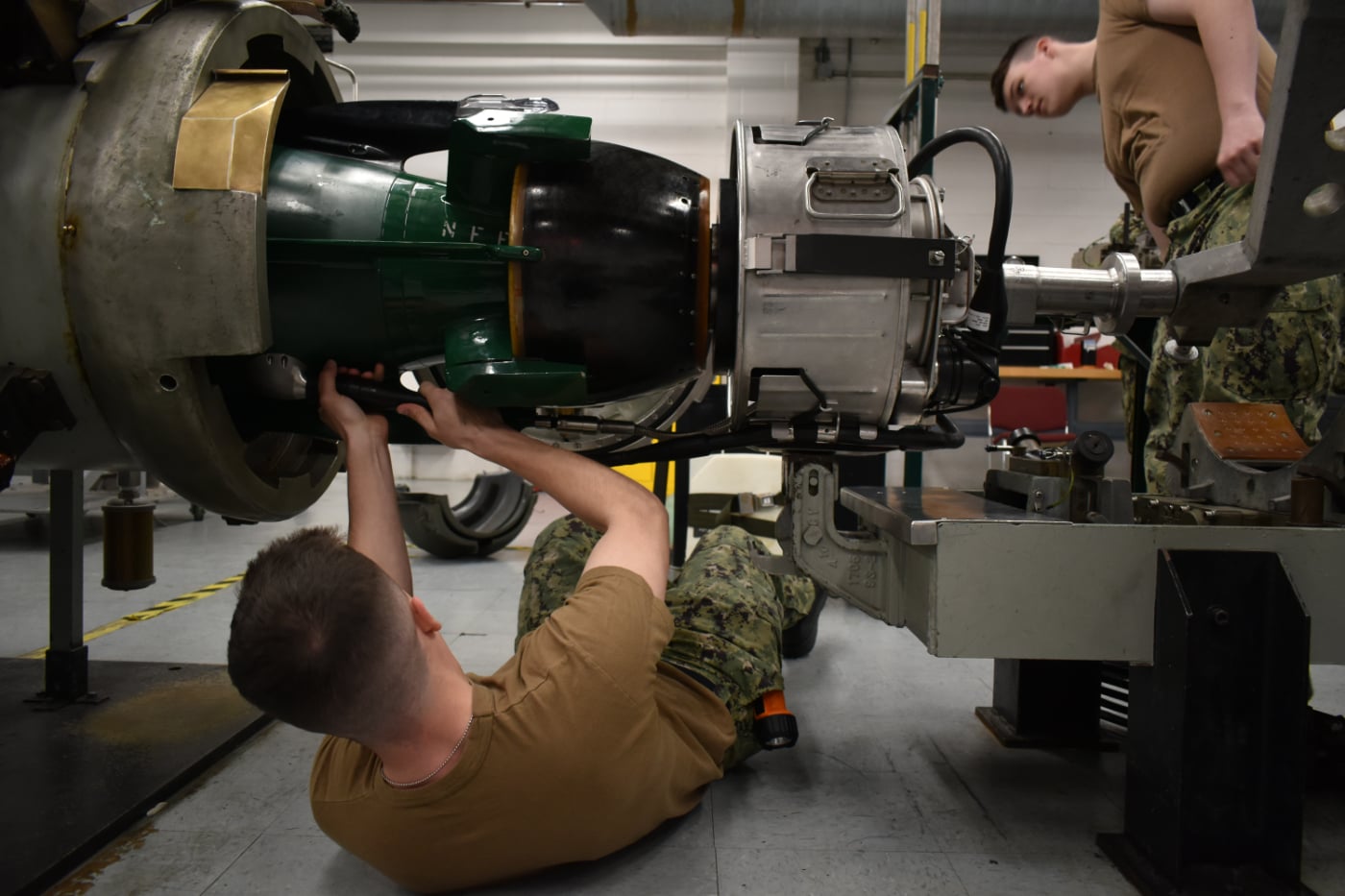
The U.S. Navy has awarded Oceaneering International a $38.2 million sole-source task order to keep developing and building TETRA II, a submarine system designed to launch and recover an unmanned underwater vehicle through a standard torpedo tube, according to an award notice the Naval Undersea Warfare Center Division Newport posted on the federal government’s contracting website on Nov. 3.
The order, N6660426FC850, was signed on Sept. 2 under the warfare center’s Unmanned Undersea Vehicle Family of Systems multiple-award contract and combines cost-plus-fixed-fee and cost-reimbursement terms, with a total value of $38,152,142.80 if all options are exercised. The Navy published a heavily redacted justification with the notice, blacking out the estimated value it approved, the deployment the work supports and key details of the vehicle’s design.
The justification describes TETRA as a torpedo tube launched and recovered system managed by the warfare center’s Undersea Warfare Platforms and Payload Integration Department, known as Code 45, which handles payload and unmanned vehicle integration across every class of U.S. Navy submarine. Oceaneering’s work covers conceptual design studies, engineering development, hardware, firmware and software changes, system certification, shipboard installation and integration, operator training, logistics, cybersecurity monitoring and the fabrication, testing and acceptance of prototype hardware.
Funding comes from three accounts: operation and maintenance, Other Procurement, Navy, and research and development. The mix suggests the money pays for continued development as well as equipment and support for use on operational submarines, although the Navy has not said how many systems it plans to field or on which boats.
The program dates to 2019, when it began with prototype vehicles and components from an earlier legacy system. The Navy’s undersea warfare directorate, OPNAV N94, submitted TETRA to the Accelerated Acquisition Board of Directors, which approved it as a Maritime Accelerated Acquisition program in July 2019. The Navy has since tested launch and recovery from a moving barge and the delivery of a payload effect from the vehicle’s payload bay, according to the justification, which does not describe that payload. The document says TETRA will send real-time operational data back to the submarine and let operators intervene during a sortie, and it refers to the vehicle as the TETRA ROV, the standard abbreviation for a remotely operated vehicle.
That description matches earlier Navy budget material. In 2021, Janes reported that the Navy planned to move the TETRA ROV from an N94 rapid prototyping effort to a program of record, with an initial system of three medium-class ROVs and ancillary equipment, deliveries from March 2023 and Oceaneering as designer under an $8.3 million prototype contract.
Oceaneering won the previous TETRA order, N6660425FC846, on Dec. 12, 2024, after the warfare center opened the work to all 23 holders of its unmanned vehicle contract on July 2, 2024. Only 12 were eligible to bid as prime because the solicitation required qualification in all 12 of the contract’s functional areas, and Oceaneering was the only company that submitted an offer.
The Navy used that competition to justify skipping a new one. Under Federal Acquisition Regulation 16.505(b)(2)(i)(C), an agency can issue a sole-source order as a logical follow-on to an earlier order if all contract holders had a fair chance to compete for the first one. The justification says only Oceaneering can deliver the capability in time for a planned deployment, whose timing is redacted, and that switching to another company would add a year of delay and cause the Navy to miss future operational windows.
The document attributes much of that delay to elements of the baseline design that NAVSEA has already approved, which are blacked out, and to the learning curve a new vendor would face on what it calls an emerging, complex system. A new contractor would also have to replace proprietary hardware, retest the system, recertify it for submarine use and retrain operators just to reach the current state, at an added cost the Navy redacted. The warfare center said the next iteration of the work may be competed as the program matures.
Recovering an unmanned vehicle into a submarine torpedo tube has been one of the hardest problems in undersea robotics. Launching a vehicle from a tube is straightforward, but bringing it back means guiding it into a 533 mm (21-inch) opening on a moving submarine, which until recently forced the U.S. Navy to rely on dry deck shelters and divers carried only by a few specially modified boats. In 2007, Boeing’s AN/BLQ-11 Long-Term Mine Reconnaissance System demonstrated recovery with a robotic arm extended from a second torpedo tube, but that program ended in 2008.
The U.S. Navy has made faster progress in the past three years. The Virginia-class submarine USS Delaware (SSN 791) completed the first end-to-end launch and recovery of an HII REMUS medium UUV, under the Yellow Moray effort, in December 2023, with the Naval Undersea Warfare Center’s Code 45 among the participants. Delaware then carried out the first forward-deployed torpedo tube launch and recovery for a tactical mission in European waters in 2025, flying three sorties of up to about 10 hours each without divers. In 2025, the Navy also canceled the Mk 20 version of its Razorback vehicle, which had been meant to provide the same capability, and in April 2026 the Defense Innovation Unit awarded HII a contract to develop a torpedo tube launch and recovery system built around its REMUS vehicles.
TETRA sits on a separate track from those REMUS efforts. Yellow Moray is an autonomous survey vehicle that operates on its own after launch, while TETRA, by the Navy’s own description, keeps an operator in the loop and returns data to the submarine during the mission. The Navy has not said whether the two are meant to perform different missions or would compete for the same tubes.
Oceaneering, based in Houston, does most of its U.S. Navy work through its Hanover, Maryland, defense business, which has supported the Navy’s dry deck shelter program since 2002 and won a follow-on contract worth up to $154 million in October to sustain the shelters. The company is also developing its Freedom autonomous underwater vehicle, selected by the Defense Innovation Unit in 2024 as a large displacement UUV prototype, and in July 2026 it was selected with Kongsberg to work on an extra-large unmanned underwater vehicle for the Pentagon.
Content preview only. Full article available at source. View Full Article
The U.S. Navy awarded a $38.2 million sole-source task order to Oceaneering International for the continued development of TETRA II, a submarine system designed for launching and recovering unmanned underwater vehicles. This contract, signed on Sept. 2 and announced on Nov. 3, supports the integration of the TETRA system into operational submarines. The program has been ongoing since 2019 and involves various aspects of engineering and logistics.
- U.S. Navy awarded a $38.2 million contract to Oceaneering International for TETRA II development.
- TETRA II is designed to launch and recover unmanned underwater vehicles from a torpedo tube.
- The contract combines cost-plus-fixed-fee and cost-reimbursement terms.
- Funding for the project comes from operation and maintenance, Other Procurement, Navy, and research and development accounts.
- The program has been in development since 2019.