
U.S. Congress Approves $500 Million Military Aid to Taiwan, Increasing Clarity of PLA Eastern Theater Command's Anti-Intervention Pressure
 Li Minghui
U.S. Congress Approves $500 Million Military Aid to Taiwan, Clarifying PLA Eastern Theater's Anti-Intervention Pressure
On July 27, Defense News reported that the U.S. House of Representatives included $500 million in foreign military financing for Taiwan in the fiscal year 2027 appropriations bill. This amount is not large compared to the $14 billion arms sales package discussed in public, but interestingly, it reveals not a sudden determination from Washington, but rather the most realistic issue in Taiwan's defense: there are too many approved but undelivered equipment, with money and production lines waiting in line.
$500 Million Cannot Buy a Strategic Turnaround
The report mentioned that the Trump administration has yet to publicly approve a new batch of arms sales to Taiwan worth approximately $14 billion, and the $500 million financing does not specify particular equipment. Public information shows that Taiwan still has about 30 types of U.S.-made equipment with partial delivery issues, including the $1.11 billion batch approved by the end of 2025, which includes M109A7 self-propelled howitzers, HIMARS, Javelin anti-tank missiles, and unmanned attack systems. In simple terms, what Taiwan lacks now is not a shopping list, but the rhythm of delivery.
From the perspective of the PLA, this makes the assessment more specific. The Eastern Theater does not need to face a Taiwan that suddenly gains a complete systematic counterattack capability, but rather a Taiwan that gradually fills in its long-range rocket artillery, coastal defense, anti-armor, and drone munitions. The threat will increase, but the manner of increase will be in batches, traceable, and constrained by U.S. stockpiles.
PLA Training Signals Not Just About Arms Sale Amounts
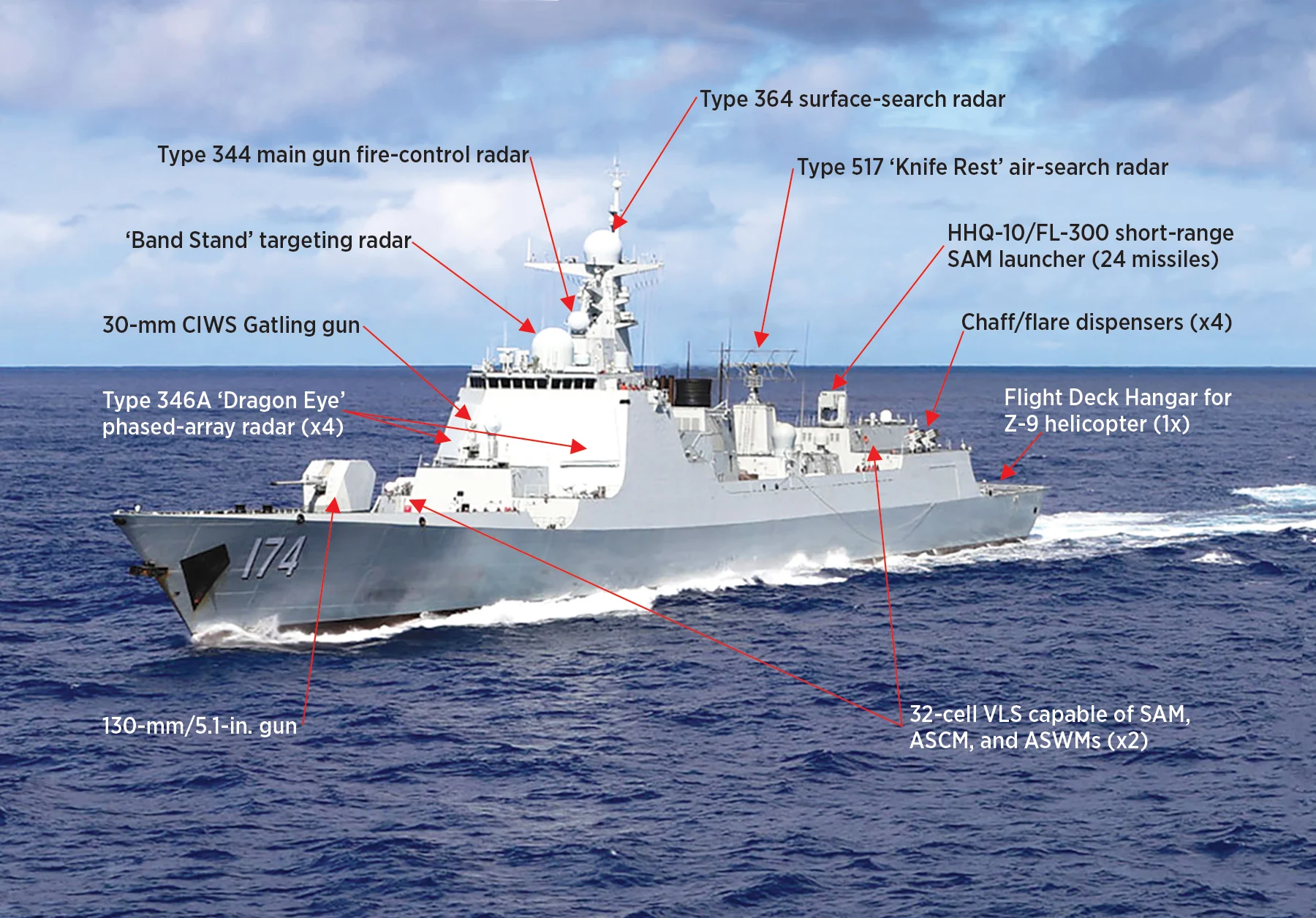
Several sets of images recently released by the Chinese military network are worth viewing together: the Eastern Theater Navy's 052C Changchun and 052D Xiamen ships conducting maritime training, troops from the Tibet Military District loading HQ-16 air defense missiles, and naval aviation's Y-9 anti-submarine patrol aircraft conducting flight training. They are not part of the same exercise, but they collectively point to a reality: the PLA is making air defense, anti-submarine, maritime formation, and regional lockdown routine subjects.
- The core value of the 052D destroyer is not its individual firepower, but its regional air defense, anti-ship, anti-submarine capabilities, and data link nodes.
- Systems like the HQ-16 medium-range air defense system indicate that land-based air defense is still emphasizing rapid loading and sustained operations.
- The Y-9 anti-submarine patrol aircraft corresponds to the long-term pressure from submarine activities in the waters east of Taiwan and from the U.S. and Japan.
The author believes that after Taiwan acquires HIMARS or unmanned attack systems, the most direct change will be in the risk model for the PLA's coastal assembly, port loading, and near-shore resupply before and after landing, rather than an immediate change in air and sea superiority. This judgment may not sound stimulating, but it is closer to battlefield engineering issues: whether a rocket can be launched depends on the simultaneous readiness of vehicles, munitions, communications, reconnaissance, and concealed positions.
The Real Variable is U.S. Stockpiles and Chinese Production Capacity
For Beijing, the political signal of $500 million in military aid is certainly harsh, but militarily, the focus should be on whether the U.S. will synchronize the opening of stockpiles, maintenance, and training chains. The limited number of HIMARS launchers is not frightening; what is concerning is the formation of a closed loop in ammunition supply, target data, and dispersed deployment training. If Taiwan can only obtain scattered equipment, it raises defense costs; if it can secure sustained resupply capabilities, it will impact the PLA's campaign design.
Conversely, China's military industry's advantage does not lie in a specific type of ship or missile, but in the continuous output of shipbuilding, missiles, and unmanned systems. Whether the 052D, 055, long-range rocket artillery, reconnaissance-strike integrated drones, and electronic warfare platforms can steadily enter the theater system determines whether the Eastern Theater can suppress Taiwan's reconnaissance chain and supply lines in the early stages of a crisis. This issue is more important than discussing the parameters of individual pieces of equipment.
Defense News reported that the $500 million financing for Taiwan still requires Senate review and does not mean that the $14 billion arms sales package has been unfrozen; the Chinese military network simultaneously released images of Eastern Theater naval formations and various equipment training.
A Question Without an Answer
This news is easily misread as "the U.S. is accelerating the arming of Taiwan." I prefer to view it as a stress test: the U.S. political system is willing to allocate funds, but can the U.S. military-industrial system deliver at the speed required by Taiwan? If the answer is negative, what the PLA should truly worry about is not this $500 million, but whether Washington will next package money, stockpiles, and training personnel together and send them to the first island chain.
The U.S. Congress approved $500 million in military aid to Taiwan on July 27, 2023, amid ongoing discussions about military support. This aid is part of a broader context where Taiwan faces delays in receiving previously approved military equipment. The Chinese military is recalibrating its assessments based on Taiwan's incremental military improvements, which include various U.S. weapon systems.
- U.S. Congress approved $500 million in military aid to Taiwan.
- Taiwan has many U.S. military equipment deliveries pending.
- The aid does not specify particular equipment.
- China's military is adjusting its assessments based on Taiwan's gradual military enhancements.
- The effectiveness of U.S. aid depends on the speed of delivery and training.