
U.S. Fire on M/T Lavine Turns Hormuz Blockade Into a Battlefield
 Ahmed Al-Rashid
U.S. Fire on M/T Lavine Turns Hormuz Blockade Into a Battlefield
On July 24, the U.S. military said it had disabled the M/T Lavine in the Gulf of Oman after the merchant vessel tried at least four times to break the American blockade of Iranian ports. That single sentence changes the military meaning of the Hormuz crisis. For thirteen nights Washington has struck Iranian targets. Now the blockade itself is no longer only a declared legal pressure mechanism or a warning to shipowners. It is becoming a zone where commercial hulls can be stopped by gunfire.
According to Capt. Tim Hawkins, the U.S. Central Command spokesman quoted by the Associated Press, American forces warned the Lavine's crew, judged that the vessel did not comply, and then fired into the engine room to disable it. CENTCOM also said 12 vessels have been redirected since the renewed blockade, while AP described the Lavine as the second commercial ship disabled under the measure. Those details matter more than the tonnage or the flag. In practical military terms, the United States has moved from striking Iranian military infrastructure to physically enforcing maritime exclusion against merchant traffic.
The Threshold Has Moved From Air Campaign to Maritime Coercion
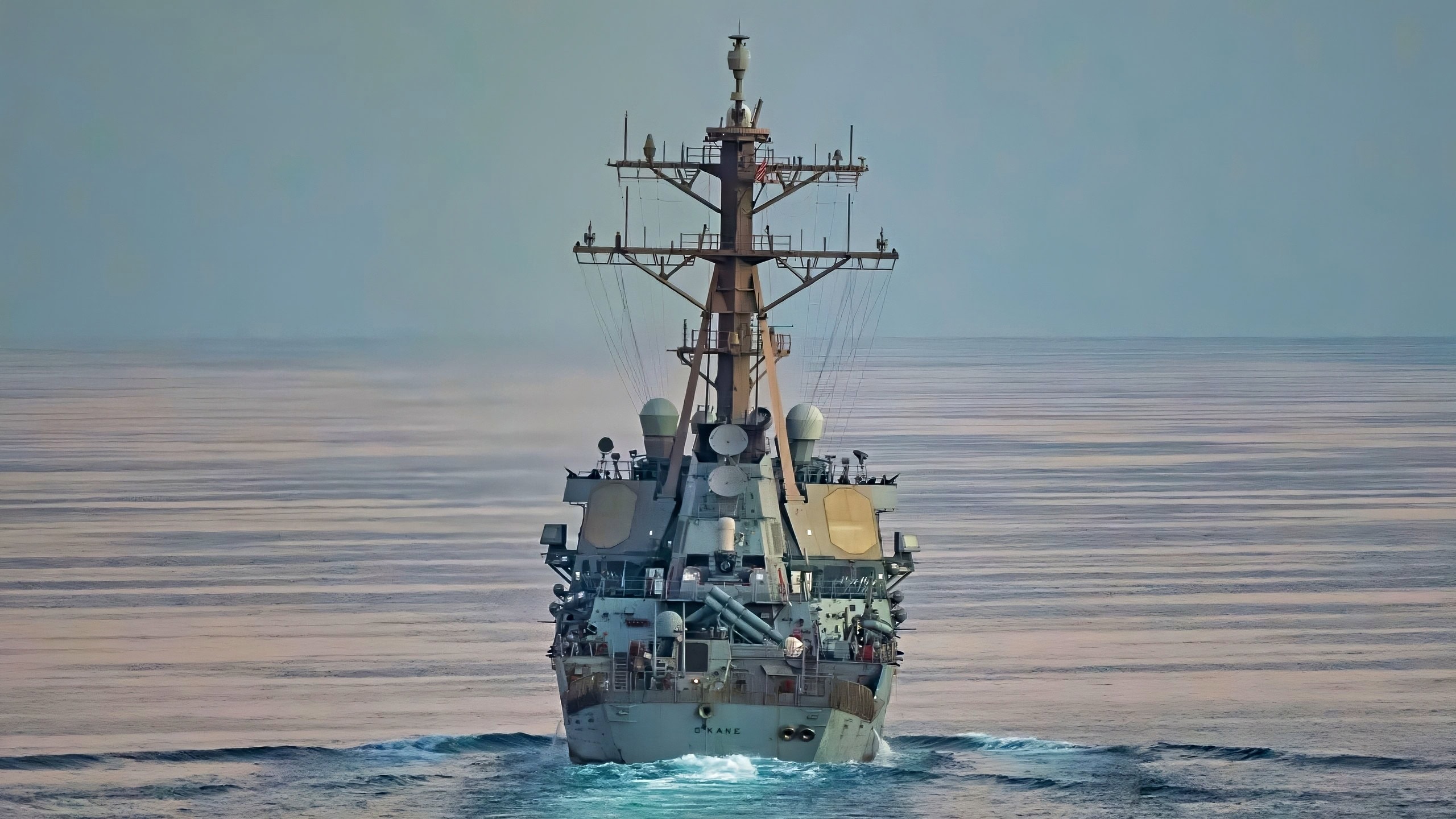
The first threshold in this war was the U.S.-Israeli strike campaign that began on February 28. The second was Iran's attempt to turn Hormuz into a pressure instrument rather than merely a naval theater. The third is what happened to the Lavine: U.S. fire directed at the machinery of a merchant vessel, not at a missile launcher or a Revolutionary Guard boat. Washington will say this is enforcement, not escalation. Tehran will describe it as piracy or aggression. Commercial insurers will use less emotional language, but they will understand the same thing: a trading route has become a battlefield with rules written in real time.
There is a military logic behind the American choice. A naval blockade only has credibility if some vessels are forced to comply. Warnings, bridge-to-bridge calls, shadowing and boarding teams are useful until a captain, owner, charterer or state sponsor decides to test them. Once a vessel is allowed through, the blockade becomes theatre. Once a vessel is disabled, the blockade becomes operational reality. Any officer who has served in the Gulf knows the distance between those two conditions is not legal wording; it is the willingness to accept a bad night at sea.
Still, this is not a clean battlefield. A merchant engine room is not an air defense battery. Even a carefully aimed disabling shot can injure crew, start a fire, contaminate the sea or create a salvage emergency in a crowded waterway. The United States may have the surveillance, rules of engagement and boarding capability to manage a single ship. Managing dozens of nervous crews, shadow fleets, spoofed AIS tracks, unclear cargo documents and political flags is another matter.
What Is Confirmed and What Remains Claimed
The confirmed core is narrow but serious. AP reported the U.S. statement on the Lavine, the four attempts to run the blockade, the engine-room fire, the second disabled commercial vessel, and the redirection of 12 ships. The same AP report said the United States conducted a 13th straight night of strikes on Iran and that CENTCOM described the latest barrage as intended to further degrade Iran's ability to threaten civilian mariners and commercial vessels in regional waters.
The broader retaliation picture is more mixed. In Irbil, northern Iraq, security officials said U.S.-led forces shot down five explosive-laden drones after at least seven blasts near the airport area where American forces are based. U.S. military officials did not immediately comment on those apparent attacks in the AP account. Iran's Revolutionary Guard claimed it struck the Udairi base in Kuwait, destroying three ammunition and storage sheds, and also claimed damage to a watchtower linked to the U.S. Navy's Fifth Fleet in Bahrain. CENTCOM did not confirm those Iranian claims when AP sought comment. Bahrain and Jordan said they intercepted Iranian aerial attacks, which gives the episode a regional air-defense dimension even where damage claims remain disputed.
On the American side, the latest targets reportedly included a Revolutionary Guard naval base in northern Iran, Qeshm Island, Isfahan province, and additional targets in Khuzestan and Fars. Qeshm is especially relevant because Iranian naval assets there include systems useful for harassment or attack in the strait, including drone boats. Isfahan carries a different weight because it is associated with a major air base and nuclear infrastructure. The pattern suggests Washington is not merely punishing Iran for past actions. It is trying to reduce the tools Iran can use to keep Hormuz unsafe.
Hormuz and Bab el-Mandeb Now Press the Same Nerve
Iran does not need to close the Strait of Hormuz completely to achieve strategic effect. It needs enough uncertainty to change decisions in shipping offices, insurance markets, naval headquarters and energy ministries. The same is true in the Red Sea. The Houthis' claim that they attacked two Saudi oil tankers, and their threat to close Bab el-Mandeb to Saudi-linked shipping, create a second maritime pressure point at the southern entrance to the Red Sea. AP noted that around 12 percent of global trade, including about one-fourth of container traffic, normally passes Bab el-Mandeb.
This is why the July 24 escalation is more dangerous than a simple exchange of missiles. Hormuz and Bab el-Mandeb are not separate files in the mind of a shipping company moving crude, LNG, refined products or containers between Asia, the Gulf and Europe. They are one route-risk calculation. A tanker that avoids Hormuz cannot export Gulf crude. A tanker that avoids Bab el-Mandeb must take the longer route around Africa. Saudi Arabia can divert some flows through pipelines and Red Sea terminals, but Houthi pressure on Saudi-linked shipping narrows even that option.
From Tehran's point of view, this layered pressure is useful. Iran can deny direct control over every Houthi decision while benefiting from the leverage. From Washington's point of view, it complicates escalation management. Hitting Iranian naval infrastructure may reduce the Hormuz threat, but it may also encourage allied groups to widen the map. The old military saying is that the enemy gets a vote. In this crisis, shipowners, insurers, port authorities and proxy forces also get votes.
Oil Markets Are Signaling Fear but Not Panic
Energy markets are already pricing the risk. AP reported Brent crude near $96 a barrel on Friday, down slightly on the day but far above roughly $72 before the war. U.S. gasoline prices have moved higher, with AAA cited at an average of $4.11 a gallon. Separate Reuters market reporting on July 24 pointed to oil falling on reports that China was pushing for an end to the U.S.-Iran war. I could not directly access the Reuters article through the available web tools because Reuters returned a JavaScript access block, so that item should be treated here as market context rather than independently quoted evidence.
The important point is not whether Brent closes at $96, $100 or $103. The important point is that traders are now balancing two opposite signals: the physical danger to energy routes and the possibility that China, Russia, Oman or another mediator can keep a channel open. China has a direct interest in preventing a prolonged Gulf energy shock. Russia has an interest in shaping any diplomatic exit in a way that weakens U.S. freedom of action. Oman has the most practical channel because Muscat has spent years talking to both Washington and Tehran without turning mediation into theatre.
AP reported that an Omani delegation was in Tehran to discuss management of shipping traffic in the strait. That is a small diplomatic fact, but it may be more important than another public threat. Maritime crises often de-escalate first through procedures: notification channels, safe lanes, inspection protocols, escort understandings, or quiet promises about which ships will not be challenged. None of that solves the war. It can, however, stop a collision, a mistaken strike, or a panicked crew from becoming the next casus belli.
The Forgotten Front Is the Crew
The International Maritime Organization figure reported by AP should not be treated as a footnote: about 400 vessels and at least 6,000 mariners stranded around Hormuz. U.N. human rights chief Volker Türk called for urgent action, and his office warned that some seafarers were exposed to fighting, abandoned by owners, and left without adequate food, water, fuel, medical care, electricity or communications. In Arab military conversations we often speak about chokepoints as if they are lines on a map. They are also workplaces.
This matters operationally. Exhausted crews make mistakes. Ships held too long require fuel, medicine, parts and security. Abandoned vessels become navigation hazards, insurance disputes and potential political symbols. If a crew member is killed by U.S. disabling fire, Iranian attack, Houthi missile, accident or neglect, the legal and diplomatic pressure will rise quickly. A blockade that cannot protect seafarers while claiming to protect maritime security will lose legitimacy faster than Washington expects.
What Comes Next
There are three immediate paths. The first is controlled coercion: the United States keeps disabling or redirecting selected vessels, Iran answers mostly through drones, missiles and deniable partners, and Oman works to carve out traffic-management rules. This is dangerous but still manageable. The second is maritime spillover: a ship burns, a crew dies, a Gulf state suffers confirmed damage, or the Houthis hit a Saudi-linked tanker hard enough to force wider military action. The third is a diplomatic freeze, where China and Russia help Tehran save face while Washington claims the blockade forced compliance.
My assessment is that the Lavine incident narrows the room for ambiguity. Before July 24, many governments could say the war was primarily an air and missile campaign with maritime consequences. After July 24, the maritime campaign is a front in itself. The United States is proving it will enforce the blockade. Iran is proving it can spread risk around American bases and Gulf allies. The Houthis are proving the Red Sea can be activated at the same time as Hormuz.
The structural contradiction is now clear: Washington says it is using force to protect commercial navigation, but the method includes firing on commercial navigation when it violates the blockade. Tehran says it is defending sovereignty, but the method exposes Arab neighbors and civilian crews to retaliation. Between those two claims are the sailors waiting at anchor, the Gulf states intercepting drones over their own skies, and the oil markets watching whether one more vessel becomes the event that diplomacy can no longer contain.
On July 24, U.S. military forces disabled the M/T Lavine in the Gulf of Oman after it attempted to breach the blockade of Iranian ports. This incident marks a shift in U.S. military strategy from airstrikes to direct enforcement of maritime exclusion, with 12 vessels redirected since the blockade's renewal. The U.S. also conducted strikes on Iranian military targets, indicating an escalation in the ongoing conflict.
- U.S. disabled the M/T Lavine after it attempted to break the blockade four times.
- 12 vessels have been redirected since the blockade was renewed.
- This incident marks the second commercial ship disabled under the blockade.
- U.S. conducted a 13th consecutive night of strikes on Iranian targets.
- Iran's Revolutionary Guard claimed attacks on U.S. bases in the region.