
US Marine MRF-SEA Turns Philippine Access Into a 2026 First Island Chain Test
 Marcus Chen
US Marine MRF-SEA Turns Philippine Access Into a 2026 First Island Chain Test
The sixth Marine Rotational Force–Southeast Asia rotation is now underway, and the important number is not the size of the force. It is continuity. According to USNI News, MRF-SEA has entered its second consecutive rotation in the Philippines after the Marine Corps extended the deployment beyond its original six-month cycle. The command turnover took place on October 26.
That changes the military problem. A temporary exercise can demonstrate a concept. A continuous presence has to sustain communications, move weapons, share targeting data, repair equipment and remain politically acceptable to the host nation. MRF-SEA is becoming a live test of whether the United States can turn Philippine access into usable combat power along the first island chain.
Continuity Is the New Capability
DVIDS describes MRF-SEA as I Marine Expeditionary Force's forward command element in the Philippines. Unlike Marine Rotational Force–Darwin, which normally deploys as a Marine Air-Ground Task Force, MRF-SEA is a scalable headquarters. Other Marine units are attached when required. That is a less impressive formation on paper, but it may be better suited to an archipelago where the operational question is not how many Marines arrive at one base. It is how quickly small teams can plug into Philippine units at several locations.
The stated training portfolio is broad: command and control, sensing, fires integration, maritime domain awareness, aviation, communications and unmanned systems. The Archipelagic Coastal Defense Continuum is particularly significant because it fills the dead space between major exercises. Balikatan and KAMANDAG create visible peaks. A recurring continuum creates repetition, and repetition is what turns liaison officers, radios and targeting procedures into habits.
The Weapon Test Is Distributed, Not Spectacular
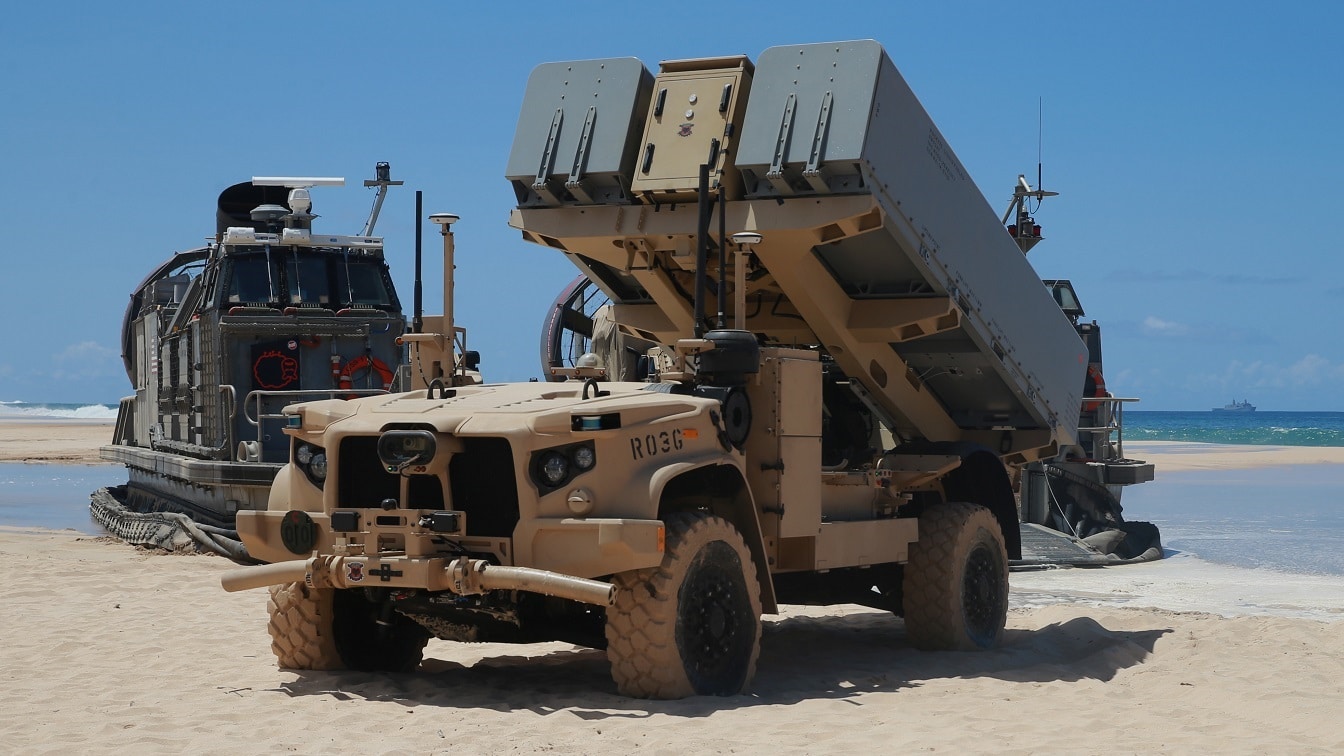
USNI News reported that the previous rotation tested the movement of the AN/TPS-80 Ground/Air Task-Oriented Radar, the Navy-Marine Expeditionary Ship Interdiction System, or NMESIS, and the Marine Air Defense Integrated System from ports to dispersed exercise locations. Those systems matter because they force the alliance to solve practical problems. A launcher that cannot be moved through a port, hidden on a small island or supplied after the first strike is a static display, not sea denial.
NMESIS is a mobile anti-ship missile system built around the Naval Strike Missile and a remotely operated Joint Light Tactical Vehicle. Its value in the Philippines is geographic. The archipelago offers many potential firing positions, but it also imposes narrow roads, limited staging areas and difficult resupply. The system's range and lethality are only half the calculation. The other half is whether Philippine and US crews can generate a firing solution, relocate before detection and repeat the cycle under contested communications.
The same logic applies to the radar and air-defense elements. Sensors must be distributed without losing a common operating picture. Fires must be authorized quickly without creating fratricide or political confusion. None of this is solved by announcing another exercise.
Access Is Not the Same as Permission to Fight
The Philippine government has invited the force, which is a major political advantage. But access remains conditional. Philippine geography places US units near Taiwan, the South China Sea and the Bashi Channel, yet Manila retains its own priorities and must manage escalation with Beijing. A rotational command that trains for coastal defense and disaster response is easier to sustain politically than a formation openly described as a Taiwan war package.
That ambiguity is useful, but it has limits. In a crisis, the alliance would need to decide which sites can be used, which missions are authorized and how long the force can remain after Chinese pressure begins. The more distributed the force, the more host-nation coordination is required. Every extra node creates another protection, fuel, maintenance and communications problem.
Balikatan 27 Will Show Whether the Model Works
The incoming rotation will continue the continuum and support Balikatan 27. The exercise should be judged by less photogenic metrics: how long it takes to establish a remote command post, how often units lose communications, whether missile batteries can move without a large logistics signature, and how many days of fuel and critical parts are available at dispersed sites.
MRF-SEA is not a substitute for a carrier strike group, long-range bombers or a larger Marine Littoral Regiment. It cannot hold the first island chain by itself. Its purpose is narrower and more credible: build the connective tissue that lets larger forces operate with Philippine partners when bases are threatened and the map is broken into islands.
The deployment is therefore more important than its modest headquarters footprint suggests. Six rotations have created familiarity; the second continuous Philippine rotation creates endurance. But endurance is not yet resilience. Until MRF-SEA proves that its sensors, fires and command networks can keep functioning after disruption, the United States has Philippine access—not a dependable first-island-chain defense network. That is the test Balikatan 27 cannot avoid.
Sources
US Marine MRF-SEA is conducting its second consecutive rotation in the Philippines as of October 26, 2026, focusing on enhancing military capabilities and testing operational concepts. The rotation includes the deployment of advanced military systems such as the AN/TPS-80 radar and NMESIS. While the Philippine government has invited the force, access remains conditional, requiring careful management of military operations in the region.
- US Marine MRF-SEA is in its second consecutive rotation in the Philippines.
- The command turnover occurred on October 26, 2026.
- MRF-SEA focuses on building military capabilities and testing operational concepts.
- The rotation involves testing various military systems and ensuring operational readiness.
- Access to the Philippines is politically advantageous but remains conditional.