
US Marines in Okinawa receive first MADIS, NMESIS platforms
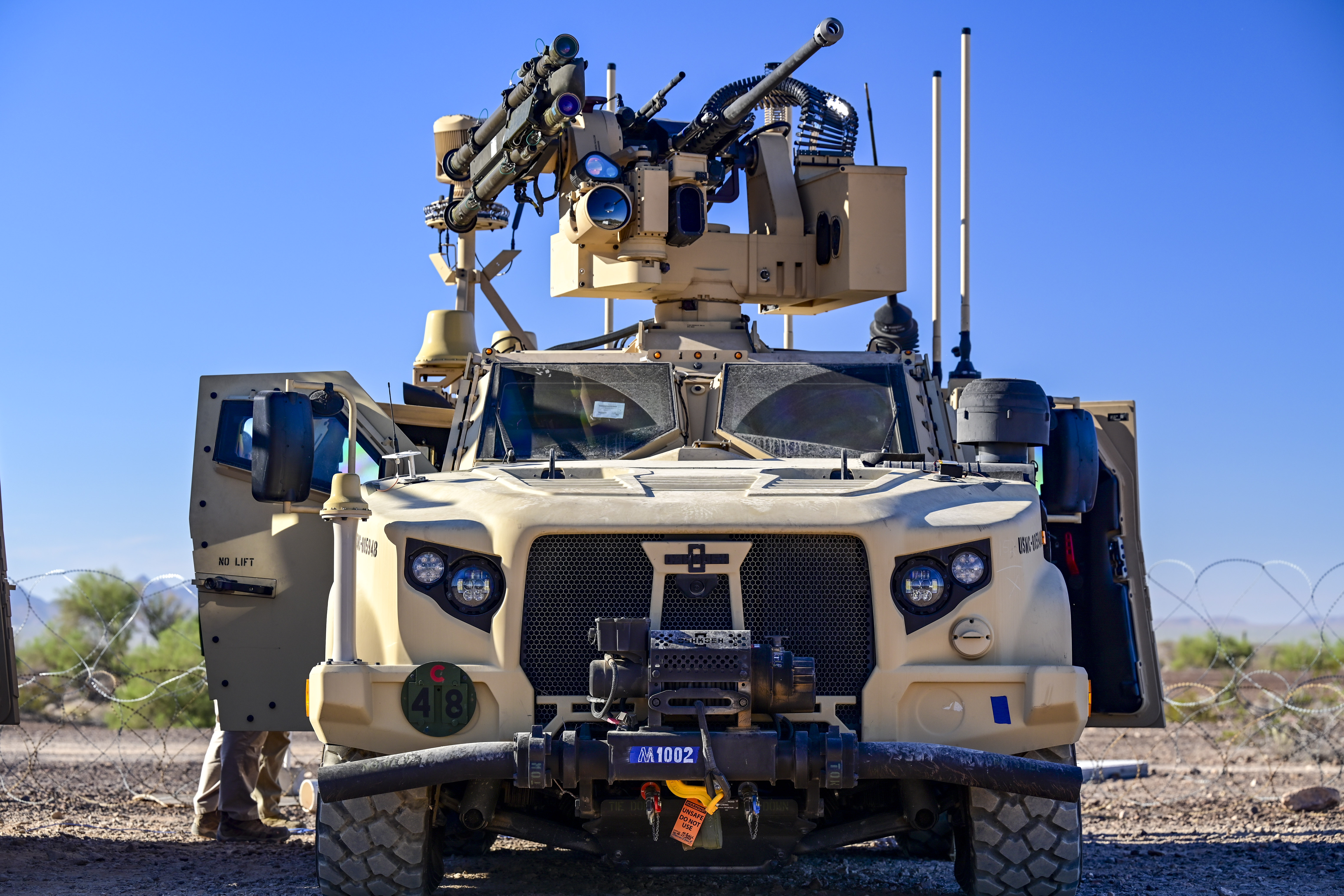
U.S. Marines in Okinawa this month formally received the installation’s first Navy-Marine Expeditionary Ship Interdiction System and Marine Air Defense Integrated System, the service announced. The delivery is the service’s latest integration of modernized defenses in the increasingly contested Indo-Pacific.
The two systems, NMESIS and MADIS, were welcomed by personnel from the 12th Marine Littoral Regiment, 3rd Marine Division, as key pieces in those threat recalibration efforts.
The NMESIS is a ground-based ship-killing missile system designed to be deployed in sea denial operations near coastlines.
The system features a Naval Strike Missile system — fixed to a Joint Light Tactical Vehicle — that can operate through both semi-autonomous and fully autonomous launches.
The short-range, surface-to-air defense capabilities of the MADIS make the highly mobile platform especially potent for low altitude air defense personnel taking on helicopters, fixed wing aircraft and small unmanned aircraft systems, or sUAS.
Mounted aboard two 4x4 Joint Light Tactical Vehicles, MADIS operates as a complementary duo, with one vehicle primarily performing the role of counter-sUAS detection and elimination — via 360-degree radar, a command-and-control suite and an electronic warfare system — while the second vehicle combats fixed wing and rotary aircraft courtesy of a multi-Stinger missile pod, 30mm cannon and electronic warfare capabilities.
The 3rd Marine Division’s Hawaii-based 3rd MLR was the first unit to receive the NMESIS and MADIS. Since then, the Marine Corps has pushed to field the new tech across the Indo-Pacific to match the rapid evolution of regional threats.
Marines with the 3rd MLR in May deployed the NMESIS across multiple islands, as part of the Balikatan 26 exercise, after hitching rides aboard Air Force C-130Js and Army LCU-2000 landing craft.
Operating for three days in the Batanes Islands archipelago, Marines ran through a series of dry fire missions in which they practiced denying warships access to the Luzon Strait.
Days earlier, Marines in Zambales demonstrated the capabilities of the MADIS in knocking quad-copters and fixed-wing drones out of the sky.
U.S. Marines in Okinawa received the first Navy-Marine Expeditionary Ship Interdiction System (NMESIS) and Marine Air Defense Integrated System (MADIS) this month. These systems enhance the Marines' capabilities for sea denial and air defense operations. The NMESIS is a ground-based missile system, while the MADIS provides short-range air defense against drones and aircraft. Recent exercises demonstrated their effectiveness in operational scenarios across the Indo-Pacific region.
- U.S. Marines in Okinawa received the first NMESIS and MADIS systems.
- NMESIS is designed for sea denial operations with ground-based missile capabilities.
- MADIS provides short-range air defense against various aerial threats.
- Marines demonstrated the capabilities of MADIS against drones in Zambales.
- The systems are part of a broader effort to modernize defenses in the Indo-Pacific.