
US Marines Test MRIC on Guam but Three Batteries Are Not Enough
 Marcus Chen
US Marines Test MRIC on Guam but Three Batteries Are Not Enough
Forty-three miles is the number that matters. That is the advertised outer reach of the Marine Corps' new Medium-Range Intercept Capability, the trailer-mounted air defense system Marines fired successfully from Camp Blaz on Guam during Valiant Shield 2026. It is a useful range. It is also a reminder of how small the defended bubbles are in the western Pacific.
Defense News reported that III Marine Expeditionary Force personnel used MRIC to intercept an aerial target on June 30, with the article published July 10. The system carries 20 interceptors per trailer and is designed to hit targets from roughly two to 43 miles away. The Corps says three MRIC batteries are planned by 2028. On paper, that restores a capability the Marines gave up when the HAWK system disappeared in the 1990s.
On a map of Guam, Okinawa, Luzon and the first island chain, it is not nearly enough.
The System Fills a Real Gap
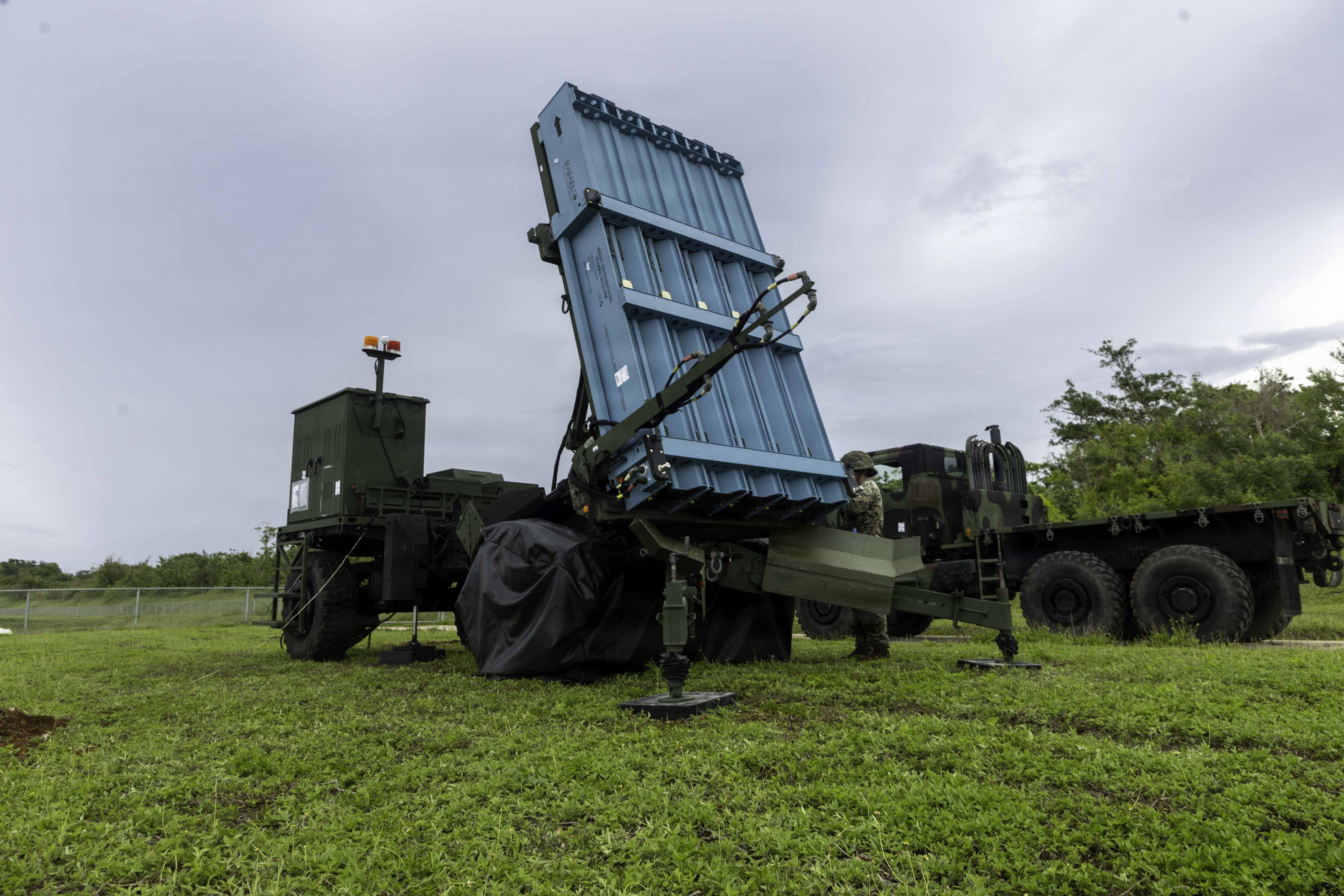
MRIC is not a luxury add-on. Marine Littoral Regiments are supposed to operate inside an adversary's weapons engagement zone, move between islands, refuel aircraft, fire anti-ship missiles, pass targeting data and survive long enough to matter. That concept collapses if a forward arming and refueling point can be shut down by cheap drones, cruise missiles, loitering munitions or a small raid package of aircraft.
The system is built around technology derived from Israel's Iron Dome family, adapted for Marine expeditionary use. That matters because the threat set in the Pacific is not only ballistic missiles. A Patriot battery is valuable against high-end threats, but it is large, scarce and already overtasked. Stingers are portable, but they do not cover enough airspace. MRIC sits in the middle, where many of the likely day-one targets live.
Anyone who has served on a destroyer knows the instinctive response to this problem: push air defense seaward and keep the shooters layered. But a destroyer tied to defending every small island becomes a very expensive guard post. The Marine Corps is trying to give the joint force another option.
Guam Is the Right Test Site
Testing MRIC on Guam was not incidental. Guam is the fixed hub the United States cannot hide. Andersen Air Force Base, Naval Base Guam, munitions storage, fuel, command nodes and repair capacity all sit within range of Chinese missile forces. The island is also a logistics platform for forces moving north toward Japan or west toward the Philippines.
China's missile inventory is the hard part of the math. Defense News separately noted last week that the DF-17 hypersonic glide vehicle has a reported range of about 1,800 to 2,500 kilometers, while CSIS has assessed that China fields a large and diverse missile force built to complicate U.S. intervention around Taiwan. MRIC is not meant to defeat that entire arsenal. It is meant to keep smaller but still lethal threats from finishing the job after the first wave hits.
That distinction matters. A Guam defense architecture needs long-range sensors, Aegis ships, Patriot, THAAD, counter-drone systems, hardened shelters, runway repair teams and enough interceptors to fight for days. MRIC helps only one layer of that stack. Calling it a solution would be unserious. Ignoring it would be worse.
The Battery Count Is the Problem
The Marine Corps plan for three MRIC batteries by 2028 sounds significant until you spread them across the actual theater. One battery tied to Guam, one tied to Okinawa or the Ryukyus, and one available for a Philippines contingency is already an optimistic allocation. That leaves no real reserve, no training float and no margin for maintenance.
Twenty interceptors per launcher also sounds like a lot until the enemy gets a vote. A modest saturation attack can force defenders to fire multiple interceptors per inbound track, especially when identification is uncertain and the asset being defended is a runway, fuel farm or command post. Even if MRIC performs well, the question becomes magazine depth. How many interceptors are forward? How fast can they be reloaded? How many resupply trucks survive after the first missile salvo?
This is where Marine expeditionary rhetoric meets logistics. A trailer system can move, but it still needs radar support, command links, spare parts, generators, fuel, maintenance crews and secure reload points. In a Pacific fight, every one of those signatures is targetable. Mobility reduces vulnerability; it does not abolish it.
The Joint Force Still Has to Pay the Bill
MRIC should be read as a positive but limited development. It gives Marine commanders a tool they have lacked for a generation. It makes expeditionary air bases less naked. It can protect a refueling site, a missile battery, a temporary command node or a logistics beachhead long enough for the larger force to maneuver.
But the United States is still trying to cover a theater measured in thousands of miles with systems measured in dozens of miles. That is the central imbalance in the Pacific. China can threaten fixed bases and predictable logistics nodes at scale. The U.S. response depends on dispersal, hardening, deception, repair capacity and enough air defense to prevent a raid from becoming a campaign-ending event.
MRIC is useful because it fills the middle of the defensive ladder. It is insufficient because the ladder is still too short.
The Guam test proves the Marines are rebuilding a capability they should never have allowed to atrophy. It does not prove the Corps can defend the island chain. Three batteries by 2028 is a start. In the western Pacific, a start is not a posture.
US Marines tested the Medium-Range Intercept Capability (MRIC) system on Guam on June 30, 2026. The MRIC is designed to intercept aerial threats within a range of 2 to 43 miles, but three planned batteries by 2028 may not provide adequate defense against potential threats in the Pacific. The testing highlights the need for improved air defense capabilities in the region.
- US Marines tested the MRIC system on Guam on June 30, 2026.
- The MRIC system has a range of 2 to 43 miles and carries 20 interceptors per trailer.
- Three MRIC batteries are planned by 2028, which may be insufficient for the Pacific theater.