
U.S. Media: How High is the Risk of a U.S. Military Attack on Hark Island?
Reference News Network reported on March 29 An article was published on CNN's website on March 26, titled "How Risky is a U.S. Attack on Iran's Hark Island? Why Might Trump Consider It?" The author is Billy Stockwell. The translation is as follows:
Hark Island is a coral reef island near the Iranian coast and is the economic lifeline of Tehran, accounting for about 90% of Iran's crude oil exports.
Experts question whether, even if Washington successfully occupies this small but strategically significant island, it would give the U.S. enough leverage to force Iran to reopen the Strait of Hormuz amid the escalating global energy crisis.
Here is our understanding of the potential ground operations and their risks.
Hark Island is about one-third the size of Manhattan, and U.S. officials refer to it as "the hub of all Iranian oil supplies." Its long pier extends into deep water capable of accommodating supertankers, making the island a key location for oil transshipment, which has long been vital to the Iranian economy.
Two Marine Expeditionary Units (MEUs), which are specifically responsible for executing rapid response amphibious landings, raids, and assault missions from Navy amphibious vessels, have recently been deployed to the Middle East.
Former NATO Supreme Allied Commander James Stavridis stated that the MEU's ships "possess formidable combat capabilities."
However, he warned that before launching any ground operations, they must transit through the Strait of Hormuz to reach the northern Gulf region, facing Iranian drones, ballistic missiles, and mines in the waterways.
Stavridis said, "Once positioned near Hark Island, the Marines will need to have an unassailable air and maritime advantage within at least a 100-mile (approximately 160 kilometers) radius of the island."
A significant risk is that Iran may attack the amphibious vessels. He added that another concern is the fate of the island's residents—estimated to be thousands, almost all of whom are oil workers—who would need to be "controlled" or evacuated.
Stavridis also questioned what strategic leverage such an operation would provide Washington.
He said, "If Washington's idea is to bargain with Tehran over the opening of the Strait of Hormuz afterward, it is unclear whether the remaining leaders of the Iranian regime would be intimidated by the threat of losing Hark Island."
He added, "They may be unwilling to agree to give up everything for Hark Island."
Richard Haass, former president of the Council on Foreign Relations, stated last week that any action against Hark Island is likely to "further deplete U.S. missile stocks," in addition to potentially causing U.S. military casualties.
Iranian Parliament Speaker Mohammad Baqer Qalibaf stated on the 25th that "Iran's enemies, with the support of certain regional countries," are preparing to occupy an Iranian island. However, he did not specify which island.
According to multiple sources, Iran has been fortifying defenses in recent weeks and has increased military personnel and air defense forces on Hark Island in preparation for a possible U.S. island seizure operation.
Sources indicate that multilayered defense facilities have been deployed on the island, and in recent weeks, Iran has also deployed shoulder-fired surface-to-air missile systems, which are portable air defense missile systems, on the island. Iran has also laid defensive equipment around the island, including along the coastline, consisting of anti-personnel mines and anti-tank mines.
Earlier this month, Trump claimed that the U.S. had bombed "all military targets" on Hark Island and threatened that if Iran continued to obstruct ships from passing through the Strait of Hormuz, the U.S. would attack the island's oil infrastructure.
According to an informed source, White House officials believe that occupying Hark Island would "completely bankrupt" the Iranian Islamic Revolutionary Guard Corps and could lead to a swift end to the war.
However, many within the government are cautious about this, especially considering that it would require a large number of ground troops to achieve. (Translation/ Wang Haifeng)
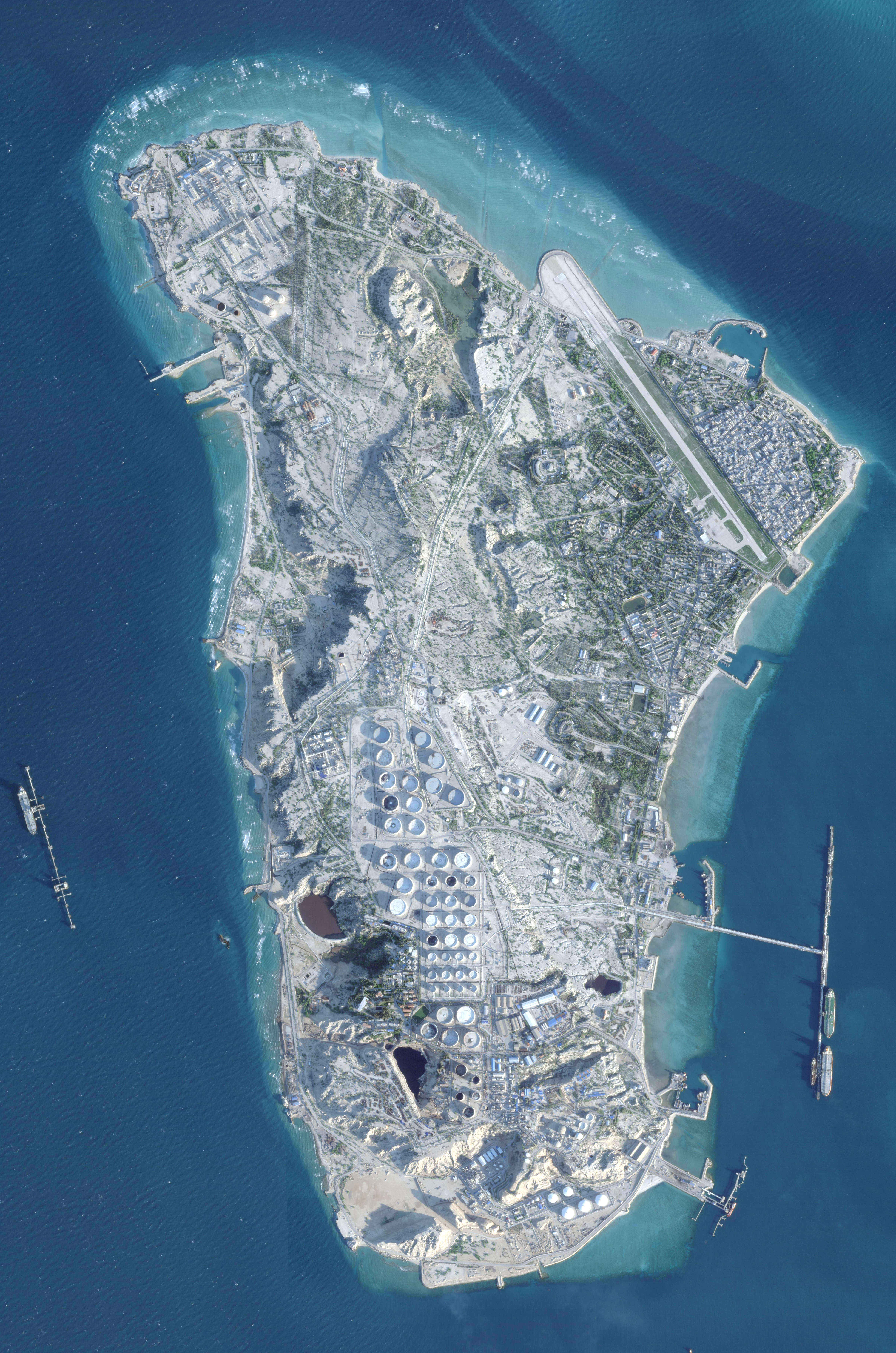
Satellite image of Hark Island (AFP)
U.S. Marine Expeditionary Units have been deployed to the Middle East, preparing for potential ground operations on Hark Island, a strategic location for Iran's oil exports. Military experts highlight the risks of Iranian retaliation and the need for air and naval superiority in the region. Iran has bolstered its defenses on Hark Island, anticipating U.S. actions, while concerns about the strategic implications of such an operation persist.
- Hark Island is crucial for Iran's oil exports, handling about 90% of its crude oil exports.
- U.S. Marine Expeditionary Units have been deployed to the Middle East for rapid response operations.
- Iran has reinforced Hark Island with military personnel and defensive systems in anticipation of U.S. actions.
- Experts warn of significant risks associated with a potential U.S. operation on Hark Island, including Iranian retaliation.
- The strategic value of Hark Island raises questions about the potential outcomes of U.S. military action.