
U.S. Navy discloses new details on plasma test over the Pacific
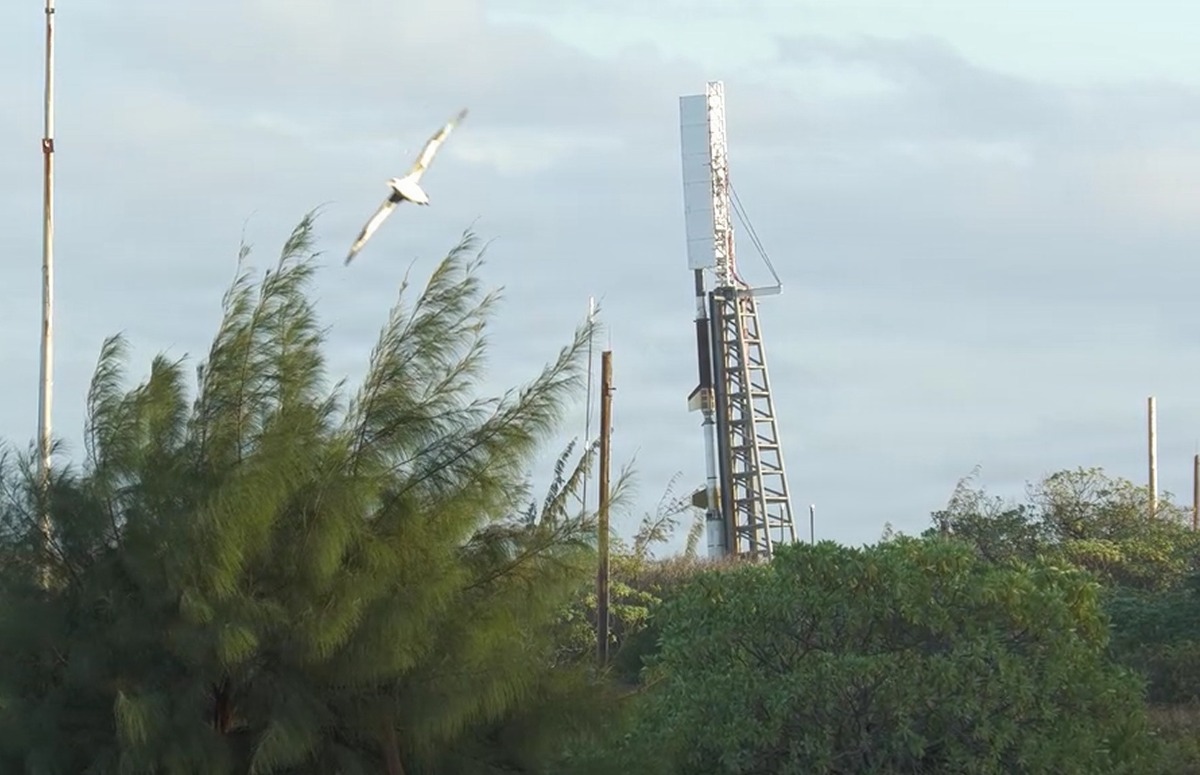
A U.S. Navy rocket team deliberately vaporized metal high above the Pacific Ocean this February, creating a plasma field in the upper atmosphere to study how that energy converts and behaves in space, and Naval Surface Warfare Center, Port Hueneme Division has now revealed new details of the previously little-known test in a recent report.
The White Sands Detachment, a Navy unit normally based at White Sands Missile Range in New Mexico, launched its largest sounding rocket ever built on Feb. 12 from Wake Island, a remote atoll in the middle of the Pacific, marking the unit’s first flight of a four-stage sounding rocket and one of its most demanding expeditionary missions to date.
A sounding rocket is a research vehicle that flies a payload of scientific instruments up to high altitude and back down without going into orbit, and the newly detailed mission, called the Space Measurement of A Rocket-released Turbulence project, or SMART, needed a bigger and more powerful version than the detachment had ever flown before. Eight personnel from the White Sands Detachment spent roughly seven weeks on the isolated atoll, from early January to late February, building launch facilities essentially from nothing and executing a mission that ultimately drew 42 people to the island, including scientists from the Naval Research Laboratory, which managed the SMART program, along with personnel from Naval Surface Warfare Center Indian Head Division, NASA’s Goddard Space Flight Center, two university research teams, and several supporting contractors.
The rocket itself, named Oriole IV, stacked four separate rocket motors, known as Talos, Terrier, Oriole, and Nihka, to carry two scientific payloads to an altitude of roughly 539 kilometers (335 miles), high enough to reach the same region of space where many orbiting satellites operate. Once there, the vehicle detonated a directional explosive called a shape charge to vaporize several pounds of barium metal, creating an artificial plasma field, essentially a cloud of electrically charged particles, while a second payload deployed instruments to measure the electromagnetic effects that plasma field produced. The purpose behind that carefully engineered explosion had not been widely publicized before this report, and Jay Breuer, senior test director in the detachment’s suborbital vehicles division, explained that the mission sought to validate physics theories about plasma energy conversion that had previously only been tested in laboratory conditions, work he said could eventually translate into real capabilities for the fleet.
“At the end of the day, we are proving theories that will lead to delivering capabilities for our warfighters,” Breuer said.
Christopher Netwall, branch head for Dynamics and Control Systems at the Naval Research Laboratory’s Naval Center for Space Technology, who served as SMART’s program manager and experiment lead, described the specific physics question behind the plasma conversion test in more technical terms, framing the goal as confirming how electrostatic lower hybrid waves convert into electromagnetic whistler waves when a high-speed metal vapor release occurs in the ionosphere, the electrically charged layer of Earth’s upper atmosphere that plays a role in radio communications and space-based sensing. Netwall said the successful results represent a meaningful early step toward applications with direct national security relevance, work that began years earlier when he first started coordinating with the White Sands team on the mission’s planning.
“They knew it was a tough mission, but they really supported the idea, and they supported me,” Netwall said.
The newly disclosed report also reveals that Wake Island was not the mission’s original destination. SMART had initially been planned for Wallops Flight Facility in Virginia with NASA handling the launch, but the space agency’s own safety analysis found that detonating the shape charge at such high altitude would scatter debris across too wide an area for the Virginia site to safely contain, prompting NASA to refer the entire project to the Navy instead. The Navy then relocated the mission to Wake Island, an atoll managed by the U.S. Air Force that sits roughly 3,701 kilometers (2,300 miles) west of Honolulu and 2,414 kilometers (1,500 miles) northeast of Guam, with the nearest inhabited island lying almost 966 kilometers (600 miles) away, isolation that made the site ideal for safely closing off the necessary airspace and ocean area for a test the Navy had kept largely out of public view until now.
“It’s in the middle of nowhere,” Breuer said.
That same isolation created a logistics problem the White Sands team had never fully faced before. Sounding rocket launches represent the detachment’s longest-running mission, typically conducted at established ranges like White Sands itself or international sites such as the Hebrides Range in Scotland and the Pacific Missile Range Facility at Barking Sands in Kauai, locations that already have telemetry dishes, launch control infrastructure, and basic utilities in place. Wake Island had none of that, forcing the team to bring virtually everything needed to run a launch campaign except the launch rail itself, work Breuer described as fundamentally different from the detachment’s usual operations.
“Usually, we deploy to a range with telemetry dishes and launch control,” Breuer said.
The team ultimately set up its launch control center inside an abandoned garage on the island that had a leaking roof, mold on the walls, and a dirt floor, a facility Breuer called “post-apocalyptic,” while relying on Starlink satellite internet terminals for connectivity since the island otherwise offered no cellular service or Wi-Fi outside those units. Advance teams had scouted the site the previous spring and returned in September to begin staging equipment, groundwork that Netwall said proved critical given the mission’s difficulty and the detachment’s awareness that other expeditionary programs had failed in the past simply because they arrived without everything they needed.
“We knew what type of situation we were going into, and we understood that other programs have failed because of a lack of bringing what they needed,” Netwall said. “That motivated us to do everything we could do … to ensure that we didn’t fail when we got there.”
Getting the rocket and its team to Wake required its own logistical effort separate from the launch itself. Three C-17 cargo aircraft flew personnel, equipment, and the rocket’s ordnance roughly 9,334 kilometers (5,800 miles) from Holloman Air Force Base in New Mexico, with the aircraft carrying the explosives and rocket stages stopping first at Travis Air Force Base in Northern California and again at Joint Base Pearl Harbor-Hickam in Honolulu to refuel before crossing the International Date Line and landing on Wake roughly four days after departure. The launch itself came from a Missile Defense Agency-owned launcher rated to support loads up to 22,680 kilograms (50,000 pounds), which the detachment extended to accommodate the 20.7-meter (68-foot) Oriole IV vehicle, and after multiple delays needed to avoid potential collisions with satellites already in orbit, the rocket finally lifted off on Feb. 12 with what Breuer described as nominal performance across all systems, meaning the flight went as predicted and both payloads met the Naval Research Laboratory’s scientific objectives for the plasma energy conversion test.
“We had a good flight, and we collected good science,” Breuer said.
Repurposing decommissioned rocket motors rather than building a single larger one kept the mission’s cost down substantially, since Breuer said one bigger single-stage motor capable of reaching the same altitude would have cost tens of millions of dollars more than stacking four smaller, relatively inexpensive motors together. That cost logic matters beyond this single flight, because after the launch the Missile Defense Agency transferred ownership of the Wake Island launch rail to the White Sands Detachment, leaving the unit owning four of the five such 50,000-pound-capacity launchers known to exist anywhere. Breuer said proving the detachment’s expeditionary capability at Wake sets up the unit to support future missions the Pentagon considers increasingly urgent, including testing of hypersonic vehicles and development work tied to Golden Dome for America, the layered homeland missile defense architecture the Department of War has been building out with a sharply expanded budget for directed energy and interceptor technology in recent years.
Content preview only. Full article available at source. View Full Article
The U.S. Navy launched the Oriole IV sounding rocket from Wake Island on February 12, creating a plasma field to study energy conversion in space. This mission involved eight personnel from the White Sands Detachment and reached an altitude of approximately 539 kilometers. The operation was initially planned for Wallops Flight Facility but was relocated due to safety concerns regarding debris scattering.
- The U.S. Navy launched the Oriole IV sounding rocket from Wake Island on February 12.
- The mission aimed to create a plasma field to study energy conversion in space.
- Eight personnel from the White Sands Detachment were involved in the mission.
- The rocket reached an altitude of approximately 539 kilometers (335 miles).
- The mission was relocated from Wallops Flight Facility in Virginia to Wake Island due to safety concerns.